


IC Markets is widely recognized in the retail trading industry for its low-latency execution model and competitive raw spread structure. In this IC Markets review, we conduct a detailed evaluation of its forex trading conditions in 2026, including spreads, commission tiers, leverage structure, margin mechanics, platform infrastructure, and cost transparency.
Rather than focusing on marketing claims, this review analyzes measurable trading variables: cost per lot, execution model, liquidity depth, rollover structure, regulatory framework, and capital risk exposure. The objective is to determine whether IC Markets remains structurally competitive for global retail forex traders in 2026.
IC Markets operates multiple regulated entities and offers tiered account structures that significantly impact trading costs. For active forex traders, understanding the difference between Raw Spread, Raw Pro, and Standard pricing models is essential for long-term cost control.
Quick Overview
| Category | Details |
|---|---|
| Broker Name | IC Markets |
| Founded | 2007 |
| Headquarters | Sydney, Australia |
| Regulators | ASIC (AU), CySEC (EU), FSA Seychelles |
| Trading Model | ECN / No Dealing Desk |
| Max Leverage | Up to 1:1000 (offshore entity) |
| Platforms | MT4, MT5, cTrader, TradingView |
| Minimum Deposit | $0 (varies by method/entity) |
| Stop Out Level | 50% |
| EUR/USD Spread | From 0.0 pips (Raw accounts) |
| Commission | From $2 to $7 round turn |
| Swap-Free Option | Available (conditions apply) |
| Hedging | Allowed |
| Scalping | Allowed |
| EA Trading | Allowed |
| Negative Balance Protection | Available under certain entities |
- Extremely low raw spreads from 0.0 pips
- Tiered commission structure (as low as $2/lot)
- Market execution with deep liquidity
- Multiple platform support
- Suitable for scalping and algorithmic trading
- Competitive gold and index spreads
- Investor protection varies by entity
- High leverage increases liquidation risk
- Swap-free accounts may include admin fees
- No proprietary trading platform
- Stop-out at 50% may trigger rapid closures
- Offshore regulation provides weaker safeguards
What Is IC Markets?
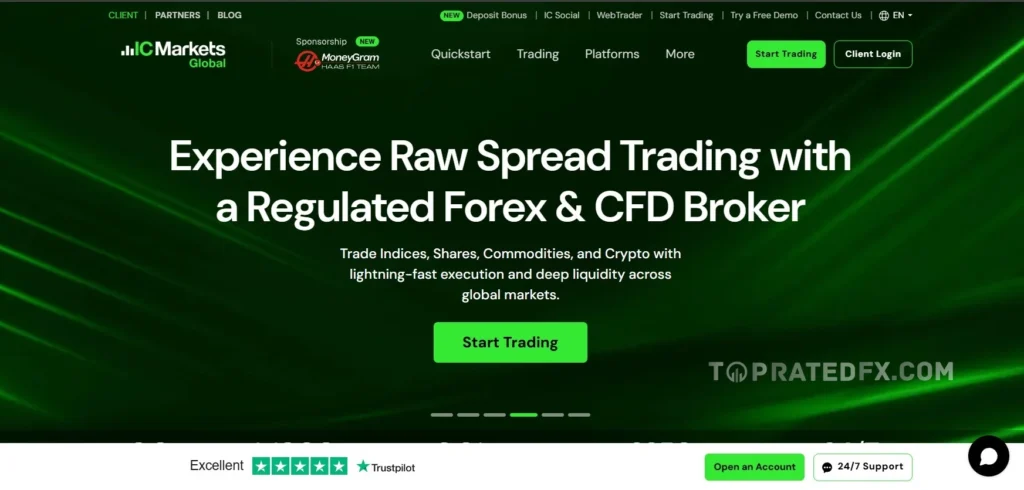
IC Markets is a multi-entity forex and CFD broker established in 2007, primarily structured around an ECN-style pricing model. The broker provides direct market access through aggregated liquidity providers rather than operating a traditional dealing desk structure.
From a forex trading perspective in 2026, IC Markets positions itself as a low-spread, commission-based broker offering institutional-style pricing to retail traders. Orders are executed using market execution, meaning:
- No requotes
- Both positive and negative slippage are possible
- Orders filled at the best available liquidity price
The broker supports:
- Spot forex trading (major, minor, exotic pairs)
- Commodities (Gold, Silver, Oil)
- Index CFDs
- Cryptocurrency CFDs
- Equity CFDs
- Bond and futures CFDs (depending on entity)
However, this review focuses primarily on forex trading conditions, where IC Markets is most competitive.
The broker operates through multiple regulatory entities, which affects leverage limits, investor protection, and compensation schemes.
Is IC Markets Legit or a Scam?
IC Markets is not an unregulated offshore-only broker. It operates under several recognized regulatory authorities. However, the level of investor protection varies depending on which entity holds the client account.
A broker’s legitimacy should be assessed based on:
- Regulatory oversight
- Client fund segregation
- Negative balance protection
- Compensation framework
- Operational transparency
IC Markets meets these criteria under its major regulated entities.
Company Information
| Entity | Legal Name | Jurisdiction |
|---|---|---|
| IC Markets AU | International Capital Markets Pty Ltd | Australia |
| IC Markets EU | IC Markets (EU) Ltd | Cyprus |
| IC Markets Global | Raw Trading Ltd | Seychelles |
Founded in Sydney, IC Markets expanded globally to accommodate different regulatory regimes and leverage structures.
Each entity operates under different capital and compliance requirements.
Regulation Status
| Regulator | Entity | Regulatory Tier | Retail Leverage Cap |
|---|---|---|---|
| ASIC | Australia | Tier-1 | 1:30 |
| CySEC | Cyprus (EU) | Tier-1 (ESMA) | 1:30 |
| FSA Seychelles | Offshore | Tier-3 | Up to 1:1000 |
ASIC (Australia)
ASIC is considered a Tier-1 regulator. Client funds must be segregated from operational funds. Retail leverage is capped at 1:30 for major forex pairs.
Australia does not operate a formal compensation scheme for broker insolvency.
CySEC (European Union)
Under the ESMA framework:
- Retail leverage is limited to 1:30
- Mandatory negative balance protection
- Investor Compensation Fund coverage up to €20,000
CySEC provides structured dispute resolution within the EU.
FSA Seychelles
The Seychelles entity allows leverage up to 1:1000.
While client funds are segregated, investor compensation frameworks are limited compared to EU standards.
Traders choosing higher leverage under offshore regulation accept higher structural risk in exchange for capital efficiency.
Restricted Countries
IC Markets does not accept clients from certain jurisdictions, including:
- United States
- Canada
- Israel
- Iran
- North Korea
- Other sanctioned regions
Country restrictions may change based on regulatory updates.
Regulatory Risk Consideration (Forex Traders)
The regulatory entity chosen impacts:
- Maximum leverage
- Margin call exposure
- Compensation eligibility
- Legal dispute resolution
For example:
Trading 1 lot of EUR/USD at 1:1000 requires approximately $110 margin.
At 1:30, the same trade requires approximately $3,666.
Higher leverage increases capital efficiency but dramatically increases liquidation speed.
Therefore, regulatory selection should align with risk tolerance and capital size.
Account Types
IC Markets offers a tiered account structure designed around commission discounts, platform preference, and trading volume. All accounts operate under a market execution model with access to the same core liquidity pool, but pricing efficiency varies significantly depending on the commission tier.
The primary differences between accounts are:
- Commission per lot
- Minimum deposit requirement
- Platform availability
- Server infrastructure
All accounts include:
- Leverage up to 1:1000 (Seychelles entity)
- 50% Stop Out level
- Hedging allowed
- Scalping allowed
- Expert Advisors permitted
- Micro lot trading (0.01 lot)
Below is a detailed breakdown.
Raw Pro + Account
The Raw Pro + account offers the lowest commission tier and is structured for high-volume or professional traders.
Features
| Feature | Raw Pro + |
|---|---|
| Platform | MetaTrader 4 / 5 |
| Spread | From 0.0 pips |
| Commission | $1.00 per side ($2.00 round turn) |
| Minimum Deposit | $100,000 |
| Server Location | New York |
| Max Orders | 200 |
Cost Example – EUR/USD (1 Standard Lot)
Assumptions:
- 1 lot = 100,000 units
- Pip value = $10
- Average spread = 0.1 pip
Spread cost:
0.1 × $10 = $1
Commission: $2
Total cost per lot = $3
This pricing level approaches institutional ECN structures.
Raw Pro Account
The Raw Pro account provides a discounted commission compared to retail Raw Spread accounts but requires a moderate capital commitment.
Features
| Feature | Raw Pro |
|---|---|
| Platform | MetaTrader 4 / 5 |
| Spread | From 0.0 pips |
| Commission | $1.50 per side ($3.00 round turn) |
| Minimum Deposit | $5,000 |
| Server Location | New York |
| Max Orders | 200 |
Cost Example – EUR/USD (1 Lot)
Spread cost: $1
Commission: $3
Total cost = $4 per lot
Compared to Standard pricing (~$10 per lot), the cost is reduced by approximately 60%.
Raw Spread Account
This is the most common retail ECN-style account with no minimum deposit requirement.
Features
| Feature | Raw Spread |
|---|---|
| Platform | MetaTrader 4 / 5 |
| Spread | From 0.0 pips |
| Commission | $3.50 per side ($7.00 round turn) |
| Minimum Deposit | $0 |
| Server Location | New York |
| Max Orders | 200 |
Cost Example – EUR/USD (1 Lot)
Spread cost: $1
Commission: $7
Total cost = $8 per lot
This is aligned with standard retail ECN pricing globally.
cTrader Account
The cTrader account offers raw spreads with commission calculated per USD 100,000 notional traded.
Features
| Feature | cTrader |
|---|---|
| Platform | cTrader / TradingView |
| Spread | From 0.0 pips |
| Commission | $3 per $100,000 (≈ $6 round turn) |
| Minimum Deposit | $0 |
| Server Location | London |
| Max Orders | 2,000 |
| Programming | C# (cTrader Automate) |
Cost Example – EUR/USD (1 Lot)
Spread cost: $1
Commission: $6
Total cost = $7 per lot
Slightly cheaper than MT4 Raw Spread.
Standard Account
The Standard account operates on a spread-only pricing model.
Features
| Feature | Standard |
|---|---|
| Platform | MetaTrader 4 / 5 |
| Spread | Typically 0.8–1.0 pips (majors) |
| Commission | $0 |
| Minimum Deposit | $0 |
| Server Location | New York |
| Max Orders | 200 |
Cost Example – EUR/USD (1 Lot)
Assume 1.0 pip spread:
1.0 × $10 = $10 per lot
No additional commission.
Account Cost Comparison (EUR/USD Example)
| Account | Spread Used | Commission | Total Cost per Lot |
|---|---|---|---|
| Raw Pro + | 0.1 pip | $2 | $3 |
| Raw Pro | 0.1 pip | $3 | $4 |
| cTrader | 0.1 pip | $6 | $7 |
| Raw Spread | 0.1 pip | $7 | $8 |
| Standard | 1.0 pip | $0 | $10 |
Cost Scaling Impact
For a trader executing 50 lots monthly:
| Account | Cost per Lot | Monthly Cost |
|---|---|---|
| Raw Pro + | $3 | $150 |
| Raw Pro | $4 | $200 |
| Raw Spread | $8 | $400 |
| Standard | $10 | $500 |
Commission tier selection directly impacts long-term profitability for active forex traders.
Structural Evaluation
- Raw Pro + is capital-intensive but highly cost-efficient.
- Raw Pro provides meaningful commission savings at moderate capital levels.
- Raw Spread is accessible but carries standard retail ECN cost.
- cTrader offers slightly improved commission compared to MT4 Raw Spread.
- A standard account is the simplest but most expensive for high-frequency trading.
For forex-focused traders in 2026, commission tier selection materially affects cost structure over time.
Trading Assets & Markets
IC Markets provides access to multiple CFD markets, but its core competitive advantage remains in forex trading conditions. Asset coverage varies slightly depending on the regulatory entity and platform, but overall market access is broad.
Below is a structured breakdown of available trading instruments in 2026.
Forex (Spot FX)
It is the primary market offered by IC Markets, with deep liquidity and tight spreads across major pairs.
Forex Market Coverage
| Category | Approx. Number of Pairs |
|---|---|
| Major Pairs | 7+ |
| Minor Pairs | 20+ |
| Exotic Pairs | 20+ |
| Total FX Pairs | 60+ |
Major Pairs Available
- EUR/USD
- GBP/USD
- USD/JPY
- USD/CHF
- AUD/USD
- USD/CAD
- NZD/USD
Forex Trading Conditions Overview
| Parameter | Typical Condition |
|---|---|
| Spread (Raw) | From 0.0 pips |
| Spread (Standard) | 0.8–1.0 pips typical |
| Commission | $2–$7 round turn (account dependent) |
| Leverage | Up to 1:1000 (offshore) |
| Minimum Lot | 0.01 |
| Max Lot Size | Platform dependent |
Forex execution is market-based, with access to aggregated liquidity providers. Scalping and algorithmic trading are permitted.
Commodities
IC Markets offers CFD trading on precious metals and energy products.
Metals
| Instrument | Symbol |
|---|---|
| Gold | XAU/USD |
| Silver | XAG/USD |
Energy Products
| Instrument | Example Symbols |
|---|---|
| Brent Crude | UKOIL |
| WTI Crude | USOIL |
| Natural Gas | NATGAS |
Gold (XAU/USD) is among the most actively traded non-forex instruments on the platform.
Gold Trading Conditions (Example)
| Parameter | Raw Account Example |
|---|---|
| Spread | From ~1.0–2.0 pips |
| Commission | $6–$7 round turn |
| Leverage | Up to 1:1000 (offshore) |
Commodity spreads are variable and widen during high volatility events.
Indices (Stock Index CFDs)
IC Markets provides access to major global stock indices.
Major Indices
| Region | Index Examples |
|---|---|
| US | US500, US100, US30 |
| Europe | GER40, UK100 |
| Asia | JP225, HK50 |
| Australia | AUS200 |
Index CFDs are priced with variable spreads and overnight financing adjustments.
Cryptocurrency CFDs
Cryptocurrency CFDs are available depending on entity restrictions.
Crypto Instruments
| Example Assets |
|---|
| BTC/USD |
| ETH/USD |
| LTC/USD |
| XRP/USD |
Crypto trading is offered as CFD exposure, not direct ownership.
Spreads are wider than forex majors, and leverage is typically lower.
Shares (Equity CFDs)
IC Markets offers share CFDs on US, EU, and AU equities.
| Market | Examples |
|---|---|
| US | Apple, Tesla, Microsoft |
| EU | Major European stocks |
| AU | ASX-listed shares |
Equity CFDs are subject to overnight financing and dividend adjustments.
Bonds & Futures CFDs
Certain bonds, futures, and CFDs are available depending on the platform and entity.
| Example Instruments |
|---|
| US 10-Year Treasury |
| Other government bond CFDs |
Liquidity varies depending on the contract and trading hours.
Market Coverage Summary
| Asset Class | Availability | Core Strength |
|---|---|---|
| Forex | 60+ pairs | Primary strength |
| Metals | Yes | Strong liquidity |
| Energies | Yes | Moderate depth |
| Indices | Yes | Competitive |
| Crypto CFDs | Yes | Higher spreads |
| Shares CFDs | Yes | Broad selection |
Structural Evaluation of Markets
- Forex remains IC Markets’ strongest segment.
- Gold and major indices are competitively priced.
- Crypto spreads are wider compared to forex.
- Asset availability depends on the regulatory entity.
- Market depth is strongest on major FX pairs.
For traders primarily focused on forex trading conditions in 2026, IC Markets provides sufficient instrument coverage with strong liquidity in major pairs.
Trading Platforms
IC Markets provides access to multiple third-party trading platforms rather than operating a proprietary system. Platform selection directly affects execution transparency, automation capability, and trading workflow efficiency.
In 2026, IC Markets supports:
- MetaTrader 4 (MT4)
- MetaTrader 5 (MT5)
- cTrader
- TradingView integration
- IC Social (social trading platform)
Each platform serves a different type of forex trader.
MetaTrader 4 (MT4)
MT4 remains one of the most widely used retail forex platforms.
Core Features
- Forex-focused architecture
- Supports Expert Advisors (EAs)
- Uses the MQL4 programming language
- One-click trading
- Hedging supported
- Micro lot trading (0.01)
MT4 is suitable for traders running legacy automated strategies or simple discretionary systems.
Execution Model
IC Markets uses market execution on MT4:
- No requotes
- Slippage possible (positive and negative)
- Orders routed to aggregated liquidity providers
MetaTrader 5 (MT5)
MT5 expands on MT4 with improved infrastructure and multi-asset functionality.
Core Features
- Multi-asset trading (Forex, indices, commodities, crypto CFDs)
- Additional timeframes
- Improved strategy tester (multi-threaded)
- Basic Depth of Market
- MQL5 programming language
MT5 is suitable for traders requiring stronger backtesting capability.
cTrader
cTrader is positioned as a more execution-transparent platform.
Core Features
- Level II Depth of Market
- Advanced order types
- C# automation (cTrader Automate)
- Built-in copy trading functionality
- Fast order routing
Depth of Market Advantage
cTrader allows traders to view:
- Liquidity available at multiple price levels
- Volume distribution
- Potential slippage exposure
This feature is particularly relevant for traders executing multi-lot forex positions.
TradingView Integration
IC Markets allows direct trade execution through TradingView charts.
Key Characteristics
- Advanced charting interface
- Extensive indicator library
- Social trading community
- Browser-based environment
TradingView is stronger for technical analysis than for latency-sensitive execution.
IC Social (Social & Copy Trading Platform)
IC Social is IC Markets’ dedicated social trading environment.
Platform Overview
IC Social allows traders to:
- Follow experienced strategy providers
- Copy trades automatically
- Interact within a trading community
- Access the platform via desktop and mobile
Functionality
- Performance statistics per strategy provider
- Risk metrics visibility
- Allocation control per copied strategy
- Integrated execution through IC Markets infrastructure
Risk Consideration
Copy trading does not eliminate risk. Performance is dependent on:
- Strategy provider risk management
- Market volatility
- Capital allocation structure
Losses are replicated proportionally.
IC Social is more suitable for passive or semi-passive traders rather than active scalpers.
Execution Speed & Infrastructure
IC Markets operates servers in:
- Equinix NY4 (New York)
- London data centers (for cTrader)
Under optimal conditions, execution latency can be below 40 milliseconds. However, real-world performance depends on:
- Trader’s geographic location
- Internet quality
- VPS usage
- Market volatility
Market execution means that price improvement and slippage are both possible.
VPS Hosting
IC Markets offers volume-based VPS access.
VPS Qualification Structure
| Monthly Trading Volume | VPS Access |
|---|---|
| 15 lots | Entry-level VPS |
| 30 lots | Mid-tier VPS |
| 75+ lots | Advanced VPS |
VPS reduces latency between the trading terminal and the broker server, improving consistency for automated strategies.
Platform Comparison Overview
| Feature | MT4 | MT5 | cTrader | TradingView | IC Social |
|---|---|---|---|---|---|
| Forex Trading | Strong | Strong | Strong | Moderate | Via Copy |
| EA Support | Yes | Yes | Yes (C#) | No | No |
| Depth of Market | Limited | Basic | Advanced | Limited | No |
| Copy Trading | External | External | Built-in | Community-based | Built-in |
| Best For | Legacy EAs | Multi-asset traders | Execution-focused traders | Charting | Passive traders |
Platform Evaluation for Forex Traders (2026)
- MT4 remains suitable for traditional EA users.
- MT5 provides stronger testing tools.
- cTrader offers the highest execution transparency.
- TradingView excels in charting quality.
- IC Social provides structured copy trading within IC Markets’ ecosystem.
For active forex traders prioritizing spread efficiency and execution quality, cTrader or MT5 typically offer the strongest technical infrastructure.
Special Features
Beyond core trading conditions and platform infrastructure, IC Markets provides several additional tools and services designed to enhance execution efficiency, analysis capability, and trading flexibility. While these features are secondary to spread and commission structure, they can influence the overall trading environment.
This section evaluates:
- VPS hosting
- IC Social copy trading
- Trading Central integration
- IC Insights
- Advanced MetaTrader tools
- Trading servers & infrastructure
VPS (Virtual Private Server)
IC Markets offers VPS access for traders who meet monthly trading volume requirements.
VPS Qualification Structure
| Monthly Trading Volume | VPS Tier |
|---|---|
| 15 lots | Standard VPS |
| 30 lots | Pro VPS |
| 75+ lots | Premium VPS |
Purpose of VPS
A VPS reduces latency between the trader’s platform and IC Markets’ trading servers. This is particularly relevant for:
- Automated strategies (EAs)
- Scalping systems
- High-frequency trading
- News trading
Performance Consideration
Lower latency can:
- Reduce execution delay
- Improve fill consistency
- Minimize slippage variability
However, VPS does not eliminate market slippage caused by liquidity gaps during volatile events.
IC Social (Copy Trading Platform)
IC Social allows traders to follow and copy strategies from other traders within the IC Markets ecosystem.
Core Functions
- Strategy provider ranking
- Performance statistics
- Risk metrics (drawdown, win rate)
- Adjustable capital allocation
- Automatic trade replication
Risk Perspective
Copy trading exposes users to:
- Strategy provider over-leverages
- Market volatility risk
- Concentration risk
- Replicated drawdowns
Past performance does not guarantee future results. Copy trading does not eliminate trading risk.
IC Social is generally more suitable for passive investors rather than active forex scalpers.
Trading Central Integration
IC Markets integrates Trading Central tools on supported platforms.
Features Include
- Technical analysis signals
- Pattern recognition
- Economic event analysis
- Trade ideas
These tools serve as supplemental analysis aids rather than execution tools.
They should not replace independent risk management decisions.
IC Insights
IC Insights provides:
- Market commentary
- Technical analysis updates
- News summaries
- Sentiment analysis
These materials are informational and do not constitute investment advice.
MetaTrader Advanced Tools
IC Markets offers enhanced MT4/MT5 plugins that may include:
- Mini-terminal for advanced order management
- Correlation matrices
- Sentiment indicators
- Alarm managers
These tools improve workflow efficiency but do not alter underlying execution conditions.
Trading Servers & Infrastructure
IC Markets hosts its trading servers in major financial data centers:
- Equinix NY4 (New York)
- London data centers
Infrastructure Advantages
- Fiber connectivity to liquidity providers
- Multi-provider aggregation
- Low-latency routing
Execution model: Market execution (no dealing desk).
Execution Risk Consideration
During high-impact events:
- Liquidity depth may thin
- Spreads widen
- Slippage increases
Infrastructure quality reduces latency risk but does not eliminate market risk.
Swap-Free Accounts
IC Markets offers swap-free (Islamic) accounts on eligible account types.
Key Characteristics
- No overnight interest charged
- Administrative fees may apply after specific holding periods
- Conditions vary by entity
Swap-free accounts are structured for compliance reasons and may include limitations.
Overall Evaluation of Special Features
| Feature | Practical Value |
|---|---|
| VPS | High value for automated traders |
| IC Social | Moderate value for passive traders |
| Trading Central | Supplemental analysis |
| IC Insights | Informational |
| Advanced Tools | Workflow enhancement |
| Infrastructure | Strong execution backbone |
Special features enhance usability but do not fundamentally change cost structure or leverage risk.
For forex-focused traders in 2026, VPS and infrastructure quality remain the most relevant additions.
Deposits & Withdrawals
Funding efficiency is an important operational component of any forex broker. While spreads and execution determine trading cost, deposit and withdrawal processes affect liquidity management, capital mobility, and operational risk.
IC Markets offers a broad range of funding methods, with most deposit options processed instantly. However, processing times and eligibility may vary depending on the regulatory entity and client location.
Minimum Deposit & Minimum Withdrawal
Minimum Deposit
IC Markets does not impose a strict universal minimum deposit across all entities. However:
- Most accounts can be opened with a $0 minimum deposit
- Practical minimum funding depends on:
- Payment method
- Base currency
- Margin requirements
- Account type (Raw Pro + requires $100,000)
For realistic forex trading, margin calculations should determine capital allocation rather than the minimum deposit policy.
Example:
Opening 1 lot EUR/USD at 1:1000 requires approximately $110 margin.
At 1:30 leverage, the same position requires approximately $3,666.
Minimum Withdrawal
IC Markets does not publicly impose a fixed minimum withdrawal amount for most methods, but:
- Some payment providers may apply minimum thresholds
- Bank wires may require minimum transfer values depending on the region
Withdrawal requests must typically be made through the secure client area.
Deposit Methods
IC Markets supports multiple global funding options.
Accepted Base Currencies
| Accepted Currencies |
|---|
| USD |
| EUR |
| AUD |
| GBP |
| SGD |
| NZD |
| JPY |
| HKD |
| CHF |
| CAD |
Available Deposit Methods
| Method | Processing Time | Fees |
|---|---|---|
| Visa / Mastercard | Instant | Free |
| Google Pay | Instant | Free |
| PayPal | Instant | Free |
| Skrill | Instant | Free |
| Neteller | Instant | Free |
| AstroPay | Instant | Free |
| SticPay | Instant | Free |
| Cryptocurrencies (BTC, ETH, USDT, USDC) | 5–60 minutes | Free |
| BVNK Crypto Gateway | Instant | Free |
| SEPA Transfer | 1–2 business days | Free |
| SWIFT Bank Wire | 2–5 business days | Free |
| Broker-to-Broker Transfer | 2–14 business days | Free |
Processing time refers to crediting of the trading account. Banking intermediaries may impose external fees.
Withdrawal Methods
Withdrawals are generally processed back to the original funding source in accordance with anti-money laundering (AML) policies.
Withdrawal Processing Time
| Method | Processing Time |
|---|---|
| E-wallets | Same day to 24 hours |
| Cards | 1–3 business days |
| Bank Wire | 2–5 business days |
| Crypto | Network dependent |
Internal processing typically occurs within one business day, but the total time depends on the receiving provider.
Fee Transparency
IC Markets does not charge deposit or withdrawal fees directly in most cases. However:
- Currency conversion fees may apply
- Intermediary bank fees may be deducted
- Crypto network fees may apply
- Inactivity fees may apply after extended dormancy
Traders should verify the cost structure in their specific jurisdiction.
Funding Risk Considerations
While deposit methods are broad and efficient, traders should consider:
- Currency conversion risk if the account base differs
- Chargeback restrictions
- AML verification requirements
- Crypto price volatility during the transfer window
Operational efficiency appears strong, but liquidity planning remains the trader’s responsibility.
Deposits & Withdrawals Summary
| Category | Evaluation |
|---|---|
| Funding Speed | Strong |
| Method Variety | Extensive |
| Internal Fees | Generally none |
| External Fees | Possible via providers |
| Transparency | Clear within client area |
IC Markets provides broad global funding coverage suitable for international retail traders.
IC Markets vs Competitors
To properly evaluate IC Markets’ position in 2026, it is necessary to compare its forex trading conditions with those of other globally recognized brokers. This comparison focuses on:
- Spread structure
- Commission per lot
- Maximum leverage
- Execution model
- Minimum deposit
- Stop-out level
For this comparison, we benchmark IC Markets against:
- Exness
- Pepperstone
- XM
The focus remains on forex trading conditions rather than promotional features.
Raw Account Cost Comparison (EUR/USD Example)
Assumptions:
- 1 standard lot (100,000 units)
- Pip value = $10
- Average raw spread = 0.1 pip
Commission & Total Cost Comparison
| Broker | Account Type | Commission (Round Turn) | Spread Used | Total Cost per Lot |
|---|---|---|---|---|
| IC Markets | Raw Pro + | $2 | 0.1 pip | $3 |
| IC Markets | Raw Spread | $7 | 0.1 pip | $8 |
| Exness | Raw Spread | $7 | 0.1 pip | $8 |
| Pepperstone | Razor | ~$7 | 0.1 pip | ~$8 |
| XM | Zero Account | ~$10 | 0.1 pip | ~$11 |
Observation:
- IC Markets Raw Pro + offers one of the lowest commission structures available.
- Raw Spread pricing is aligned with Pepperstone and Exness.
- XM Zero structure is typically more expensive on a per-lot basis.
Standard Account Comparison
Assume average EUR/USD spread = 1.0 pip.
| Broker | Standard Spread (EUR/USD) | Commission | Total Cost per Lot |
|---|---|---|---|
| IC Markets | ~1.0 pip | $0 | $10 |
| Exness | ~1.0 pip | $0 | $10 |
| Pepperstone | ~1.1 pip | $0 | $11 |
| XM | ~1.6 pip | $0 | $16 |
IC Markets remains competitive in spread-only pricing compared to peers.
Leverage Comparison
| Broker | Maximum Leverage |
|---|---|
| IC Markets | Up to 1:1000 |
| Exness | Up to 1:Unlimited (conditions apply) |
| Pepperstone | Up to 1:500 |
| XM | Up to 1:1000 |
Exness offers higher theoretical leverage, but IC Markets remains within high-leverage offshore standards.
Stop-Out Level Comparison
| Broker | Stop-Out Level |
|---|---|
| IC Markets | 50% |
| Exness | 0–20% (account dependent) |
| Pepperstone | 50% |
| XM | 20% |
Lower stop-out levels allow more drawdown before forced liquidation but increase account risk exposure.
Minimum Deposit Comparison
| Broker | Minimum Deposit |
|---|---|
| IC Markets | $0 (most accounts) |
| Exness | $10+ |
| Pepperstone | $200 |
| XM | $5 |
IC Markets does not impose a strict minimum, but margin requirements determine practical capital needs.
Execution Model Comparison
| Broker | Execution Type | Dealing Desk |
|---|---|---|
| IC Markets | Market Execution | No |
| Exness | Market Execution | No |
| Pepperstone | Market Execution | No |
| XM | Mixed Model | May vary |
IC Markets aligns with ECN-style execution standards.
Institutional Perspective
From a pure forex trading cost standpoint:
- IC Markets Raw Pro + offers one of the lowest cost structures in the industry.
- Raw Spread pricing is competitive but not uniquely cheaper than Exness or Pepperstone.
- Standard account pricing is within industry average.
- Stop-out level at 50% is relatively conservative compared to some competitors.
- Leverage flexibility is strong under offshore regulation.
Overall, IC Markets remains structurally competitive in 2026, particularly for mid- to high-volume forex traders.
Is IC Markets Good for Beginners?
Evaluating whether IC Markets is suitable for beginners requires separating two factors:
- Platform accessibility
- Risk exposure due to leverage and margin structure
While IC Markets provides competitive pricing and flexible account structures, high leverage availability and market execution mechanics can increase risk for inexperienced traders.
This section examines suitability from a structural and risk-management perspective.
Leverage Risk Explanation
Leverage amplifies both gains and losses.
Example – 1:1000 Leverage
Trade: 1 lot EUR/USD
Price: 1.1000
Notional value =
100,000 × 1.1000 = $110,000
Required margin at 1:1000 =
110,000 / 1000 = $110
A 10-pip adverse move equals:
10 × $10 = $100 loss
With only a $110 margin required, a small movement can significantly impact equity.
Same Trade at 1:30 (Regulated Entity)
Margin required =
110,000 / 30 = $3,666
Here, the same 10-pip move represents a much smaller percentage of total capital.
Higher leverage increases liquidation speed dramatically.
Margin Call & Stop-Out Mechanics
IC Markets applies a 50% stop-out level.
Practical Example
Account balance = $1,000
Open 5 lots EUR/USD at 1:1000
Margin per lot ≈ $110
Total margin ≈ $550
If floating loss reduces equity to $275:
Margin level =
275 / 550 × 100 = 50%
Positions begin closing automatically.
Beginners using high leverage may experience rapid forced liquidation during volatile conditions.
Spread & Commission Complexity
Beginners often underestimate transaction costs.
Raw accounts:
- Lower spread
- Separate commission
Standard accounts:
- Simpler pricing
- Higher spread
For low-frequency traders, Standard accounts may be easier to understand, even if slightly more expensive.
Platform Complexity
Suitable for Beginners:
- MetaTrader 4 (simpler interface)
- Standard account structure
- Lower leverage settings
Less Suitable for Beginners:
- Raw Pro + (requires large capital)
- High leverage (1:500–1:1000)
- Complex algorithmic trading setups
cTrader offers advanced transparency but may require a learning curve.
Copy Trading (IC Social) for Beginners
IC Social allows beginners to copy experienced traders.
However:
- Losses are copied proportionally
- Strategy providers may use high leverage
- Drawdowns can be significant
Copy trading reduces execution complexity but does not remove financial risk.
Psychological Risk Consideration
High leverage combined with tight spreads can create:
- Overtrading behavior
- Excessive position sizing
- Emotional decision-making
Cost efficiency does not equal profitability.
Who IC Markets Is Suitable For
| Trader Type | Suitability |
|---|---|
| High-volume forex traders | High |
| Scalpers | High |
| EA traders | High |
| Swing traders | Moderate |
| First-time beginners | Moderate (with low leverage) |
Who Should Be Cautious
- Traders with small capital using 1:1000 leverage
- Individuals unfamiliar with margin mechanics
- Traders relying solely on copy trading
- Those without defined risk management rules
Beginner Risk Summary
IC Markets is not inherently unsafe, but:
- High leverage increases capital risk
- 50% stop-out may liquidate positions quickly
- Raw commission structure may confuse beginners
New traders should:
- Start with lower leverage
- Use small lot sizes
- Understand margin level calculations
- Avoid overexposure during news events
Final Assessment for Beginners
IC Markets can be suitable for beginners if:
- Leverage is kept conservative
- Risk management is applied
- Position sizing remains controlled
However, its infrastructure and pricing model are better optimized for active or experienced forex traders.
FAQ
Yes, IC Markets remains competitive for forex trading in 2026 due to its raw spread accounts, tiered commission structure, and market execution model. Cost efficiency improves significantly on Raw Pro and Raw Pro+ accounts.
Most accounts can technically be opened with no fixed minimum deposit. However, practical trading capital depends on leverage and margin requirements. Raw Pro requires $5,000, while Raw Pro+ requires $100,000.
On Raw accounts, EUR/USD spreads start from 0.0 pips, with an average of around 0.1 pips under normal liquidity. Total cost depends on commission tier, ranging from approximately $3 to $8 per lot.
Yes, commission applies to Raw accounts. It ranges from:
$2 round turn (Raw Pro+)
$3 round turn (Raw Pro)
$6 round turn (cTrader)
$7 round turn (Raw Spread)
Standard accounts do not charge commission but include the cost in the spread.
Maximum leverage is:
-Up to 1:1000 under the Seychelles entity
-Up to 1:30 under ASIC and CySEC regulation
Higher leverage increases liquidation risk.
Yes. IC Markets operates under:
ASIC (Australia)
CySEC (European Union)
FSA (Seychelles)
Regulatory protection varies depending on the entity.
Yes. Scalping, hedging, and automated trading (Expert Advisors) are permitted across supported platforms.
Final Verdict
IC Markets remains structurally competitive in 2026, particularly for forex-focused traders seeking low spreads and transparent commission structures.
Strengths:
- Extremely competitive Raw Pro+ pricing
- Strong liquidity and execution infrastructure
- High leverage flexibility (offshore)
- Suitable for scalping and automation
Considerations:
- 50% stop-out level
- Investor protection varies by entity
- High leverage significantly increases risk
- Swap-free accounts may include administrative fees
IC Markets is best suited for active forex traders who understand margin mechanics and cost structure. While accessible to beginners, its infrastructure is optimized for experienced or volume-based traders.
Conclusion
IC Markets offers competitive raw spreads from 0.0 pips, tiered commission pricing from $2 per lot, and leverage up to 1:1000, making it structurally strong for active forex traders in 2026.
IC Markets Details