


The FBS Review 2026 aims to provide a structured, data-driven evaluation of FBS as a global forex broker, with a primary focus on trading conditions such as spreads, execution quality, leverage, and overall cost structure. This analysis is designed for retail traders seeking a clear understanding of how FBS operates within the competitive forex brokerage landscape, particularly in terms of pricing efficiency and execution reliability.
FBS has positioned itself as a high-leverage broker catering to emerging and developing markets, offering multiple account types and access to MetaTrader platforms. However, beyond marketing claims, the real assessment lies in examining its execution model, spread consistency, commission structure, and regulatory framework.
This review adopts a neutral, institutional-style approach—evaluating whether FBS delivers competitive trading conditions when compared to established global brokers.
Quick Overview
| Parameter | Details |
|---|---|
| Founded | 2009 |
| Headquarters | Belize (FBS Markets Inc.), Cyprus (EU entity) |
| Regulators | IFSC (Belize), CySEC (EU entity) |
| Platforms | MetaTrader 4 (MT4), MetaTrader 5 (MT5), FBS Trader App |
| Minimum Deposit | From $1 (Cent account) |
| Maximum Leverage | Up to 1:3000 (offshore entity) |
| Spreads | From ~0.7 pips (Standard), ~0.0 pips (Pro/Raw conditions) |
| Commission | $0 – $6 per lot (depending on account type) |
| Stop Out Level | Typically 20% |
| Tradable Assets | Forex, Metals, Indices, Stocks, Crypto CFDs |
- Very low minimum deposit (from $1)
- High leverage up to 1:3000
- Multiple account types for different trader profiles
- Supports MT4 and MT5 platforms
- Accessible to emerging market traders
- Offshore regulation for high leverage accounts
- Spread variability on standard accounts
- Limited institutional-grade liquidity transparency
- Fewer advanced tools compared to ECN-focused brokers
- Crypto CFD offering is limited compared to competitors
What Is FBS?
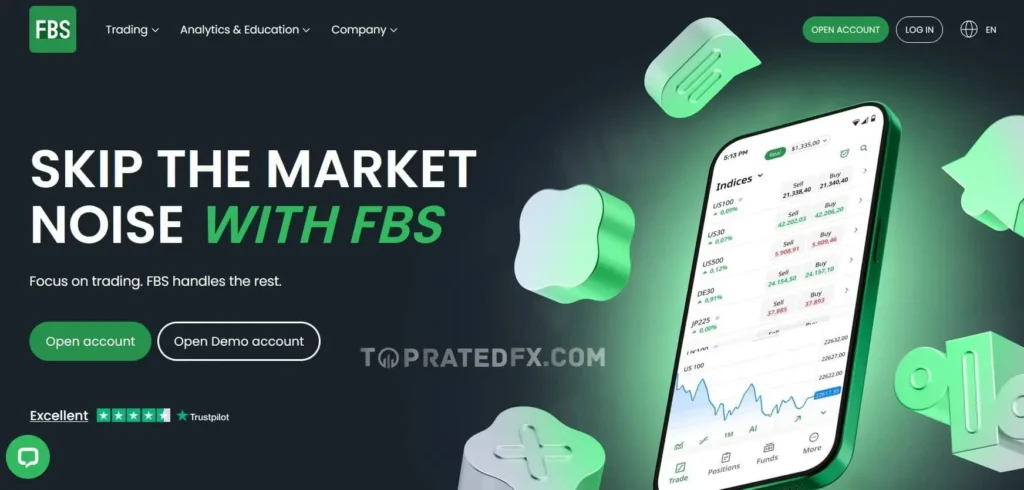
FBS is an international forex and CFD broker established in 2009, offering trading services primarily to retail clients across Asia, Africa, Latin America, and parts of Europe. The broker provides access to leveraged trading on multiple asset classes, with a strong emphasis on forex markets.
From an operational standpoint, FBS follows a hybrid brokerage model, combining elements of market-making and straight-through processing (STP), depending on the account type and regulatory entity. This means that execution conditions, spreads, and pricing transparency can vary depending on whether a trader is using the offshore entity or the European-regulated branch.
FBS is particularly known for:
- High leverage offerings (up to 1:3000 under offshore regulation)
- Low entry barriers (minimum deposit starting from $1)
- A simplified onboarding process targeting beginner traders
However, these characteristics also introduce trade-offs in terms of execution transparency and regulatory protections, which are critical factors for professional evaluation.
Is FBS Legit or a Scam?
FBS operates through multiple legal entities, each serving different jurisdictions:
- FBS Markets Inc. – Registered in Belize, serving international clients
- Tradestone Ltd. (FBS EU) – Registered in Cyprus, serving European Economic Area (EEA) clients
This multi-entity structure allows FBS to offer varying levels of leverage, regulatory protection, and trading conditions depending on the client’s region.
From an institutional perspective, this structure is common among global brokers, but it requires traders to clearly understand which entity they are registering under, as this directly impacts risk exposure and legal safeguards.
Regulation Status
FBS is regulated under two primary frameworks:
- IFSC (International Financial Services Commission – Belize)
- Offshore regulatory body
- Allows high leverage (up to 1:3000)
- Lower capital and compliance requirements
- Limited investor protection mechanisms
- CySEC (Cyprus Securities and Exchange Commission)
- European regulator under the MiFID II framework
- Leverage capped at 1:30 for retail traders
- Provides investor protection schemes (e.g., compensation fund)
- Enforces stricter compliance and reporting standards
Regulatory Assessment
From a professional standpoint:
- The CySEC-regulated entity offers a higher level of credibility and client protection.
- The offshore IFSC entity, while enabling flexible trading conditions (high leverage, bonuses), introduces higher counterparty risk and reduced regulatory oversight.
This dual structure is typical among retail brokers but requires traders to balance trading flexibility vs regulatory safety.
Restricted Countries
FBS does not provide services to residents of certain jurisdictions due to regulatory restrictions. These typically include:
- United States
- Canada
- United Kingdom (under offshore entity)
- Japan
- Israel
- Certain sanctioned or high-risk jurisdictions
Restrictions may vary depending on the regulatory entity (EU vs offshore). Traders should verify eligibility during account registration.
Legitimacy Verdict
FBS is not a scam, but its legitimacy depends significantly on the entity under which the account is opened:
- The CySEC-regulated branch aligns with recognized European compliance standards.
- The offshore entity operates legally but with lower regulatory safeguards.
From an institutional evaluation perspective, FBS can be considered a legitimate broker with moderate regulatory strength, suitable for retail traders who understand the implications of offshore trading environments.
Account Types
FBS offers a streamlined account structure compared to earlier versions of its offering. As of 2026, the broker primarily focuses on three core account types: Standard, Cent, and Pro. Each account is designed to target a different segment of retail traders, with variations in trade size, cost structure, and execution conditions.
From a trading conditions perspective, the key differences lie in spread configuration, commission model, and execution environment rather than platform access, as all accounts support MetaTrader infrastructure.
Standard Account
The Standard Account is the most widely used account type at FBS. It is designed for retail traders seeking straightforward access to forex markets without commission-based pricing.
Features Table
| Feature | Details |
|---|---|
| Spreads | From ~0.7 pips (variable) |
| Commission | $0 |
| Minimum Deposit | $10 |
| Leverage | Up to 1:3000 (offshore entity) |
| Platforms | MT4, MT5 |
| Stop Out Level | 20% |
Analysis
The Standard Account operates on a spread-only model, meaning trading costs are embedded within the bid-ask spread. While this simplifies pricing, it typically results in wider effective costs compared to raw spread or ECN-style accounts.
Execution is generally suitable for:
- Swing traders
- Position traders
- Beginner to intermediate users
However, for high-frequency or scalping strategies, spread variability may reduce cost efficiency.
Cent Account
The Cent Account is specifically structured for beginner traders and those testing strategies with minimal capital exposure. It uses cent-based lot sizing, where balances are displayed in cents instead of dollars.
Features Table
| Feature | Details |
|---|---|
| Spreads | From ~1.0 pip (variable) |
| Commission | $0 |
| Minimum Deposit | $1 |
| Leverage | Up to 1:1000 |
| Platforms | MT4 |
| Stop Out Level | 20% |
Analysis
The Cent Account is not designed for cost efficiency but rather for:
- Risk-controlled learning
- Strategy testing in live market conditions
- Micro-position trading
Because of:
- Wider spreads
- Limited platform support (MT4 only)
- Lower execution priority
It is generally unsuitable for advanced traders or those seeking tight pricing conditions.
Pro Account
The Pro Account is positioned as FBS’s closest offering to a low-spread trading environment, targeting more experienced traders.
Features Table
| Feature | Details |
|---|---|
| Spreads | From ~0.0 – 0.5 pips (variable) |
| Commission | $0 – included in spread (varies by instrument) |
| Minimum Deposit | $100 |
| Leverage | Up to 1:2000 |
| Platforms | MT4, MT5 |
| Stop Out Level | 20% |
Analysis
Despite being labeled as a “Pro” account, this structure differs from traditional ECN or Raw Spread accounts found in institutional-grade brokers:
- No fixed per-lot commission structure
- Costs are still partially embedded in spreads
- Execution model is not fully transparent (no clear ECN routing confirmation)
However, compared to the Standard Account, it offers:
- Tighter spreads
- Potentially better execution conditions
- Improved suitability for active trading
This makes it more appropriate for:
- Intraday traders
- Scalpers (with caution)
- Traders are sensitive to spread compression
Account Structure Evaluation
From an institutional perspective, FBS offers a simplified but less specialized account structure compared to brokers that provide:
- True ECN accounts with raw spreads + fixed commissions
- Tiered liquidity access
- Detailed execution reporting
Instead, FBS prioritizes:
- Accessibility
- Flexibility in leverage
- Simplicity in pricing
This approach is effective for retail onboarding but may limit transparency for advanced traders seeking institutional-grade execution conditions.
Trading Assets & Markets
FBS provides access to a multi-asset CFD offering, with a primary emphasis on forex trading, which remains the core of its liquidity and execution infrastructure. While additional asset classes are available, the depth, pricing competitiveness, and instrument variety vary significantly across categories.
From an institutional perspective, evaluating FBS’s asset offering requires examining both instrument diversity and trading conditions (spreads, leverage, execution stability) within each market.
Forex
Forex is the strongest segment within FBS’s product offering, both in terms of liquidity access and execution consistency.
| Category | Details |
|---|---|
| Number of Pairs | 35+ currency pairs |
| Major Pairs | EUR/USD, GBP/USD, USD/JPY, USD/CHF |
| Minor Pairs | EUR/GBP, AUD/CAD, NZD/JPY |
| Exotic Pairs | USD/TRY, USD/ZAR, EUR/TRY |
| Spreads | From ~0.0 pips (Pro), ~0.7 pips (Standard) |
| Leverage | Up to 1:3000 (offshore) |
| Execution Type | Market execution |
| Swap | Variable (swap-free accounts available in some regions) |
Analysis
- Major pairs benefit from tighter spreads and deeper liquidity.
- Exotic pairs exhibit significantly wider spreads and higher volatility.
- High leverage availability increases flexibility but also amplifies exposure to margin risk.
Overall, FBS delivers competitive retail-level forex access, though it lacks the transparency and depth of institutional ECN pricing.
Commodities
FBS offers a limited but standard range of commodity CFDs, primarily focused on precious metals.
| Instrument | Type | Typical Spread | Leverage |
|---|---|---|---|
| Gold (XAU/USD) | Precious Metal | ~20–30 points | Up to 1:500 |
| Silver (XAG/USD) | Precious Metal | ~20–40 points | Up to 1:500 |
| Oil (WTI, Brent) | Energy | Variable | Up to 1:200 |
Analysis
- Gold trading is a key offering, often used for hedging against USD exposure.
- Spread stability can fluctuate during volatile sessions.
- Compared to specialized brokers, commodity coverage is limited in breadth.
Indices
FBS provides access to major global equity indices via CFDs.
| Index | Region | Typical Spread | Leverage |
|---|---|---|---|
| US30 (Dow Jones) | USA | Variable | Up to 1:200 |
| NAS100 | USA | Variable | Up to 1:200 |
| SPX500 | USA | Variable | Up to 1:200 |
| GER40 (DAX) | Germany | Variable | Up to 1:200 |
Analysis
- Indices are suitable for macro-driven trading strategies.
- Spread widening may occur during market open/close periods.
- Execution is generally stable but not optimized for ultra-low latency strategies.
Crypto CFDs
FBS offers a limited selection of cryptocurrency CFDs, primarily focusing on major digital assets.
| Crypto Pair | Type | Spread | Leverage |
|---|---|---|---|
| BTC/USD | CFD | Wide | Up to 1:5 |
| ETH/USD | CFD | Wide | Up to 1:5 |
| LTC/USD | CFD | Wide | Up to 1:5 |
Analysis
- Crypto CFDs at FBS are not a core strength.
- Spreads are relatively wide compared to crypto-focused platforms.
- Low leverage reflects higher volatility and risk management constraints.
This segment is more suitable for occasional exposure rather than active crypto trading.
Stocks
FBS provides access to a limited range of stock CFDs, mainly covering major US-listed companies.
| Adjusted via the CFD mechanism | Details |
|---|---|
| Coverage | US equities (e.g., Apple, Amazon, Tesla) |
| Execution | CFD-based (no ownership of underlying asset) |
| Leverage | Typically up to 1:20 |
| Dividends | Adjusted via CFD mechanism |
Analysis
- Stock CFD offering is relatively narrow compared to multi-asset brokers.
- Suitable for short-term speculation rather than long-term investment.
- Pricing may include embedded spreads and overnight financing costs.
Asset Offering Evaluation
From a professional standpoint:
- Forex is the strongest and most competitive segment.
- Commodities and indices provide adequate diversification but lack depth.
- Crypto and stocks are secondary offerings with limited competitiveness.
FBS is best categorized as a forex-focused broker with supplementary CFD products, rather than a fully diversified multi-asset platform.
Trading Platforms
FBS provides access to industry-standard trading platforms alongside its proprietary mobile solution. The platform offering is centered around the MetaTrader ecosystem, which remains the dominant infrastructure for retail forex trading globally.
From an institutional perspective, platform evaluation focuses on execution stability, order management capabilities, latency sensitivity, and analytical tools rather than the user interface alone.
MetaTrader 4 (MT4)
MetaTrader 4 remains one of the most widely used platforms in retail forex trading, particularly for its simplicity and compatibility with automated trading systems.
Core Features
- Execution Type: Market execution
- Order Types: Market, Limit, Stop, Trailing Stop
- Charting: 9 timeframes, 30+ built-in indicators
- Automation: Expert Advisors (EAs) supported
- Programming Language: MQL4
- Availability: Desktop, Web, Mobile
Trading Conditions Context
MT4 at FBS is typically used across:
- Standard Account
- Cent Account
- Pro Account
Analysis
- MT4 is well-suited for algorithmic trading and scalping, provided latency conditions are stable.
- Execution quality depends on the underlying account type rather than the platform itself.
- Limited compared to newer platforms in terms of depth of market (DOM) and advanced order management.
Despite its age, MT4 remains a reliable and efficient platform for retail forex execution.
MetaTrader 5 (MT5)
MetaTrader 5 is the successor to MT4, offering expanded functionality and improved infrastructure for multi-asset trading.
Core Features
- Execution Type: Market execution
- Order Types: Includes Buy Stop Limit / Sell Stop Limit
- Charting: 21 timeframes, 80+ built-in indicators
- Depth of Market (DOM): Available
- Automation: Expert Advisors (EAs) supported
- Programming Language: MQL5
- Availability: Desktop, Web, Mobile
Trading Conditions Context
MT5 is available primarily for:
- Standard Account
- Pro Account
Analysis
- MT5 offers faster backtesting capabilities and improved multi-thread processing.
- More suitable for traders requiring:
- Advanced technical analysis
- Multi-asset exposure
- Improved order execution flexibility
However, the actual trading performance still depends on:
- Liquidity sources
- Server infrastructure
- Account type pricing model
MT5 represents a technological upgrade, but not necessarily a change in execution quality by itself.
FBS Trader App
FBS also offers a proprietary mobile trading application designed for simplified access to financial markets.
Core Features
- User-friendly interface optimized for beginners
- Integrated account management
- Basic charting tools
- One-click trading functionality
- Deposit and withdrawal integration
Analysis
- The app is designed primarily for accessibility rather than advanced trading.
- Limited analytical tools compared to MetaTrader platforms.
- Suitable for:
- Monitoring positions
- Executing basic trades
- Managing accounts on the go
From a professional perspective, it is not intended for high-frequency or strategy-driven trading.
Copy Trading
FBS offers a copy trading service, allowing users to replicate trades from selected strategy providers.
Core Components
- Strategy provider selection
- Performance tracking metrics
- Automated trade replication
- Risk allocation controls
Analysis
- Copy trading introduces additional layers of risk, including dependency on third-party strategies.
- Performance metrics are historical and do not guarantee future results.
- Execution slippage may occur between provider and follower accounts.
This feature is generally used by:
- Beginner traders lack strategy development experience
- Passive investors seeking exposure to forex markets
However, from an institutional standpoint, copy trading lacks transparency in execution quality and risk control mechanisms.
Platform Infrastructure Evaluation
From a professional evaluation:
- Strengths:
- Industry-standard MetaTrader support (MT4 & MT5)
- Compatibility with automated trading systems
- Multi-device accessibility
- Limitations:
- No proprietary advanced desktop platform
- Limited transparency in execution routing
- Absence of institutional-grade tools (FIX API, advanced order book data)
Overall, FBS provides a functional and widely accessible platform ecosystem, but it does not offer the advanced infrastructure typically required by professional or institutional traders.
Special Features
FBS supplements its core trading offering with a range of additional features designed to enhance user engagement, support learning, and provide alternative ways to participate in the market. While these features can add value—particularly for beginner and intermediate traders—they should be evaluated in terms of practical utility, transparency, and impact on trading performance.
Copy Trading
FBS provides a built-in copy trading service, allowing users to automatically replicate trades from selected strategy providers.
Key Characteristics
- Selection of strategy providers based on performance metrics
- Automatic trade replication in real time
- Adjustable investment allocation
- Performance-based ranking system
Analysis
- Copy trading simplifies market participation but introduces dependency risk on third-party traders.
- Historical performance metrics may not reflect future outcomes, especially during changing market conditions.
- Slippage and execution delays can occur, particularly during high volatility periods.
From a professional standpoint, copy trading is a supplementary feature, not a substitute for independent risk management or strategy development.
Bonus Programs
FBS has historically offered various trading bonuses and promotional incentives, particularly under its offshore entity.
Typical Bonus Types
- Deposit bonuses
- Cashback programs
- Trading contests
Analysis
- Bonuses often come with strict trading volume requirements before withdrawal is permitted.
- They may encourage increased trading activity, which can lead to higher exposure and risk-taking behavior.
- Under stricter regulatory frameworks (e.g., EU), such promotions are generally restricted or unavailable.
From an institutional perspective, bonus programs should be viewed cautiously, as they do not improve core trading conditions such as spreads or execution quality.
Market Analysis Tools
FBS provides basic market analysis resources aimed at supporting trading decisions.
Available Tools
- Daily market updates
- Technical analysis summaries
- Economic calendar
- Trading ideas and insights
Analysis
- The analysis content is generally introductory to intermediate level.
- It can assist traders in understanding market direction, but it lacks depth compared to institutional research providers.
- No integration with advanced analytics platforms or proprietary research tools.
These tools are useful for orientation but should not be relied upon as the sole basis for trading decisions.
Educational Resources
FBS offers a range of educational materials designed to support trader development.
Content Includes
- Forex basics and terminology
- Video tutorials
- Webinars and seminars
- Platform usage guides
Analysis
- Educational content is structured primarily for beginner to intermediate traders.
- Coverage of advanced topics (e.g., order flow, liquidity dynamics, institutional strategies) is limited.
- Materials focus more on practical onboarding than deep market theory.
This makes FBS suitable for traders at the early stages of their learning curve.
Trading Signals
FBS integrates access to trading signals, typically through MetaTrader services or third-party providers.
Key Features
- Signal subscription via MT4/MT5
- Automated trade copying from signal providers
- Performance tracking
Analysis
- Signal services introduce similar risks as copy trading, including over-reliance on external strategies.
- Signal quality varies significantly depending on the provider.
- Execution differences may affect actual performance compared to advertised results.
From a professional standpoint, signals should be used cautiously and combined with independent validation.
Special Features Evaluation
From an institutional perspective:
- FBS focuses on accessibility and user engagement rather than advanced trading infrastructure.
- Features such as copy trading, bonuses, and signals are designed to lower entry barriers, not to enhance execution quality.
- There is limited availability of:
- Advanced analytics
- Institutional-grade research
- Customizable trading environments
Overall, these features can support beginner onboarding and engagement, but they do not materially improve the broker’s core trading conditions, which remain the primary factor for professional evaluation.
Deposits & Withdrawals
The efficiency of deposits and withdrawals is a critical operational factor when evaluating a forex broker. For FBS, the funding infrastructure is designed to support a global client base, with a strong emphasis on fast processing and low entry barriers.
However, from a professional standpoint, the evaluation should focus on:
- Processing reliability
- Transparency of fees
- Consistency across regions
- Currency conversion implications
Minimum Deposit
FBS maintains one of the lowest entry thresholds in the industry.
| Account Type | Minimum Deposit |
|---|---|
| Cent Account | $1 |
| Standard Account | $10 |
| Pro Account | $100 |
Analysis
- The low minimum deposit structure enhances accessibility for retail traders.
- However, lower deposits combined with high leverage may increase risk exposure, especially for inexperienced users.
- Professional traders typically operate with higher capital allocations, making the minimum deposit less relevant from an institutional perspective.
Minimum Withdrawal
| Payment Method | Minimum Withdrawal |
|---|---|
| Bank Transfer | $200 (approximate, varies by region) |
| Credit/Debit Card | $5–$10 |
| E-wallets | $1–$5 |
Analysis
- E-wallets offer the lowest withdrawal thresholds and are generally the most flexible.
- Bank transfers may impose higher minimums and additional intermediary fees.
- Withdrawal limits can vary depending on:
- Account currency
- Region
- Payment provider policies
Payment Methods
FBS supports a wide range of payment solutions to accommodate its international client base.
| Method | Type | Availability |
|---|---|---|
| Bank Transfer | Traditional | Global (varies) |
| Visa / Mastercard | Card Payments | Widely available |
| Skrill | E-wallet | Supported |
| Neteller | E-wallet | Supported |
| Local Payment Systems | Regional | Varies by country |
Analysis
- The inclusion of local payment systems is a key advantage in emerging markets.
- E-wallets provide faster processing and lower friction compared to traditional banking.
- Availability depends heavily on jurisdiction and regulatory constraints.
Processing Times & Fees
| Method | Deposit Time | Withdrawal Time | Fees |
|---|---|---|---|
| Bank Transfer | 1–3 business days | 2–5 business days | Possible bank/intermediary fees |
| Credit/Debit Card | Instant | 1–3 business days | Usually free (FBS side) |
| E-wallets | Instant | Within 24 hours | Typically free |
Analysis
- Deposits are generally processed instantly, particularly via cards and e-wallets.
- Withdrawals are typically processed within 24 hours internally, but final settlement depends on the payment provider.
- FBS often advertises zero internal fees, but third-party charges (banks, payment processors) may still apply.
Funding Infrastructure Evaluation
From an institutional perspective:
- Strengths:
- Wide range of payment options
- Fast deposit processing
- Low minimum thresholds
- Strong support for emerging markets
- Limitations:
- Lack of full transparency on intermediary fees
- Variability depending on region and payment provider
- No support for institutional funding methods (e.g., prime brokerage, multi-currency accounts)
Overall, FBS provides a retail-focused funding system that prioritizes accessibility and speed over institutional-grade infrastructure.
FBS vs Competitors
To properly evaluate FBS, it is essential to benchmark its trading conditions against established global brokers such as IC Markets, Exness, and Pepperstone. These brokers are widely recognized for their execution quality, pricing transparency, and infrastructure.
This comparison focuses specifically on core trading metrics:
- Spreads
- Commissions
- Leverage
- Minimum deposit
- Stop-out levels
Spreads Comparison (EUR/USD Benchmark)
| Broker | Account Type | Typical Spread (EUR/USD) | Pricing Model |
|---|---|---|---|
| FBS | Standard / Pro | ~0.7 pips / ~0.0–0.5 pips | Spread-based |
| IC Markets | Raw Spread | ~0.0–0.1 pips | Raw + commission |
| Exness | Raw Spread | ~0.0–0.3 pips | Raw + commission |
| Pepperstone | Razor | ~0.0–0.3 pips | Raw + commission |
Analysis
- FBS offers competitive spreads on its Pro account, but:
- Costs are still partially embedded in spreads
- No fixed commission structure for transparency
- Competitors provide true raw spread accounts, allowing clearer cost calculation.
Commissions Comparison
| Broker | Commission per Lot (Round Turn) |
|---|---|
| FBS | $0 (spread-based) |
| IC Markets | ~$7 |
| Exness | ~$6–$7 |
| Pepperstone | ~$7 |
Analysis
- FBS eliminates explicit commissions, simplifying pricing.
- However, competitors offer lower total cost structures in many cases due to tighter raw spreads.
- Institutional traders typically prefer commission-based transparency over spread-only pricing.
Leverage Comparison
| Broker | Maximum Leverage |
|---|---|
| FBS | Up to 1:3000 |
| IC Markets | Up to 1:500 |
| Exness | Up to unlimited (conditions apply) |
| Pepperstone | Up to 1:500 |
Analysis
- FBS provides one of the highest leverage levels in the retail market.
- High leverage increases:
- Capital efficiency
- Risk exposure significantly
- Competitors maintain lower leverage under stricter regulatory frameworks.
Minimum Deposit Comparison
| Broker | Minimum Deposit |
|---|---|
| FBS | From $1 |
| IC Markets | $200 |
| Exness | $10 |
| Pepperstone | $200 |
Analysis
- FBS leads in accessibility with extremely low entry requirements.
- This is advantageous for beginner traders but less relevant for professional capital deployment.
Stop-Out Level Comparison
| Broker | Stop-Out Level |
|---|---|
| FBS | ~20% |
| IC Markets | ~50% |
| Exness | 0% – 20% (dynamic) |
| Pepperstone | ~50% |
Analysis
- Lower stop-out levels (like FBS at 20%) allow positions to remain open longer.
- However, this increases the risk of deeper drawdowns before automatic liquidation.
- Higher stop-out levels (50%) provide more conservative risk control.
Overall Competitive Positioning
From a professional evaluation standpoint:
Where FBS Competes Well
- Extremely low minimum deposit
- High leverage flexibility
- Simple account structure
Where FBS Falls Short
- Lack of true ECN/raw pricing transparency
- Limited institutional-grade execution data
- Less competitive spreads when adjusted for total cost
- Weaker regulatory profile (offshore entity dependence)
Conclusion of Comparison
FBS positions itself as a high-accessibility broker, prioritizing:
- Low entry barriers
- High leverage
- Simplicity
In contrast, competitors such as IC Markets, Exness, and Pepperstone focus more on:
- Execution quality
- Raw spread pricing models
- Institutional-grade infrastructure
As a result, FBS is generally more suitable for retail traders prioritizing flexibility, while competitors may be better aligned with cost-sensitive and execution-focused trading strategies.
Is FBS Good for Beginners?
Evaluating whether FBS is suitable for beginners requires analyzing not only accessibility features—such as low minimum deposits—but also the risk dynamics introduced by leverage, margin requirements, and stop-out mechanisms.
While FBS lowers the barrier to entry, it simultaneously offers trading conditions that can significantly amplify risk if not properly understood.
Leverage Risk Explanation
FBS offers leverage of up to 1:3000 under its offshore entity. Leverage allows traders to control larger positions with a relatively small amount of capital.
Example
- Account balance: $100
- Leverage: 1:1000
- Maximum position size: $100,000
Analysis
- A 1% market movement against the position = $1,000 loss
- This exceeds the account balance, leading to margin calls or stop-out
Key Insight
High leverage increases:
- Profit potential
- Loss accelerates at the same rate
For beginners, excessive leverage is often the primary cause of rapid account depletion.
Margin Example
Margin is the amount required to open and maintain a leveraged position.
Illustrative Scenario
- Trade size: 1 lot (100,000 units)
- Leverage: 1:500
- Required margin: $200
If the market moves against the position:
- Loss reduces available equity
- Margin level declines
- Risk of liquidation increases
Analysis
- Beginners often underestimate how quickly margin levels can drop.
- Even small price movements can trigger margin calls when leverage is high.
Stop-Out Explanation
The stop-out level at FBS is typically around 20%, meaning positions are automatically closed when the margin level falls to this threshold.
How It Works
- Margin Level = (Equity / Margin) × 100
- When the margin level reaches 20%, positions begin to close automatically
Implications
- Positions are allowed to run deeper into loss compared to brokers with higher stop-out levels (e.g., 50%)
- This can result in:
- Larger drawdowns
- Reduced the remaining account balance after liquidation
Professional Perspective
Lower stop-out levels provide flexibility but reduce protective risk controls, which can be problematic for inexperienced traders.
Who Should Use FBS
FBS may be suitable for:
- Beginner traders who want to start with very small capital (e.g., $1–$10)
- Traders in emerging markets seeking:
- Flexible deposit options
- High leverage access
- Users looking for:
- Simple account structures
- Easy onboarding process
Additionally, the Cent Account provides a controlled environment for:
- Learning trade execution
- Testing strategies with minimal financial exposure
Who Should Avoid FBS
FBS may not be suitable for:
- Traders seeking institutional-grade execution
- No clear ECN pricing transparency
- Limited liquidity disclosure
- Low-risk traders
- High leverage increases exposure
- Lower stop-out levels allow deeper losses
- Professional or high-frequency traders
- Lack of advanced infrastructure (e.g., FIX API, deep liquidity access)
- Spread-based pricing may not be optimal for scalping
- Regulation-sensitive traders
- An offshore entity carries higher counterparty risk
Beginner Suitability Evaluation
Advantages for Beginners
- Extremely low minimum deposit
- Simple account setup
- Educational resources available
- Cent Account for low-risk practice
Risks for Beginners
- High leverage can lead to rapid losses
- Spread variability affects cost predictability
- Limited built-in risk management safeguards
Conclusion
FBS is accessible for beginners, but not inherently “safe” for inexperienced traders.
The combination of:
- High leverage
- Low stop-out levels
- Simplified onboarding
creates an environment where beginners can easily enter the market—but also where risk exposure can escalate quickly without proper discipline.
From a professional standpoint, FBS is suitable for beginners only if leverage is used conservatively and risk management principles are strictly applied.
FAQ
FBS is an international forex and CFD broker that provides retail traders access to leveraged trading through MetaTrader. It operates through multiple entities, offering different trading conditions depending on regulation and jurisdiction.
Yes, FBS operates under two primary regulatory frameworks:
Offshore regulation (Belize – IFSC)
European regulation (CySEC for EU clients)
The level of protection depends on which entity the trader registers under.
The minimum deposit starts from:
$1 for Cent Accounts
$10 for Standard Accounts
$100 for Pro Accounts
This makes FBS one of the most accessible brokers in terms of initial capital requirements.
FBS offers leverage up to 1:3000 under its offshore entity. However, leverage is significantly lower (up to 1:30) under regulated European conditions.
FBS primarily uses a spread-based pricing model, meaning most accounts do not charge explicit commissions. Trading costs are embedded within the spread, particularly on Standard and Pro accounts.
FBS can support scalping strategies on certain account types (e.g., Pro Account), but:
Spread variability
Lack of raw ECN pricing transparency
may limit its competitiveness compared to brokers offering dedicated raw spread accounts.
Withdrawals are typically processed within 24 hours internally. However, total processing time depends on the payment method:
E-wallets: fastest
Bank transfers: slower due to intermediary processing
FBS is accessible for beginners due to low deposits and simple onboarding. However, high leverage introduces significant risk, making proper risk management essential.
Final Verdict
FBS operates as a retail-focused forex broker with a strong emphasis on accessibility, high leverage, and simplified trading conditions. Its offering is structured to attract traders in emerging markets and those with limited initial capital.
From an institutional evaluation standpoint, FBS presents a mixed profile:
- It performs well in accessibility and flexibility
- It is less competitive in pricing transparency and execution depth
The absence of a clearly defined ECN/raw spread model, combined with reliance on offshore regulation for its most attractive conditions, positions FBS below brokers that prioritize institutional-grade infrastructure.
However, for traders who understand the associated risks—particularly regarding leverage and regulatory environment—FBS remains a functional platform for retail forex trading.
Risk Warning: Trading CFDs involves significant risk of loss and may not be suitable for all investors. Leverage can amplify both profits and losses.
FBS Details