


In this Pepperstone Review 2026, we take a detailed, institutional-level look at one of the most recognized non-dealing desk brokers in the global forex industry. Rather than focusing on marketing claims, this review analyzes actual trading conditions—including spreads, execution quality, leverage structure, and overall cost efficiency—based on how real traders interact with the platform.
Pepperstone has positioned itself as a low-latency, high-execution-speed broker, catering primarily to scalpers, algorithmic traders, and high-frequency strategies. The broker’s infrastructure, built around deep liquidity pools and ECN-style pricing, makes it particularly relevant for traders who prioritize tight spreads and fast execution over promotional features.
From a trading perspective, what matters most is not branding—but execution consistency, slippage control, and cost transparency. This review evaluates Pepperstone through that lens, using realistic trading scenarios where applicable.
Quick Overview
| Feature | Details |
|---|---|
| Founded | 2010 |
| Headquarters | Melbourne, Australia |
| Regulators | ASIC (Australia), FCA (UK), CySEC (Cyprus), DFSA (Dubai), SCB (Bahamas) |
| Platforms | MetaTrader 4, MetaTrader 5, cTrader, TradingView |
| Minimum Deposit | $0 (practical recommendation: $200+) |
| Maximum Leverage | Up to 1:500 (offshore), 1:30 (EU/UK retail) |
| Spreads | From 0.0 pips (Razor account) |
| Commission | $7 per lot round turn (Razor account, varies slightly by platform) |
| Stop Out Level | 20% |
| Tradable Assets | Forex, Indices, Commodities, Crypto CFDs, Shares |
- Very tight spreads (from 0.0 pips)
- Fast execution with low latency infrastructure
- Multiple professional platforms (MT4, MT5, cTrader, TradingView)
- No dealing desk (ECN-style execution)
- RFlexible leverage depending on jurisdiction
- No proprietary trading platform
- Limited investor protection under offshore entities
- No fixed spread accounts
- Crypto CFDs not available in some regions
- Educational content less structured compared to competitors
What Is Pepperstone?
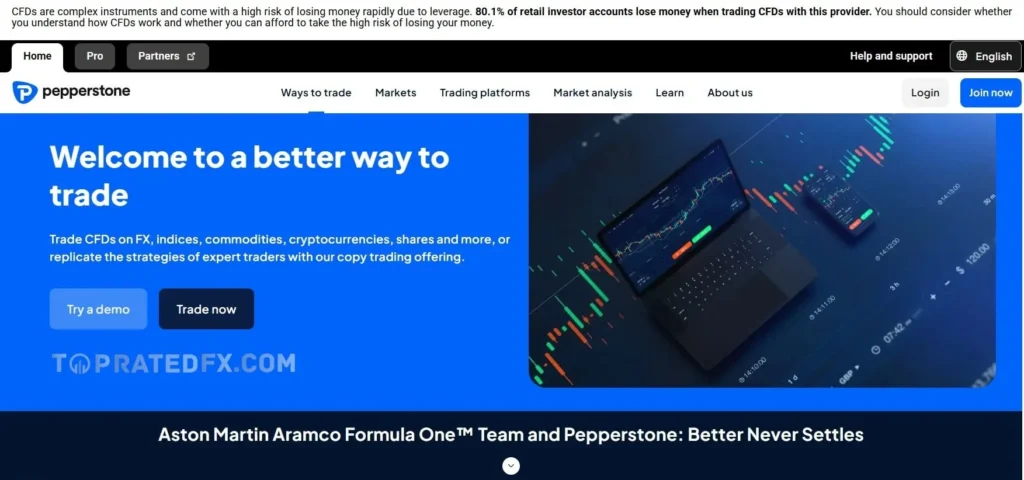
Pepperstone is a non-dealing desk forex and CFD broker that provides direct market access through aggregated liquidity providers. Its core model is built around ECN-style execution, where client orders are routed to external liquidity pools rather than being internally matched.
From a structural perspective, Pepperstone operates as an agency broker, meaning it does not take the opposite side of client trades. Instead, it earns revenue primarily through spreads and commissions, particularly on its Razor account.
This model is especially relevant for traders who rely on:
- Scalping strategies
- Algorithmic trading (EAs)
- High-frequency execution environments
Pepperstone’s infrastructure is designed to minimize:
- Order execution delays
- Requotes
- Artificial price manipulation
Instead, the broker emphasizes market execution, where trades are filled at the best available price—introducing both positive and negative slippage depending on market conditions.
Is Pepperstone Legit or a Scam?
From a regulatory and operational standpoint, Pepperstone is widely considered a legitimate broker, with multiple licenses across tier-1 and tier-2 jurisdictions. However, like any global broker operating under different entities, the level of protection depends heavily on the specific regulatory branch a trader registers under.
Company Information
Pepperstone Group Limited was founded in 2010 in Melbourne, Australia. Over time, it has expanded into a multi-jurisdictional brokerage, serving clients across Europe, Asia, Africa, and the Middle East.
Key structural points:
- Operates through segregated client accounts
- Uses top-tier liquidity providers (banks and financial institutions)
- Offers no dealing desk execution model
- Supports both retail and professional clients
The company’s growth has been driven largely by its focus on:
- Low-cost trading
- High-speed execution
- Platform flexibility
Regulation Status
Pepperstone is regulated by several authorities, each offering different levels of oversight and client protection.
| Regulator | Jurisdiction | Protection Level |
|---|---|---|
| ASIC (Australian Securities & Investments Commission) | Australia | High |
| FCA (Financial Conduct Authority) | United Kingdom | Very High |
| CySEC (Cyprus Securities and Exchange Commission) | EU | Moderate–High |
| DFSA (Dubai Financial Services Authority) | UAE | Moderate |
| SCB (Securities Commission of The Bahamas) | Offshore | Lower |
Key Regulatory Considerations
- FCA (UK) clients benefit from:
- FSCS protection (up to £85,000)
- Strict leverage limits (1:30)
- Strong compliance oversight
- ASIC (Australia) provides:
- Strong operational regulation
- No compensation scheme, but strict capital requirements
- Offshore (SCB Bahamas):
- Higher leverage (up to 1:500)
- Lower regulatory protection
- More flexibility in trading conditions
Important Insight:
The same broker can offer very different risk profiles depending on the entity you are registered under. Traders choosing higher leverage via offshore entities are effectively trading with reduced regulatory safeguards.
Restricted Countries
Pepperstone does not accept clients from certain jurisdictions due to regulatory restrictions and compliance policies.
Common restricted regions include:
- United States
- Canada (partially restricted depending on province)
- Japan
- Some sanctioned or high-risk jurisdictions
These restrictions are primarily driven by:
- Local regulatory conflicts
- Licensing limitations
- Compliance with international financial laws
Execution Model Transparency
One of the defining aspects of Pepperstone is its execution transparency:
- Market Execution Only (no instant execution)
- No requotes
- Orders filled based on liquidity availability
- Slippage possible (both positive and negative)
Example (Real Trading Scenario)
A trader places a market buy order on EUR/USD during a high-impact news event:
- Requested price: 1.1000
- Available liquidity shifts rapidly
- Order filled at: 1.1002
This results in 2 pips of negative slippage, which is a normal outcome in a true market execution environment.
Conversely, in stable conditions, traders may also receive price improvement (positive slippage).
Summary of Legitimacy
Pepperstone is:
- Not a scam
- Properly regulated across multiple jurisdictions
- Transparent in its execution model
However:
- Risk exposure depends on the regulatory entity used
- Higher leverage comes with reduced protections
Account Types
Pepperstone offers two primary account types designed around different pricing structures rather than different trading environments. Both accounts provide access to the same liquidity pool, execution model, and instruments. The key difference lies in how trading costs are structured.
The two main account types are:
- Razor Account (Raw spread + commission)
- Standard Account (Spread-only pricing)
From a professional trading perspective, the choice between these accounts depends on trading frequency, strategy type, and cost sensitivity.
Razor Account
The Razor account is designed for traders who require institutional-grade spreads with transparent commission-based pricing. It is the preferred choice for scalpers, day traders, and algorithmic systems.
Features Table
| Feature | Details |
|---|---|
| Spreads | From 0.0 pips (EUR/USD typical avg: 0.0–0.3 pips) |
| Commission | ~$7 per lot (round turn, MT4/MT5), slightly lower on cTrader |
| Minimum Deposit | $0 (recommended: $200+) |
| Leverage | Up to 1:500 (offshore), 1:30 (EU/UK retail) |
| Platforms | MT4, MT5, cTrader, TradingView |
| Stop Out Level | 20% |
Execution & Cost Insight
The Razor account operates on a raw spread model, where prices are sourced directly from liquidity providers. This means:
- Spreads can reach 0.0 pips during high liquidity
- Costs are primarily commission-driven
- Total trading cost = spread + commission
Example (Cost Breakdown)
For a 1-lot EUR/USD trade:
- Spread: 0.2 pips
- Commission: $7 round turn
- Total cost ≈ $9 per lot
This structure is typically more cost-efficient than spread-only accounts when trading frequently or using tight stop-loss strategies.
Standard Account
The Standard account is structured for simplicity, where all trading costs are included within the spread. It is more suitable for lower-frequency traders who prefer not to calculate commissions separately.
Features Table
| Feature | Details |
|---|---|
| Spreads | From 1.0 pips (EUR/USD typical avg: 1.0–1.3 pips) |
| Commission | $0 |
| Minimum Deposit | $0 (recommended: $200+) |
| Leverage | Up to 1:500 (offshore), 1:30 (EU/UK retail) |
| Platforms | MT4, MT5, cTrader, TradingView |
| Stop Out Level | 20% |
Execution & Cost Insight
Although marketed as “commission-free,” the Standard account embeds costs within wider spreads.
Example (Cost Comparison)
For the same 1-lot EUR/USD trade:
- Spread: 1.2 pips
- Commission: $0
- Total cost ≈ $12 per lot
Compared to the Razor account, this results in higher overall trading costs, especially for active traders.
Razor vs Standard – Practical Comparison
| Feature | Razor Account | Standard Account |
|---|---|---|
| Pricing Model | Raw spread + commission | Spread-only |
| Typical EUR/USD Cost | ~$7–$9 per lot | ~$10–$13 per lot |
| Best For | Scalping, EA trading, day trading | Swing trading, beginners |
| Spread Type | Variable (very tight) | Variable (wider) |
| Transparency | High (separate commission) | Medium (embedded costs) |
Which Account Type Is More Efficient?
From a purely quantitative standpoint:
- High-frequency traders benefit from the Razor account due to:
- Lower effective spreads
- Better execution precision
- Reduced cost per trade
- Low-frequency traders may prefer the Standard account for:
- Simplicity
- Fewer variables in cost calculation
However, even for moderate trading activity, the Razor account often remains more cost-efficient over time.
Execution Consistency Across Accounts
It is important to note that both accounts:
- Use the same execution model
- Access the same liquidity providers
- Offer identical platform functionality
The difference is purely in pricing structure, not execution quality.
Trading Assets & Markets
Pepperstone provides access to a broad range of CFD instruments, with a primary emphasis on forex trading, which remains the broker’s strongest offering in terms of liquidity depth, spread competitiveness, and execution quality.
While the broker supports multiple asset classes, the core trading advantage lies in major and minor forex pairs, where spreads are consistently tighter, and execution is more stable compared to other instruments.
Forex
Forex is the most developed asset class at Pepperstone, offering deep liquidity and institutional-grade pricing across major, minor, and exotic pairs.
Trading Conditions Table
| Category | Examples | Typical Spreads (Razor) | Leverage | Notes |
|---|---|---|---|---|
| Major Pairs | EUR/USD, GBP/USD, USD/JPY | 0.0 – 0.3 pips | Up to 1:500 | Highest liquidity, lowest cost |
| Minor Pairs | EUR/GBP, AUD/NZD, EUR/AUD | 0.2 – 0.8 pips | Up to 1:500 | Moderate liquidity |
| Exotic Pairs | USD/ZAR, EUR/TRY, USD/SGD | 1.0 – 5.0+ pips | Lower effective leverage | Higher volatility & cost |
Execution Insight
- Major pairs benefit from multi-bank liquidity aggregation
- Execution speeds are typically under 30ms (in optimal conditions)
- Spreads widen during:
- News events
- Low liquidity sessions (e.g., Asian session for non-JPY pairs)
Real Trading Scenario
A scalper trading EUR/USD during the London session may experience:
- Spread: 0.1 pips
- Execution: near-instant
- Slippage: minimal
However, the same trade during NFP release may result in:
- Spread widening to 2–5 pips
- Increased slippage risk
Commodities
Pepperstone offers commodity CFDs primarily focused on precious metals and energy markets.
Commodities Table
| Instrument | Typical Spread | Leverage | Notes |
|---|---|---|---|
| Gold (XAU/USD) | 0.1 – 0.3 pips | Up to 1:500 | Highly liquid, popular for hedging |
| Silver (XAG/USD) | 0.2 – 0.5 pips | Up to 1:500 | More volatile than gold |
| Crude Oil (WTI/Brent) | 2.0 – 5.0 pips | Lower than forex | Influenced by macroeconomic data |
Trading Insight
- Gold behaves similarly to forex in terms of liquidity
- Oil markets are more event-driven (OPEC, inventories, geopolitics)
- Overnight financing (swap) costs are more noticeable
Indices
Pepperstone provides access to major global indices with competitive spreads and fast execution.
Indices Table
| Index | Region | Typical Spread | Leverage | Notes |
|---|---|---|---|---|
| US30 (Dow Jones) | USA | 1.0 – 2.0 points | Up to 1:200 | High volatility |
| NAS100 (NASDAQ) | USA | 1.0 – 2.5 points | Up to 1:200 | Tech-heavy index |
| GER40 (DAX) | Germany | 1.0 – 2.0 points | Up to 1:200 | Active in EU session |
| UK100 (FTSE) | UK | 1.0 – 1.5 points | Up to 1:200 | Lower volatility |
Trading Insight
- Indices offer strong intraday trends
- Spread stability is generally good during core sessions
- Gap risk exists during market open
Crypto CFDs
Pepperstone offers cryptocurrency trading via CFDs, meaning traders do not own the underlying asset.
Crypto CFDs Table
| Asset | Typical Spread | Leverage | Notes |
|---|---|---|---|
| Bitcoin (BTC/USD) | Wide (variable) | Limited (e.g., 1:10 or lower) | High volatility |
| Ethereum (ETH/USD) | Wide (variable) | Limited | Sensitive to market sentiment |
| Other Cryptos | Variable | Limited | Depends on liquidity |
Trading Insight
- Crypto spreads are significantly wider than forex spreads
- Trading conditions vary by jurisdiction
- Not ideal for scalping due to cost structure
Share CFDs
Pepperstone also provides access to individual stock CFDs, mainly from the US, UK, and EU markets.
Share CFDs Table
| Market | Examples | Commission | Notes |
|---|---|---|---|
| US Shares | Apple, Tesla, Amazon | Variable (per trade) | High liquidity |
| UK Shares | HSBC, BP | Variable | Currency conversion may apply |
| EU Shares | SAP, Siemens | Variable | Lower liquidity vs US |
Trading Insight
- Share CFDs are better suited for swing trading
- Not optimized for short-term scalping due to:
- Wider spreads
- Commission structure
Overall Asset Evaluation
| Asset Class | Strength Level | Key Advantage | Limitation |
|---|---|---|---|
| Forex | ⭐⭐⭐⭐⭐ | Tight spreads, deep liquidity | None significant |
| Commodities | ⭐⭐⭐⭐ | Strong gold trading conditions | Swap costs |
| Indices | ⭐⭐⭐⭐ | Good volatility & spreads | Session-based gaps |
| Crypto CFDs | ⭐⭐⭐ | High volatility | Wide spreads |
| Shares CFDs | ⭐⭐⭐ | Market access | Higher trading costs |
Key Takeaway
Pepperstone is fundamentally a forex-first broker, where:
- Pricing is most competitive
- Execution is most consistent
- Liquidity is deepest
Other asset classes are supportive additions, but they do not match the efficiency of forex trading conditions.
Trading Platforms
Pepperstone provides access to a range of third-party professional trading platforms, rather than developing a proprietary system. This approach allows traders to choose platforms based on execution style, strategy requirements, and interface preference.
All platforms are connected to the same underlying infrastructure, meaning:
- Execution quality is consistent across platforms
- Differences arise mainly in the interface, tools, and order handling features
MetaTrader 4 (MT4)
MetaTrader 4 remains one of the most widely used platforms in retail forex trading, particularly for algorithmic trading and legacy systems.
Core Features
- Supports Expert Advisors (EAs) for automated trading
- Multiple order types (market, limit, stop)
- Built-in indicators and custom script support
- Lightweight and stable execution environment
Execution Characteristics
- Slightly limited compared to newer platforms in terms of:
- Depth of Market (DOM)
- Advanced order routing
However, MT4 remains highly efficient for:
- Scalping strategies
- Low-latency execution setups
- VPS-based automated trading
Best For
- Traders using pre-built EAs
- Those requiring a stable, low-resource platform
MetaTrader 5 (MT5)
MetaTrader 5 is an upgraded version of MT4, offering enhanced functionality and broader market access.
Core Features
- More timeframes and technical indicators
- Built-in economic calendar
- Supports both netting and hedging systems
- Improved backtesting capabilities
Execution Characteristics
- Faster order processing compared to MT4
- Better handling of multi-asset portfolios
Best For
- Traders who want:
- More analytical tools
- Improved strategy testing
- Access to multiple asset classes
cTrader
cTrader is designed for professional traders who require more transparency and control over order execution.
Core Features
- Full Depth of Market (Level II pricing)
- Advanced order types:
- Market range orders
- Server-side trailing stops
- Detachable charts and customizable workspace
Execution Characteristics
- Provides more granular control over execution
- Displays liquidity levels and order flow
- Particularly useful for:
- Scalpers
- High-frequency traders
Cost Advantage
- Commission on cTrader is often slightly lower than MT4/MT5
- More transparent pricing display
Best For
- Traders focused on:
- Execution precision
- Order flow visibility
- Short-term trading strategies
TradingView Integration
Pepperstone integrates with TradingView, allowing traders to execute trades directly from one of the most advanced charting platforms available.
Core Features
- Industry-leading charting tools
- Access to community indicators and strategies
- Clean, browser-based interface
Execution Characteristics
- Orders are routed through Pepperstone’s backend
- Slight delay possible compared to native platforms
Best For
- Traders who prioritize:
- Technical analysis
- Charting flexibility
- Visual strategy development
Copy Trading
Pepperstone supports copy trading through third-party integrations rather than a native social trading network.
Available Solutions
- Myfxbook AutoTrade
- DupliTrade
- cTrader Copy (within the cTrader ecosystem)
How It Works
- Traders can allocate funds to mirror strategies
- Performance depends entirely on the selected provider
- No guaranteed returns
Risk Consideration
Copy trading introduces:
- Strategy dependency risk
- Potential drawdowns based on provider decisions
Platform Comparison Table
| Feature | MT4 | MT5 | cTrader | TradingView |
|---|---|---|---|---|
| Ease of Use | High | Medium | Medium | High |
| Algorithmic Trading | Excellent | Excellent | Good (cAlgo) | Limited |
| Depth of Market | No | Limited | Full | No |
| Execution Control | Basic | Improved | Advanced | Moderate |
| Charting Tools | Good | Very Good | Very Good | Excellent |
| Best For | EAs, scalping | Multi-asset traders | Professional scalpers | Technical analysts |
Execution Infrastructure
Regardless of platform choice, Pepperstone maintains:
- Low-latency execution servers
- Data centers in financial hubs (e.g., London, New York)
- Compatibility with VPS services for automated trading
This ensures:
- Reduced execution delays
- Stable connectivity for high-frequency strategies
Key Takeaway
Pepperstone’s platform offering is built around flexibility and execution performance, not proprietary ecosystem control.
- MT4/MT5 → Best for automation and familiarity
- cTrader → Best for execution transparency and precision
- TradingView → Best for charting and analysis
The absence of a proprietary platform is not a weakness; in this case, it reflects a focus on institutional-grade infrastructure over retail customization.
Special Features
Pepperstone’s feature set is built around enhancing trading performance rather than adding promotional tools. Instead of offering gamified features or bonuses, the broker focuses on execution support, analytical tools, and infrastructure improvements that are relevant to active traders.
These features are particularly useful for:
- Algorithmic traders
- Scalpers
- Strategy-driven discretionary traders
VPS (Virtual Private Server)
Pepperstone supports VPS hosting through third-party providers, allowing traders to run their platforms continuously with minimal latency and downtime.
Key Benefits
- 24/7 platform uptime (even when your local device is offline)
- Reduced latency by hosting near broker servers
- Stable environment for Expert Advisors (EAs)
Trading Impact
For algorithmic traders, VPS usage can significantly improve:
- Order execution speed
- Strategy consistency
- Slippage control
Typical Use Case
A trader running a scalping EA on EUR/USD:
- Without VPS:
- Execution delay due to local internet fluctuations
- With VPS (London server):
- Faster order routing
- Reduced latency spikes
Smart Trader Tools (MT4/MT5 Add-ons)
Pepperstone offers a suite of advanced tools for MetaTrader platforms, designed to extend functionality beyond default capabilities.
Key Tools Include
- Mini Terminal → Advanced order management
- Correlation Matrix → Identify relationships between currency pairs
- Sentiment Trader → Market positioning insights
- Alarm Manager → Event-based alerts
- Excel RTD → Real-time data export to Excel
Practical Value
These tools help traders:
- Execute trades with more precision
- Manage multiple positions efficiently
- Analyze market structure beyond basic indicators
Copy Trading Solutions
Pepperstone integrates with external copy trading platforms rather than offering a built-in social trading network.
Available Options
- Myfxbook AutoTrade
- DupliTrade
- cTrader Copy
Functionality
- Allocate capital to mirror other traders
- Automatically replicate trades in real time
- Maintain control over risk allocation
Limitations
- Performance depends entirely on the signal provider
- No built-in risk guarantees
- Historical performance does not ensure future results
Trading Tools & Execution Enhancements
Pepperstone provides several tools aimed at improving execution and market awareness.
Execution-Oriented Features
- Depth of Market (cTrader) → View liquidity levels
- One-click trading → Faster order entry
- Advanced order types → Better trade control
- Low-latency infrastructure → Reduced execution delays
Risk Management Tools
- Stop-loss and take-profit orders
- Trailing stops (platform-dependent)
- Margin monitoring in real time
Research & Market Analysis
Pepperstone offers a moderate level of research content, primarily focused on practical market insights rather than extensive education programs.
Available Resources
- Daily market analysis
- Economic calendar
- Technical outlooks
- Third-party integrations (e.g., Autochartist, depending on region)
Content Focus
- Short-term trading opportunities
- Key macroeconomic events
- Technical levels and patterns
Limitations
- Less structured compared to brokers focused on beginners
- Not designed as a full educational ecosystem
Autochartist (Pattern Recognition Tool)
In some regions, Pepperstone provides access to Autochartist, a tool that automatically identifies trading opportunities.
Core Capabilities
- Chart pattern recognition
- Fibonacci setups
- Volatility analysis
- Trade setup alerts
Use Case
A trader receives an alert identifying a triangle breakout on EUR/USD, allowing for faster decision-making without manual chart scanning.
Summary of Special Features
| Feature Category | Strength | Key Benefit | Limitation |
|---|---|---|---|
| VPS Support | ⭐⭐⭐⭐⭐ | Low-latency automated trading | Requires external setup |
| Smart Trader Tools | ⭐⭐⭐⭐ | Enhanced MT4/MT5 functionality | Platform-specific |
| Copy Trading | ⭐⭐⭐ | Passive strategy access | Provider-dependent risk |
| Execution Tools | ⭐⭐⭐⭐⭐ | Faster and precise order handling | Requires experience |
| Research Tools | ⭐⭐⭐ | Practical insights | Limited depth |
Key Takeaway
Pepperstone’s special features are clearly aligned with performance-driven trading, rather than beginner-focused education or promotional tools.
The broker prioritizes:
- Execution efficiency
- Analytical support
- Infrastructure reliability
This makes it particularly suitable for traders who:
- Already understand market mechanics
- Require tools that enhance execution rather than simplify trading concepts
Deposits & Withdrawals
Pepperstone provides a relatively straightforward funding system, focusing on fast processing and minimal internal fees. However, actual experience may vary depending on region, payment provider, and account base currency.
From a trading perspective, funding efficiency matters because it affects:
- Speed of capital deployment
- Withdrawal reliability
- Cost leakage through fees or currency conversion
Minimum Deposit
Pepperstone does not enforce a strict minimum deposit requirement.
- Official Minimum Deposit: $0
- Practical Trading Minimum: $200–$500
Practical Insight
While it is technically possible to open an account with a very small balance, realistic trading conditions are especially important when using:
- Proper risk management
- Stop-loss placement
- Reasonable position sizing
require a higher capital base.
Minimum Withdrawal
- Minimum Withdrawal Amount: Typically $0 (no fixed restriction)
- Some payment providers may impose their own minimum thresholds
Important Consideration
Withdrawals must generally be processed via:
- The same funding method is used for deposits (anti-money laundering policy)
Deposit Methods & Conditions
Pepperstone supports a range of global payment methods. Availability depends on the trader’s country and regulatory entity.
Deposit Methods Table
| Payment Method | Processing Time | Fees | Notes |
|---|---|---|---|
| Bank Transfer | 1–3 business days | Usually free (bank fees may apply) | Suitable for large deposits |
| Credit/Debit Card (Visa/Mastercard) | Instant | Free | Most commonly used method |
| E-wallets (Skrill, Neteller) | Instant | Free | Fast and flexible |
| Local Payment Methods | Depends on the country | Usually free | Depends on country |
| Crypto (limited regions) | Varies | Network fees apply | Not universally available |
Withdrawal Methods & Conditions
Withdrawals are processed through the same channels, with some operational differences.
Withdrawal Table
| Payment Method | Processing Time | Fees | Notes |
|---|---|---|---|
| Bank Transfer | 2–5 business days | Usually free (bank charges possible) | Slower but reliable |
| Credit/Debit Card | 1–3 business days | Free | Refunds may be prioritized |
| E-wallets | 24–48 hours | Free | Fastest withdrawal method |
| Local Methods | Varies | Usually free | Region-dependent |
Internal Fees vs External Costs
Pepperstone generally does not charge internal fees for:
- Deposits
- Withdrawals
However, traders may still incur:
External Costs
- Bank transfer fees
- Currency conversion charges
- Payment provider commissions
Currency Conversion
If your account base currency differs from your deposit currency:
- Conversion is applied automatically
- Rates depend on:
- Payment provider
- Market exchange rates
Processing Speed – Practical Evaluation
| Transaction Type | Expected Speed | Reliability |
|---|---|---|
| Deposits (Cards/E-wallets) | Instant | High |
| Withdrawals (E-wallets) | 1–2 days | High |
| Withdrawals (Bank) | 2–5 days | Medium–High |
Real Scenario
A trader withdrawing profits via Skrill:
- Request submitted: Monday
- Processed by broker: same day
- Funds received: Tuesday
In contrast, bank withdrawals may involve:
- Intermediary banks
- Additional delays
Operational Policies
Segregation of Funds
Client funds are held in segregated accounts, meaning:
- Separate from company operating funds
- Reduces risk in case of insolvency
Withdrawal Priority Rules
- Card deposits are typically refunded first to the original card
- Profits can be withdrawn via alternative methods
Key Limitations
- No support for some local payment methods in certain regions
- Crypto funding is not universally available
- Bank withdrawals may involve unpredictable external delays
Summary of Funding Conditions
| Factor | Evaluation |
|---|---|
| Deposit Speed | ⭐⭐⭐⭐⭐ |
| Withdrawal Speed | ⭐⭐⭐⭐ |
| Internal Fees | ⭐⭐⭐⭐⭐ |
| Payment Flexibility | ⭐⭐⭐⭐ |
| Transparency | ⭐⭐⭐⭐ |
Key Takeaway
Pepperstone offers a cost-efficient and reliable funding system, with:
- Fast deposits
- Reasonably quick withdrawals
- Minimal internal fees
However, the overall experience is still influenced by:
- External payment providers
- Regional availability
- Currency conversion factors
Pepperstone vs Competitors
To properly evaluate Pepperstone’s position in the market, it is essential to compare it with other low-cost forex brokers that target similar trader profiles. In this section, we compare Pepperstone with:
- IC Markets (ECN-focused broker)
- Exness (high-leverage, flexible conditions)
- XM (hybrid model with beginner focus)
The comparison focuses strictly on core trading conditions, not marketing features.
Spreads Comparison (EUR/USD Focus)
| Broker | Account Type | Typical Spread | Pricing Model |
|---|---|---|---|
| Pepperstone | Razor | 0.0 – 0.3 pips | Raw spread + commission |
| IC Markets | Raw Spread | 0.0 – 0.2 pips | Raw spread + commission |
| Exness | Raw Spread | 0.0 – 0.3 pips | Raw spread + commission |
| XM | Standard | 1.0 – 1.5 pips | Spread-only |
Analysis
- Pepperstone and IC Markets are very close in spread competitiveness
- Exness matches similar raw spread conditions
- XM is clearly less competitive for tight-spread trading strategies
Commission Structure
| Broker | Commission (per lot round turn) | Notes |
|---|---|---|
| Pepperstone | ~$7 | Slight variation by platform |
| IC Markets | ~$7 | Consistent across platforms |
| Exness | ~$7 | Depends on account type |
| XM | $0 | Cost embedded in spread |
Analysis
- Pepperstone is aligned with industry-standard ECN pricing
- No significant cost advantage vs IC Markets or Exness
- XM uses a spread-based model, resulting in a higher overall cost
Maximum Leverage
| Depends on the account | Max Leverage | Notes |
|---|---|---|
| Pepperstone | Up to 1:500 | Offshore entity required |
| IC Markets | Up to 1:500 | Similar structure |
| Exness | Unlimited (conditions apply) | Dynamic leverage system |
| XM | Up to 1:1000 | Depends on account |
Analysis
- Exness offers the highest theoretical leverage, but with conditions
- Pepperstone provides balanced leverage with stable execution
- XM provides high leverage but with less competitive spreads
Minimum Deposit
| Broker | Minimum Deposit | Practical Recommendation |
|---|---|---|
| Pepperstone | $0 | $200+ |
| IC Markets | $200 | $200+ |
| Exness | $10 | $100+ |
| XM | $5 | $100+ |
Analysis
- Exness and XM are more accessible for low-capital traders
- Pepperstone is flexible but better suited for mid-level capital
Stop Out Level
| Broker | Stop Out Level | Margin Call |
|---|---|---|
| Pepperstone | 20% | ~50% |
| IC Markets | 50% | ~100% |
| Exness | 0% – 20% | Flexible |
| XM | 20% | ~50% |
Analysis
- Pepperstone offers moderate risk tolerance
- Exness allows extremely low stop-out levels, increasing risk exposure
- IC Markets is more conservative in margin protection
Execution Model
| Broker | Execution Type | Dealing Desk | Notes |
|---|---|---|---|
| Pepperstone | ECN-style | No | Deep liquidity aggregation |
| IC Markets | ECN | No | Similar infrastructure |
| Exness | Hybrid | No dealing desk (varies) | Internalization possible |
| XM | Market Maker / Hybrid | Partial | Execution may vary |
Analysis
- Pepperstone and IC Markets are closest in pure ECN-style execution
- Exness uses a hybrid approach, which may include internal matching
- XM is less transparent in its execution structure
Overall Comparison Table
| Feature | Pepperstone | IC Markets | Exness | XM |
|---|---|---|---|---|
| Spreads | ⭐⭐⭐⭐⭐ | ⭐⭐⭐⭐⭐ | ⭐⭐⭐⭐⭐ | ⭐⭐⭐ |
| Commission | ⭐⭐⭐⭐ | ⭐⭐⭐⭐ | ⭐⭐⭐⭐ | ⭐⭐⭐ |
| Leverage | ⭐⭐⭐⭐ | ⭐⭐⭐⭐ | ⭐⭐⭐⭐⭐ | ⭐⭐⭐⭐⭐ |
| Execution | ⭐⭐⭐⭐⭐ | ⭐⭐⭐⭐⭐ | ⭐⭐⭐⭐ | ⭐⭐⭐ |
| Beginner Access | ⭐⭐⭐ | ⭐⭐⭐ | ⭐⭐⭐⭐⭐ | ⭐⭐⭐⭐⭐ |
Key Competitive Positioning
Pepperstone vs IC Markets
- Nearly identical in:
- Spreads
- Commission
- Execution quality
- Choice often comes down to:
- Platform preference
- Personal execution experience
Pepperstone vs Exness
- Pepperstone offers:
- More stable execution
- More consistent spreads
- Exness offers:
- Higher leverage
- Lower entry barrier
Pepperstone vs XM
- Pepperstone is superior in:
- Spread efficiency
- Execution transparency
- XM is more suitable for:
- Beginners
- Low deposit trading
Key Takeaway
Pepperstone is positioned as a professional-grade trading broker, competing directly with IC Markets in the low-cost ECN segment.
- It does not lead to leverage flexibility (like Exness)
- It does not target beginners aggressively (like XM)
Instead, it focuses on:
- Execution quality
- Spread efficiency
- Platform flexibility
Is Pepperstone Good for Beginners?
Pepperstone is not specifically designed as a beginner-focused broker. Its infrastructure, pricing model, and platform options are optimized for execution efficiency and trading performance, rather than simplified onboarding or guided learning.
That said, beginners can still use Pepperstone, but they must understand the risk mechanics of leveraged trading, particularly in forex markets where small price movements can have amplified effects on account balance.
Leverage Risk Explanation
Leverage allows traders to control larger positions with a smaller amount of capital. While this increases potential returns, it also significantly increases risk.
Example
A trader deposits $500 and uses 1:100 leverage:
- Position size = $50,000 (0.5 lot EUR/USD)
- A 1% market move = $500
This means:
- A 1% adverse move can wipe out the entire account
Key Insight
Higher leverage does not change market volatility; it magnifies exposure.
Margin Example (Practical Scenario)
Let’s consider a realistic trade using Pepperstone’s Razor account:
- Account balance: $1,000
- Leverage: 1:100
- Trade size: 1 lot EUR/USD
- Required margin ≈ $1,000
If the market moves against the trader by 50 pips:
- Loss ≈ $500
- Remaining equity = $500
At this point:
- Margin level drops significantly
- Risk of stop-out increases
Stop-Out Explanation
Pepperstone uses a 20% stop-out level, meaning positions are automatically closed when the margin level falls to this threshold.
How It Works
- Margin Level = (Equity / Used Margin) × 100
Example
- Equity: $200
- Used Margin: $1,000
Margin Level = 20% → Positions begin to close automatically
Implication
- Traders can lose most of their account before the stop-out is triggered
- There is no guarantee of full capital protection, especially during volatile conditions
Beginner Challenges on Pepperstone
Beginners may face difficulties due to:
1. Pricing Structure Complexity
- Razor account requires understanding:
- Spread + commission
- Cost calculation is not always intuitive
2. Platform Learning Curve
- Platforms like MT4/MT5 and cTrader require:
- Manual setup
- Understanding of order types
3. Limited Structured Education
- No step-by-step learning path
- Less beginner guidance compared to brokers like XM
Who Should Use Pepperstone?
Pepperstone is more suitable for:
Experienced Traders
- Familiar with:
- Leverage mechanics
- Risk management
- Platform functionality
Scalpers and Day Traders
- Benefit from:
- Tight spreads
- Fast execution
Algorithmic Traders
- Use:
- Expert Advisors (EAs)
- VPS environments
Cost-Sensitive Traders
- Prefer:
- Transparent pricing
- Low trading costs over time
Who Should Avoid Pepperstone?
Pepperstone may not be ideal for:
Complete Beginners
- No prior trading experience
- Need guided education and structured learning
Low-Capital Traders
- Small accounts are more vulnerable to:
- Volatility
- Margin calls
Traders Seeking Simplicity
- Prefer:
- Fixed spreads
- Simplified interfaces
- Built-in strategy guidance
Risk Management Insight
Regardless of experience level, traders should consider:
- Using lower leverage (e.g., 1:10–1:30)
- Risking 1–2% per trade
- Avoiding overexposure during news events
Practical Beginner Scenario
A beginner opens a $300 account and trades 0.1 lot EUR/USD:
- Each pip ≈ $1
- A 50-pip loss = $50 (≈17% of account)
With poor risk control:
- 2–3 losing trades can significantly reduce capital
Overall Beginner Suitability
| Factor | Evaluation |
|---|---|
| Ease of Use | ⭐⭐⭐ |
| Risk Transparency | ⭐⭐⭐⭐ |
| Educational Support | ⭐⭐⭐ |
| Cost Efficiency | ⭐⭐⭐⭐⭐ |
| Beginner Friendliness | ⭐⭐⭐ |
Key Takeaway
Pepperstone is a performance-driven broker, not a beginner-oriented platform.
- It offers excellent trading conditions
- But requires a solid understanding of risk and execution
For beginners, the broker is usable—but not optimal without:
- Prior knowledge
- Careful risk management
FAQ
Yes, Pepperstone is regulated by multiple authorities, including ASIC (Australia), FCA (UK), CySEC (EU), DFSA (Dubai), and SCB (Bahamas). The level of protection depends on the entity under which the account is registered.
Pepperstone does not require a fixed minimum deposit. However, a practical starting balance of $200 or more is recommended for effective risk management.
Yes, particularly on the Razor account, where spreads can start from 0.0 pips. However, a commission is charged per trade, making the total cost a combination of spread and commission.
Leverage can go up to 1:500 under offshore entities, while retail clients under FCA or CySEC regulations are limited to 1:30.
Yes, Pepperstone is well-suited for scalping due to:
Low spreads
Fast execution
No dealing desk intervention
Yes, the broker supports automated trading through:
MetaTrader 4 (EAs)
MetaTrader 5
cTrader (cAlgo integration)
Pepperstone generally does not charge internal fees. However, external fees may apply depending on the payment provider or currency conversion.
The stop-out level is 20%, meaning positions are automatically closed when the margin level falls to this threshold.
Final Verdict
Pepperstone positions itself as a performance-focused forex broker, emphasizing execution quality, pricing transparency, and platform flexibility rather than simplified trading environments.
From an institutional perspective, its strongest advantages lie in:
- Consistently tight spreads
- Reliable market execution
- Multi-platform accessibility
However, it does not attempt to compete in areas such as:
- Beginner education
- Simplified user experience
- Promotional incentives
Conclusion
Pepperstone is best categorized as a low-cost, execution-driven broker competing directly with other ECN-style providers such as IC Markets.
It is particularly suitable for:
- Active forex traders
- Scalpers
- Algorithmic systems
Less suitable for:
- First-time traders
- Those seeking guided trading environments
Risk Warning: Trading CFDs involves significant risk of loss and may not be suitable for all investors. Leverage can amplify both profits and losses.
Pepperstone Details