


This XM Review 2026 provides a comprehensive evaluation of XM’s global forex trading conditions, account structures, regulatory framework, platform ecosystem, and risk profile. The focus of this review is primarily on forex trading, leverage mechanics, spreads, execution structure, and capital risk management.
XM has been operating for over 15 years and provides services through multiple regulated entities across different jurisdictions. Trading conditions, leverage limits, and investor protections vary depending on the entity under which a client registers.
This review evaluates XM from a global retail trader perspective while maintaining professional scrutiny regarding:
- Spread structure
- Execution model
- Leverage exposure
- Account segmentation
- Regulatory coverage
- Capital protection mechanisms
Risk Warning: Trading Forex and CFDs involves significant risk and may result in the loss of your invested capital. Leverage increases risk exposure.
Quick Overview
| Category | Details |
|---|---|
| Broker | XM |
| Founded | 2009 |
| Business Model | Market Maker |
| Platforms | MT4, MT5, XM App |
| Minimum Deposit | $5 |
| Shares Account Minimum | $10,000 |
| Maximum Leverage | 1000:1 (entity dependent) |
| Shares Leverage | 1:1 |
| Stop-Out Level | 20% (Standard/Ultra Low) |
| Shares Stop-Out | 0% |
| Commission | Shares Account Only |
| Swap Free | Ultra Low & Shares |
| Bonus Eligible | Standard Account Only |
| Copy Trading | Yes |
| Education | Yes |
| Negative Balance Protection | Yes |
| Restricted Countries | US, Canada, Israel, Iran |
- $5 minimum deposit
- Ultra Low spreads from 0.8 pips
- Swap-free available
- High leverage up to 1000:1
- MT4, MT5 & XM App/li>
- Copy trading available
- No raw ECN forex account
- Market maker execution
- Shares account requires $10,000
- No cTrader platform
- Standard spreads wider (1.6+ pips)
- Offshore regulation for some regions
Initial Professional Assessment
XM clearly segments its offering:
- Standard → Entry traders + bonus users
- Ultra Low → Lower spread forex traders
- Shares → Capitalized equity investors
For forex traders specifically, the Ultra Low account is structurally the most competitive within XM’s ecosystem.
However, the absence of a raw spread + commission model means XM competes primarily in the retail spread-only segment rather than the institutional ECN space.
What Is XM?
XM is a global online forex and CFD broker operating under the Trading Point Group. With over 15 years in operation, the company provides trading services in forex, commodities, indices, shares, and stock derivatives through multiple regulated entities across different jurisdictions.
XM does not operate under a single global license. Instead, it functions through several region-specific legal entities. This structure affects:
- Maximum leverage available
- Investor protection mechanisms
- Regulatory oversight
- Dispute resolution frameworks
- Compensation eligibility
Understanding which entity governs your account is critical before opening a live trading account.
Is XM Legit or a Scam?
Based on the regulatory disclosures visible in your screenshots, XM operates under multiple licensed entities. These include recognized regulatory bodies in Cyprus, Mauritius, Seychelles, and Belize.
XM is therefore not an unregulated broker. However, the strength of protection varies significantly depending on the entity.
Confirmed Regulatory Entities
XM International MU Limited
- Regulator: Financial Services Commission (FSC) of Mauritius
- License Number: GB23202700
- License Type: Investment Dealer
XM (SC) Limited
- Regulator: Financial Services Authority (FSA) Seychelles
- License Number: SD190
- License Type: Securities Dealer
XM Global Limited
- Regulator: Financial Services Commission (FSC) Belize
- Under the Securities Industry Act 2021
- License Number: 8557558
Trading Point of Financial Instruments Limited
- Regulator: Cyprus Securities and Exchange Commission (CySEC)
- License Number: 120/10
Regulatory Strength Comparison
Not all regulators offer equal levels of investor protection.
| Entity | Regulator | Tier Strength | Compensation Scheme |
|---|---|---|---|
| Cyprus | CySEC | Strong (EU) | Investor Compensation Fund (up to €20,000) |
| Mauritius | FSC | Moderate | No EU compensation scheme |
| Seychelles | FSA | Offshore | No formal compensation fund |
| Belize | FSC | Offshore | No EU compensation scheme |
Important Distinction
If registered under CySEC:
✔️ EU regulatory compliance
✔️ MiFID framework
✔️ Investor Compensation Fund (ICF) protection
If registered under offshore entities (Mauritius, Seychelles, Belize):
✔️ Higher leverage available
❌ No EU-level compensation scheme
❌ Less strict capital requirements
Investor Compensation & Fund Safety
Under CySEC (120/10):
Eligible retail clients may receive compensation up to €20,000 in case of broker insolvency.
Under offshore entities:
There is generally no formal investor compensation fund comparable to the EU ICF.
Client Fund Segregation
XM states that client funds are held in segregated accounts separate from operational capital.
This means:
✔️ Client deposits are not used for company expenses
✔️ Operational funds and client funds are separated
Segregation reduces insolvency risk exposure but does not eliminate it.
Restricted Regions
XM does not provide services to citizens of:
- United States
- Canada
- Israel
- Islamic Republic of Iran
- Other sanctioned jurisdictions
This aligns with international compliance obligations.
Legal Risk Disclosures
The website explicitly states:
Trading involves significant risk and may result in the loss of invested capital.
This confirms standard regulatory compliance language.
Jurisdiction & Leverage Impact
Leverage availability depends on the entity:
- CySEC clients → typically capped at 1:30 (retail)
- Offshore clients → up to 1000:1
Higher leverage jurisdictions attract traders seeking greater exposure but carry increased liquidation risk.
Transparency Assessment
XM provides:
✔️ License numbers
✔️ Regulatory references
✔️ Legal document links
✔️ Risk disclosures
However:
❌ XM is not publicly listed
❌ No public audited financial statements available to retail traders
This is common among private brokerage firms.
Regulatory Risk Analysis
Strongest Protection:
CySEC entity
Moderate Protection:
Mauritius FSC
Higher Risk Exposure:
Belize & Seychelles entities (due to offshore structure)
Traders must determine which entity they are assigned to during account registration.
Account Types
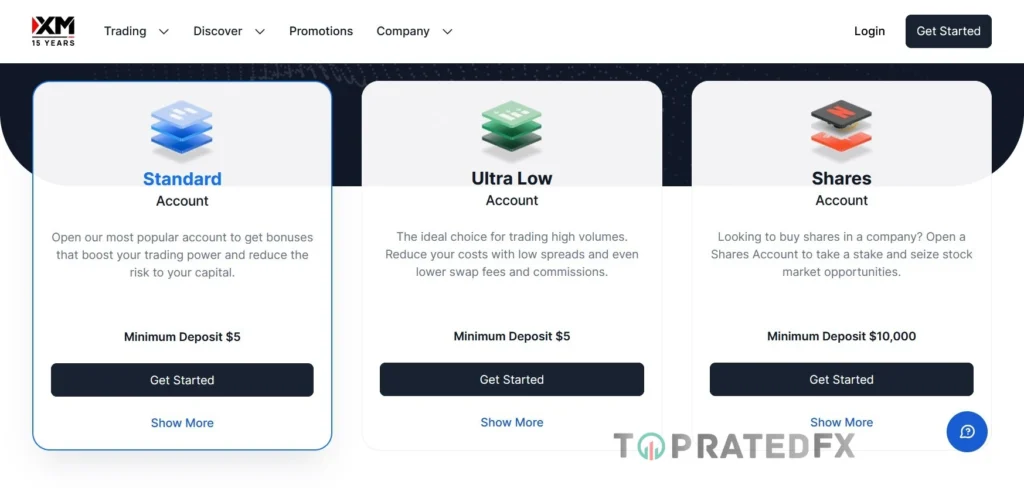
XM currently offers three primary account categories:
- Standard Account
- Ultra Low Account
- Shares Account
Important clarification:
The “Micro” feature is not a separate account type. It is a contract size option available within Standard and Ultra Low accounts.
This section focuses primarily on forex trading conditions.
Standard Account
The Standard Account is XM’s entry-level retail account and is the only account eligible for bonus programs.
Core Specifications (Verified)
| Feature | Standard Account |
|---|---|
| Minimum Deposit | $5 |
| Markets | Forex, Precious Metals, Equity Indices, Thematic Indices, Stocks, Turbo Stocks, Commodities, Energies |
| Maximum Leverage | 1000:1 (entity dependent) |
| Stop-Out Level | 20% |
| Commission | No |
| Swap-Free | No |
| Bonus Eligible | Yes |
| Micro Option | Yes |
Spreads As Low As
| Instrument | Spread From |
|---|---|
| EUR/USD | 1.6 pips |
| USD/JPY | 2 pips |
| GOLD | 3 |
These are starting spreads, not fixed spreads.
Forex Cost Example (Standard Account)
Let’s calculate the real trading cost:
EUR/USD
Spread: 1.6 pips
1 Standard Lot = $10 per pip
Cost per 1 lot trade:
1.6 × $10 = $16
For 5 lots:
$16 × 5 = $80
For high-frequency traders, this spread level becomes materially expensive compared to raw ECN models.
Who Is the Standard Account For?
✔️ Beginners
✔️ Small capital traders
✔️ Traders interested in bonuses
✔️ Traders not focused on ultra-tight spreads
Not ideal for:
❌ High-volume scalpers
❌ Algorithmic low-spread strategies
Ultra Low Account
The Ultra Low Account is positioned for cost-sensitive forex traders.
It offers materially tighter spreads than Standard.
Core Specifications (Verified)
| Feature | Ultra Low |
|---|---|
| Minimum Deposit | $5 |
| Markets | Forex, Precious Metals, Equity Indices, Thematic Indices, Stocks, Turbo Stocks, Commodities, Energies |
| Maximum Leverage | 1000:1 |
| Stop-Out Level | 20% |
| Commission | No |
| Swap-Free | Yes |
| Bonus Eligible | No |
| Micro Option | Yes |
Spreads As Low As
| Instrument | Spread From |
|---|---|
| EUR/USD | 0.8 pips |
| USD/JPY | 0.9 pips |
| GOLD | 1.6 |
This represents roughly 50% lower cost vs Standard on majors.
Forex Cost Example (Ultra Low)
EUR/USD
Spread: 0.8 pips
1 lot = $10 per pip
Cost:
0.8 × $10 = $8 per lot
Compared to Standard ($16), Ultra Low cuts cost in half.
For 10 lots:
$8 × 10 = $80
Over time, this difference significantly impacts profitability.
Swap-Free Advantage
Ultra Low supports swap-free trading.
This is important for:
- Muslim traders
- Swing traders holding overnight
- Traders avoiding rollover cost
However, administrative charges may apply after holding positions for extended periods.
Who Is Ultra Low For?
✔️ Active forex traders
✔️ Scalpers
✔️ Cost-sensitive traders
✔️ Medium-volume traders
Ultra Low is the most competitive forex account inside XM’s ecosystem.
Shares Account
The Shares Account is structurally different and does not compete directly with forex accounts.
Core Specifications (Verified)
| Feature | Shares Account |
|---|---|
| Minimum Deposit | $10,000 |
| Markets | Shares Only |
| Maximum Leverage | 1:1 |
| Stop-Out Level | 0% |
| Commission | Yes |
| Swap-Free | Yes |
| Bonus Eligible | No |
| Micro Option | No |
Structural Differences
Unlike Standard and Ultra Low:
- No leverage amplification
- Commission-based pricing
- No forex trading inside this account
- Designed for equity-focused investors
Stop-out at 0% means:
Positions are not forcibly liquidated at 20% margin level like forex accounts. However, equity drawdown still affects available margin.
Capital Implications
Minimum deposit: $10,000
This automatically excludes:
- Beginner traders
- Small retail accounts
This account targets capitalized investors.
Leverage Risk Across Accounts
Standard & Ultra Low:
Maximum leverage up to 1000:1 (entity dependent)
Example:
Account: $500
Trade: 1 lot EUR/USD
Margin at 1000:1 = $100
50 pip loss = $500
Full account liquidation is possible quickly.
Shares Account:
Leverage 1:1
This eliminates leverage amplification risk but requires higher capital.
Stop-Out Mechanism Comparison
| Account | Stop-Out Level |
|---|---|
| Standard | 20% |
| Ultra Low | 20% |
| Shares | 0% |
Forex accounts may auto-liquidate positions at 20% margin level.
Shares account structure differs due to 1:1 leverage model.
Complete Account Comparison Table
| Feature | Standard | Ultra Low | Shares |
|---|---|---|---|
| Min Deposit | $5 | $5 | $10,000 |
| Leverage | 1000:1 | 1000:1 | 1:1 |
| Stop-Out | 20% | 20% | 0% |
| Commission | No | No | Yes |
| Swap-Free | No | Yes | Yes |
| Bonus | Yes | No | No |
| Markets | Multi-Asset | Multi-Asset | Shares Only |
| Forex Access | Yes | Yes | No |
Forex Trading Conditions
Forex is XM’s core product offering inside the Standard and Ultra Low accounts.
- Forex
- Precious Metals
- Equity Indices
- Thematic Indices
- Stocks
- Turbo Stocks
- Commodities
- Energies
However, this section focuses strictly on forex execution, spreads, leverage, and cost structure.
Available Forex Markets
While the exact number of pairs is not shown in the screenshots, XM historically offers:
- Major pairs
- Minor pairs
- Exotic pairs
Forex trading is available under:
✔️ Standard Account
✔️ Ultra Low Account
❌ Not available in Shares Account
Spread Structure – Standard vs Ultra Low
Based strictly on screenshot data:
Standard Account – Spreads From
| Pair | Spread From |
|---|---|
| EUR/USD | 1.6 pips |
| USD/JPY | 2 pips |
| GOLD | 3 |
Ultra Low Account – Spreads From
| Pair | Spread From |
|---|---|
| EUR/USD | 0.8 pips |
| USD/JPY | 0.9 pips |
| GOLD | 1.6 |
This confirms:
Ultra Low reduces the spread cost by approximately 50% compared to Standard.
Cost Per Lot Calculation (Professional Breakdown)
Let’s calculate the real forex cost.
EUR/USD – Standard Account
Spread: 1.6 pips
1 lot = $10 per pip
Cost per 1 lot:
1.6 × $10 = $16
10 lots:
$16 × 10 = $160
EUR/USD – Ultra Low Account
Spread: 0.8 pips
1 lot = $10 per pip
Cost:
0.8 × $10 = $8 per lot
10 lots:
$8 × 10 = $80
Annual Impact Example
If the trader trades:
- 5 lots daily
- 20 trading days per month
Standard monthly spread cost:
5 × $16 × 20 = $1,600
Ultra Low monthly spread cost:
5 × $8 × 20 = $800
Annual difference:
$800 × 12 = $9,600
This is a major structural difference for active traders.
Gold (XAU/USD) Conditions
From screenshot:
- Standard spread from: 3
- Ultra Low spread from: 1.6
Assume 1 lot of gold = $1 per point movement (approx.)
Standard cost:
3 × $1 = $3 per lot entry
Ultra Low cost:
1.6 × $1 = $1.6 per lot entry
Gold volatility amplifies the impact of spread widening during news events.
Leverage Structure (Forex Accounts)
Maximum leverage:
1000:1 (entity dependent)
Leverage dramatically changes exposure.
Example – 1000:1 Leverage
Account balance: $500
Trade size: 1 lot EUR/USD
Required margin:
100,000 / 1000 = $100
Remaining free margin: $400
If the market moves 50 pips against you:
50 × $10 = $500 loss
Account wiped.
Example – 1:30 Leverage (Stricter Jurisdiction)
Margin required:
100,000 / 30 = $3,333
This prevents overexposure for small accounts.
High leverage increases risk more than it increases opportunity.
Stop-Out Mechanics (20%)
Standard & Ultra Low stop-out level: 20%
Meaning:
If Margin Level = 20%, the system starts closing positions.
Example:
Balance: $1,000
Used margin: $500
Margin Level = (Equity / Margin) × 100
If equity drops to $100 →
Margin Level = 20% → positions auto-liquidated
This protects broker exposure but often wipes out accounts rapidly during volatility.
Slippage & Spread Widening Risk
Since XM operates as a market maker, the following applies:
- Spreads are variable
- Spreads widen during news
- Slippage may occur during high volatility
- Weekend gaps can bypass stop-loss
Major events affecting spreads:
- Non-Farm Payroll
- CPI
- Interest rate decisions
- Geopolitical shocks
Ultra Low reduces baseline spread but does not eliminate widening risk.
Swap (Overnight Financing)
From screenshot:
- Standard → Not swap-free
- Ultra Low → Swap-free
- Shares → Swap-free
Swap costs affect:
- Swing traders
- Carry traders
- Overnight positions
Traders should verify:
- Whether swap-free has admin fees after certain days
- Triple swap Wednesday rule
Execution Model Impact on Forex
XM uses a market maker model.
Implications:
✔️ Fast retail execution
✔️ No direct ECN commission
❌ No raw spread environment
❌ No visible liquidity depth
❌ Broker may internalize order flow
For retail lot sizes (0.01 – 5 lots), execution is typically stable.
For large orders (10+ lots), spreads may widen more visibly.
Scalping Viability
Ultra Low account is suitable for scalping due to:
- Lower base spread (0.8 pips EURUSD)
- No commission
- High leverage
However:
True ECN brokers offering 0.0–0.2 raw spreads may offer tighter scalping cost efficiency.
Realistic Break-Even Threshold
If spread = 0.8 pips:
Price must move 0.8 pips in your favor to break even.
If spread = 1.6 pips:
Price must move 1.6 pips.
This affects:
- High-frequency scalpers
- Low-timeframe traders
Ultra Low reduces the break-even threshold significantly.
Overall Forex Condition Assessment
Strengths:
✔️ Ultra Low spreads are competitive for retail
✔️ High leverage available
✔️ $5 entry barrier
✔️ Swap-free option available
Limitations:
❌ No raw ECN pricing
❌ Spread-only model
❌ Market maker execution
❌ Spread widening during volatility
Trading Platforms
XM provides three primary trading interfaces:
- MetaTrader 4 (MT4)
- MetaTrader 5 (MT5)
- XM App (Proprietary Mobile App)
This confirms XM now operates beyond pure MetaTrader dependency and offers its own ecosystem-level mobile interface.
MetaTrader 4 (MT4)
MT4 remains one of the most widely used forex platforms globally.
Core Features
| Feature | Availability |
|---|---|
| Forex Trading | ✔️ |
| Indicators | 30+ |
| Timeframes | 9 |
| Expert Advisors (EAs) | ✔️ |
| One-Click Trading | ✔️ |
| Hedging | ✔️ |
| Strategy Tester | ✔️ |
Professional Perspective
MT4 is:
✔️ Lightweight
✔️ Stable
✔️ Compatible with thousands of third-party EAs
✔️ Ideal for forex-focused traders
However:
❌ Limited timeframes compared to MT5
❌ No built-in economic calendar
❌ Older architecture
Still highly viable for retail forex trading.
MetaTrader 5 (MT5)
MT5 is the upgraded version and better suited for multi-asset traders.
Core Features
| Feature | MT5 |
|---|---|
| Timeframes | 21 |
| Built-in Indicators | 38+ |
| Depth of Market | ✔️ |
| Economic Calendar | ✔️ |
| Strategy Tester | Multi-thread |
| Pending Order Types | 6 |
Forex Advantage Over MT4
MT5 allows:
- Additional pending order types
- Better backtesting environment
- Faster processing for complex EAs
- Built-in fundamental calendar
For forex traders using advanced strategies, MT5 offers superior infrastructure.
XM App (Proprietary Mobile Platform)
- “Award-Winning XM App”
- iOS & Android
- 4.7 App Store rating
- 4.5 Google Play rating
This is separate from MT4/MT5 mobile apps.
XM App Capabilities
The app allows:
✔️ Access to all XM accounts
✔️ Product overview
✔️ Trade execution
✔️ Account management
✔️ PnL tracking
✔️ One-click order
✔️ Market insights & analysis
The interface includes:
- Trade tab
- Insights
- News & Analysis
- PNL display
- Interactive chart
Strategic Significance of XM App
Unlike pure MetaTrader brokers, XM is building its own ecosystem.
Advantages:
✔️ Streamlined account access
✔️ Unified account control
✔️ Easier onboarding
✔️ Mobile-first traders supported
Limitations:
❌ Likely less customizable than MT4/MT5
❌ Limited EA automation
❌ Smaller charting space
Professional traders still rely on MT4/MT5 desktop for serious strategy execution.
Mobile Trading Experience
Mobile trading in 2026 is critical.
XM supports:
- MT4 Mobile
- MT5 Mobile
- XM App
This triple-layer support improves accessibility.
Mobile trading allows:
✔️ Position monitoring
✔️ Quick order execution
✔️ Risk management adjustments
✔️ Notifications
But:
❌ Not ideal for deep chart analysis
❌ Not ideal for strategy development
Execution & Infrastructure
XM uses a market maker execution model.
Implications for platforms:
- Orders are routed internally
- No direct ECN liquidity depth
- Variable spread environment
- Slippage is possible in high volatility
For retail lot sizes:
Execution is generally smooth.
For large volume traders:
Institutional platforms may offer tighter routing.
Automation & Algorithmic Trading
Supported via:
✔️ MT4 Expert Advisors
✔️ MT5 Expert Advisors
✔️ VPS (where applicable)
Not supported via:
❌ XM App (no automation environment)
Algorithmic traders should use MT5 + VPS configuration.
Platform Suitability by Trader Type
| Trader Type | Best Platform |
|---|---|
| Beginner | XM App / MT4 |
| Manual Forex Trader | MT4 |
| Advanced Technical Trader | MT5 |
| Algorithmic Trader | MT5 + VPS |
| Mobile Trader | XM App |
| Equity Investor | XM App or MT5 |
Platform Strength Summary
Strengths:
✔️ Industry-standard MT4 & MT5
✔️ Dedicated XM App
✔️ Strong mobile ratings
✔️ Multiple access points
✔️ Copy trading integration
Limitations:
❌ No cTrader
❌ No FIX API
❌ No institutional depth-of-market transparency
Special Features
Beyond spreads and platforms, XM provides a broader ecosystem designed to support retail traders. This includes copy trading, competitions, loyalty programs, research tools, educational content, and account-based incentives.
While these features do not directly change core forex trading costs, they influence trader experience, retention, and engagement.
This section evaluates XM’s ecosystem from a professional trading perspective.
XM Copy Trading
XM offers an integrated copy trading solution that allows clients to:
- Follow experienced traders
- Automatically replicate trades
- Diversify across multiple strategies
- Monitor performance metrics
How It Works
Investors can:
- Browse strategy providers
- Review performance history
- Allocate capital
- Mirror trades automatically
Risk Considerations
Copy trading introduces additional layers of risk:
- Strategy over-optimization
- Hidden drawdown periods
- High-risk providers using aggressive leverage
- Dependency on third-party decision-making
Copy trading does not eliminate market risk. Losses can occur just as quickly as in manual trading.
It may suit:
✔️ Passive-oriented traders
✔️ Beginners observing professional strategies
✔️ Investors diversifying exposure
It may not suit:
❌ Traders seeking full control
❌ High-risk short-term speculation
XM Competitions
XM organizes trading competitions for clients.
Competitions may involve:
- Demo contests
- Live trading contests
- Prize pools or account credits
While competitions increase engagement, they often encourage:
- High leverage usage
- Aggressive trading
- Risk-taking behavior
Professional traders should approach competitions cautiously, as competitive structures typically reward high short-term returns rather than sustainable risk management.
XM Traders Club
The Traders Club appears to function as a loyalty-style program.
Possible benefits may include:
- Reward points
- Promotional incentives
- Account privileges
Loyalty programs can improve trader retention, but do not directly improve spread cost or execution quality.
From a professional trading standpoint, trading conditions should outweigh promotional benefits.
Refer a Friend Program
XM offers referral-based incentives.
Clients may receive rewards for bringing new traders to the platform.
This program is standard across retail brokers and does not affect trading conditions directly.
Learning Center & Education
XM provides structured educational resources, including:
- Live education sessions
- Trading webinars
- Video tutorials
- Market analysis guides
- Strategy explanations
Educational material appears designed primarily for:
✔️ Beginner traders
✔️ Intermediate retail traders
✔️ Traders learning technical analysis
Advanced institutional-level macroeconomic research or quantitative modeling content is limited.
Education supports onboarding but does not substitute for disciplined risk management.
Live Education & Webinars
Live sessions provide:
- Real-time analysis
- Strategy explanations
- Market breakdowns
- Q&A sessions
This is particularly useful for:
- Traders in early development stages
- Traders learning chart structure
- Traders studying price action
However, traders should independently validate strategies before applying them with live capital.
XM Blog, News & Market Analysis
XM provides:
- Daily market commentary
- Technical outlook reports
- Event previews
- Economic updates
This content focuses primarily on:
- Short-term market movements
- Retail-friendly technical setups
- Major macroeconomic events
It does not operate as an institutional research desk but provides adequate retail-level analysis.
Analytical Tools & Economic Calendar
XM offers built-in analytical resources, including:
- Economic calendar
- Market insights
- Forex calculators
Forex Calculators May Include:
- Margin calculator
- Pip value calculator
- Profit/loss calculator
- Currency converter
These tools are useful for:
✔️ Position sizing
✔️ Risk calculation
✔️ Margin planning
✔️ Trade evaluation
Professional traders should still calculate risk independently, but these tools simplify decision-making.
Negative Balance Protection
Negative balance protection is a critical structural feature.
If extreme volatility causes equity to drop below zero:
✔️ Account balance is reset to zero
✔️ Trader is not liable for additional debt
This protects retail clients during:
- Flash crashes
- Market gaps
- Extreme geopolitical events
However, it does not prevent full capital loss.
Account Segmentation Strategy
XM clearly separates its ecosystem:
- Standard → Bonus + entry access
- Ultra Low → Cost-focused forex trading
- Shares → Capital-intensive equity investing
This segmentation improves clarity and prevents structural confusion.
Professional Evaluation of Special Features
Strengths:
✔️ Copy trading integrated
✔️ Education infrastructure is strong
✔️ Mobile-friendly ecosystem
✔️ Analytical tools available
✔️ Negative balance protection
Limitations:
❌ Competitions may promote aggressive trading
❌ No institutional research desk
❌ No advanced API trading environment
Special features improve accessibility and engagement, but do not replace a disciplined trading strategy.
Deposits & Withdrawals
Funding reliability is a core pillar in broker evaluation. Competitive spreads and strong platforms lose relevance if deposit or withdrawal processes are slow, unclear, or restrictive.
XM provides a globally accessible funding system with low entry barriers for forex accounts and a significantly higher threshold for the Shares account.
This section evaluates:
- Minimum deposit structure
- Funding methods
- Withdrawal mechanics
- Internal processing
- Fee transparency
- Capital safety considerations
Minimum Deposit Structure
XM offers one of the lowest entry barriers among global forex brokers.
Forex Accounts
| Account | Minimum Deposit |
|---|---|
| Standard | $5 |
| Ultra Low | $5 |
This allows small-capital traders to open live accounts.
Shares Account
| Account | Minimum Deposit |
|---|---|
| Shares | $10,000 |
The Shares account requires significantly higher capital due to:
- 1:1 leverage structure
- Commission-based model
- Equity-focused exposure
This capital threshold separates it clearly from retail forex accounts.
Deposit Methods
XM supports multiple funding methods depending on the region.
Common funding options include:
- Credit / Debit Cards
- Bank Wire Transfer
- E-wallet solutions
- Local payment providers (region dependent)
Processing Time
| Method | Typical Processing |
|---|---|
| Cards | Instant |
| E-wallets | Instant |
| Bank Transfer | 2–5 business days |
Instant funding allows traders to react quickly to market opportunities.
Withdrawal Process
Withdrawals follow standard anti-money laundering procedures.
Key Operational Rules
✔️ Funds must generally be returned to the original deposit method first
✔️ Identity verification required (KYC)
✔️ Address verification required
✔️ Bonus conditions (if applicable) must be met
Withdrawal Processing Time
Internal processing is typically completed within:
24 business hours
After internal approval:
| Method | External Processing |
|---|---|
| E-wallet | ~24 hours |
| Card | 2–5 business days |
| Bank Wire | 2–7 business days |
Bank delays are external and not controlled by the broker.
Withdrawal Restrictions & Compliance
Withdrawals may be delayed if:
- Account not fully verified
- Suspicious activity detected
- Trading activity is inconsistent with AML policies
- Bonus terms not fulfilled
- Margin level too low
Traders should:
✔️ Complete verification before depositing large amounts of capital
✔️ Avoid using bonuses unless conditions are fully understood
Fee Transparency
XM generally advertises:
✔️ No deposit fees
✔️ No withdrawal fees
However, traders should consider:
- Bank intermediary fees
- Currency conversion spreads
- Possible third-party payment processor charges
These are external costs, not broker-imposed.
Inactivity Policy
Like most retail brokers, XM may apply inactivity fees after prolonged dormancy.
Typical industry practice involves:
- Fee applied after 90 days of inactivity
- Monthly deduction from available balance
Traders should monitor dormant accounts to avoid unnecessary deductions.
Capital Safety & Segregation
Client funds are held in segregated accounts separate from operational capital.
This means:
✔️ Client deposits are not used for company expenses
✔️ Reduced insolvency exposure
Under certain regulated entities, investor compensation schemes may apply. Offshore entities typically do not offer EU-level compensation coverage.
Realistic Withdrawal Reliability Assessment
XM has operated for over 15 years and serves a large global client base.
Common industry observations indicate:
✔️ Small to medium withdrawals are generally processed efficiently
✔️ E-wallet withdrawals are the fastest
✔️ Large bank withdrawals may require additional verification
Most withdrawal delays in the industry occur due to banking channels rather than broker-side refusal.
Risk Considerations for Traders
Capital risk is not limited to market exposure.
Traders should consider:
- High leverage may deplete funds before withdrawal
- Overtrading may reduce the available balance
- Bonus terms may restrict withdrawal eligibility
Best practice:
✔️ Withdraw partial profits periodically
✔️ Avoid excessive leverage
✔️ Keep detailed transaction records
✔️ Confirm entity jurisdiction before large deposits
Shares Account Capital Implications
The Shares account introduces a different capital profile:
- $10,000 minimum
- 1:1 leverage
- Commission-based structure
- No stop-out at 20% like forex accounts
This reduces leverage-driven liquidation risk but increases capital commitment.
It is structured for capitalized investors rather than retail forex beginners.
XM vs Competitors
Below is a focused, professional comparison of XM against four commonly used retail forex brokers. I compare core trading factors that matter most to forex traders: spreads, commission model, execution type, leverage, platform support, regulatory strength, and trader suitability.
Brokers compared:
- Exness
- IC Markets
- Pepperstone
- Tickmill
- XM (review subject)
Core Comparison Table
| Feature | XM | Exness | IC Markets | Pepperstone | Tickmill |
|---|---|---|---|---|---|
| Business Model | Market maker (spread) | Hybrid (raw & standard) | True ECN (raw) | ECN/STP (raw) | ECN (raw) |
| Typical EUR/USD (best account) | 0.8 pips (Ultra Low) | 0.1–0.3 pips (raw) | 0.0–0.2 + commission | 0.0–0.2 + commission | 0.0–0.2 + commission |
| Commission on FX | No (shares account only) | Yes (raw) | Yes | Yes | Yes |
| Min Deposit (FX) | $5 | $10 | $200 | $200 | $100 |
| Max Leverage (offshore) | Up to 1000:1 | Very high / variable | Up to 500:1 | Up to 500:1 | Up to 500:1 |
| Regulated In | CySEC / ASIC / offshore | Multiple (incl. FCA for some entities) | ASIC, CySEC | ASIC, FCA | FCA, CySEC |
| Platforms | MT4 / MT5 / XM App | MT4 / MT5 / Web | MT4 / MT5 / cTrader | MT4 / MT5 / cTrader | MT4 / MT5 |
| Negative Balance Protection | Yes | Varies by entity | Yes | Yes | Yes |
| Best For | Retail beginners / low entry | Traders wanting flexible pricing | ECN traders, scalpers | ECN scalpers, algo traders | ECN traders, active traders |
Detailed comparison
1) Pricing model & cost efficiency
- XM: Spread-only model for Standard/Ultra Low (Ultra Low from 0.8 pips EUR/USD). No commission on forex accounts. Total cost is competitive for retail traders but higher than raw ECN when trading large volumes.
- Exness: Offers both raw (very tight spreads) and standard accounts — highly competitive for cost-sensitive, high-volume traders.
- IC Markets / Pepperstone / Tickmill: Raw ECN pricing with low spreads (0.0–0.2 pips) + per-side commission. For active scalpers and institutional-style strategies, these brokers typically provide a lower all-in cost than XM.
2) Execution model & slippage
- XM: Market maker model — fast execution for small retail sizes; spreads can widen in news; limited visible liquidity depth.
- ECN competitors: Aggregate liquidity from multiple providers; often show tighter raw spreads and deeper liquidity; may provide Level II / cTrader depth (where supported).
3) Leverage
- XM: Very high offshore leverage (up to 1:1000) — attractive to small-account traders but increases liquidation risk.
- Exness: Known for flexible and sometimes extremely high leverage conditions depending on entity and volume.
- IC Markets / Pepperstone / Tickmill: Up to 1:500 offshore; regulated retail leverage limited to 1:30 in EU/AU jurisdictions.
4) Minimum deposit & accessibility
- XM: $5 min — very accessible for beginners and affiliate traffic with low budgets.
- Exness: Low (around $10) for many accounts.
- IC Markets / Pepperstone: Higher min deposits ($200) — more of a barrier for micro retail.
- Tickmill: Moderate ($100).
5) Platform offering
- XM: MT4, MT5 and proprietary XM App — the XM App broadens mobile onboarding and account management (plus good app store ratings).
- Exness: MT4/MT5 and robust web/mobile offering.
- IC Markets / Pepperstone: MT4/MT5 + cTrader (favored by ECN scalpers and pro traders).
- Tickmill: MT4/MT5.
6) Regulation & fund safety
- XM: Multi-entity (CySEC/FSA/offshore) — protection depends on entity.
- Exness / IC Markets / Pepperstone / Tickmill: All have strong regulated entities (FCA, ASIC, CySEC). Some also run offshore arms for higher leverage.
- For EU-regulated accounts, consumer protections (e.g., ICF) apply; offshore entities trade off protection for flexibility.
7) Special features & client services
- XM: Strong education, copy trading, competitions, Traders Club, XM App, calculators, and negative balance protection.
- Competitors: Many ECN brokers invest more in low-latency execution, institutional-grade bridges, and cTrader/FIX integration; some offer robust research and PAMM/MAM services.
Who should you recommend XM to?
- Beginner traders with small capital (min deposit $5).
- Traders who prioritize a simple, no-commission model and easy mobile onboarding (XM App).
- Forex traders who want swap-free options and flexibility between Standard and Ultra Low pricing tiers.
- Retail traders who value education, copy trading, and community features over raw ECN pricing.
Who should be steered to ECN competitors?
- High-frequency or institutional traders needing raw spreads + commission models.
- Traders requiring cTrader or FIX/API connectivity and Level II liquidity.
- High-volume scalpers for whom every pip and commission difference matters.
Comparison Conclusion
- Low budget? XM from $5 — start trading forex with micro exposure.
- Need raw spreads for scalping? Consider IC Markets or Pepperstone (ECN + cTrader).
- Want tight cost and flexible pricing? Exness raw accounts are worth evaluating.
- Equities-focused investor? Use XM Shares account (commission, 1:1).
Is XM Good for Beginners?
XM positions itself as a highly accessible broker due to its $5 minimum deposit and flexible account structure. However, accessibility does not equal low risk. In this section, we evaluate whether XM is suitable for beginners and explain the real trading risks involved.
This section covers:
- Beginner accessibility
- Capital requirements
- Leverage risk
- Margin liquidation mechanics
- Spread impact on small accounts
- Psychological risk
- Trader suitability profile
Accessibility for New Traders
XM lowers the entry barrier significantly:
- $5 minimum deposit (Standard & Ultra Low)
- Micro option available
- No commission on forex accounts
- Negative balance protection
- Mobile trading via the XM App
These factors make it easy for new traders to open and operate a live account.
However, ease of entry can also encourage underprepared trading behavior.
The Leverage Risk Problem
The most critical factor beginners must understand is leverage.
XM offers leverage up to 1000:1, depending on the entity.
Example – High Leverage Risk
Account balance: $500
Trade size: 1 lot EUR/USD
Margin required at 1000:1:
$100
If the price moves 50 pips against the position:
Loss = 50 × $10 = $500
The entire account is eliminated quickly.
High leverage dramatically accelerates both gains and losses.
Margin Call & Stop-Out Mechanism
For Standard and Ultra Low accounts:
- Margin Call: Typically 50%
- Stop-Out Level: 20%
If equity drops to 20% of the used margin, positions are automatically closed.
Liquidation Example
Account: $1,000
Used Margin: $500
If equity falls to $100 →
Margin Level = 20% → Automatic position closure
In volatile markets, this can happen rapidly.
Spread Impact on Small Accounts
Even without commissions, spreads represent a cost.
Ultra Low EUR/USD spread: 0.8 pips
Standard EUR/USD spread: 1.6 pips
On a $200 account trading 0.5 lot:
Spread cost (Ultra Low):
0.8 × $5 = $4
Spread cost (Standard):
1.6 × $5 = $8
Frequent trading can quickly erode small balances.
Beginners often underestimate cumulative spread impact.
Slippage & News Volatility Risk
During high-impact events:
- Non-Farm Payroll
- Inflation releases
- Central bank announcements
Spreads may widen significantly.
Stop-loss orders may execute at worse prices than expected.
Beginners often trade news events without understanding:
- Liquidity gaps
- Price spikes
- Execution slippage
This increases the probability of rapid loss.
Psychological Risk
Most beginner losses are not due to broker structure but behavioral factors:
- Overleveraging
- Overtrading
- Revenge trading
- Ignoring stop-loss
- Increasing lot size after losses
High leverage availability amplifies emotional mistakes.
Trading discipline is more important than account type.
Is Ultra Low Better for Beginners?
Ultra Low provides:
- Lower spreads
- Swap-free option
- Same minimum deposit
From a cost perspective, Ultra Low is generally more efficient.
However, leverage risk remains identical.
Is the Shares Account Suitable for Beginners?
No.
Reasons:
- $10,000 minimum deposit
- Commission-based pricing
- Designed for equity investors
- Not structured for micro-position sizing
The Shares account is capital-intensive and not beginner-oriented.
Risk Management Guidelines for New Traders
For those choosing XM:
- Avoid maximum leverage
- Risk no more than 1–2% per trade
- Use micro lot sizing
- Avoid trading major news initially
- Test the strategy on the demo before live trading
- Withdraw partial profits periodically
These guidelines reduce risk but do not eliminate it.
Who Is XM Suitable For?
✔️ Beginner traders with small capital
✔️ Retail forex traders seeking simple spread pricing
✔️ Traders who prefer mobile-based trading
✔️ Traders looking for swap-free flexibility
Who May Prefer Other Structures?
❌ Institutional or high-frequency traders
❌ Traders requiring raw ECN pricing
❌ Traders executing large-volume strategies
❌ Traders needing advanced API connectivity
Realistic Expectation
Trading Forex and CFDs involves substantial risk.
Even with:
- Low minimum deposit
- Competitive spreads
- Negative balance protection
Capital loss remains possible.
Beginner traders should approach with realistic expectations and prioritize capital preservation over rapid profit targets.
FAQ
Yes. XM operates through multiple regulated entities, including CySEC (Cyprus), FSC (Mauritius), FSA (Seychelles), and FSC (Belize). The level of investor protection depends on the entity under which the account is registered.
The minimum deposit for Standard and Ultra Low accounts is $5.
The Shares account requires a minimum deposit of $10,000.
No. XM does not offer a traditional raw spread + commission ECN forex account. Forex trading is offered through spread-only pricing on Standard and Ultra Low accounts.
Leverage can reach up to 1000:1 depending on the regulatory entity. Under stricter jurisdictions, leverage may be capped (for example, 1:30 for retail clients).
Spreads start from:
1.6 pips (Standard EUR/USD)
0.8 pips (Ultra Low EUR/USD)
3 (Gold Standard)
1.6 (Gold Ultra Low)
Spreads are variable and may widen during volatility.
Scalping is allowed. The Ultra Low account provides tighter spreads and is more suitable for active trading strategies than the Standard account. However, XM operates as a market maker and does not provide raw ECN liquidity.
Yes. Swap-free trading is available on the Ultra Low account and the Shares account.
Withdrawal requests are typically processed within 24 business hours internally. Final processing time depends on the payment method used.
Yes. XM offers negative balance protection, meaning clients cannot lose more than their deposited capital.
Final Verdict
XM remains a well-established global retail broker in 2026 with strong accessibility and a clearly segmented account structure.
Its strengths include:
- Extremely low $5 minimum deposit
- Competitive Ultra Low spreads (from 0.8 pips)
- High leverage availability (entity dependent)
- Negative balance protection
- Strong mobile ecosystem (MT4, MT5, XM App)
- Broad educational support
However, XM does not compete in the institutional ECN segment. The absence of raw spread + commission pricing and the market maker execution model means that high-volume professional traders may find tighter cost efficiency elsewhere.
The Ultra Low account is the most competitive forex structure within XM’s offering.
The Shares account is structurally different and targets capitalized equity investors rather than retail forex traders.
Overall, XM is best categorized as a retail-focused global forex broker with strong beginner accessibility and competitive spread-only pricing.
Conclusion
XM offers accessible forex trading in 2026 with $5 minimum deposits, ultra-low spreads from 0.8 pips, high leverage options, and multi-entity regulation. It is well-suited for retail traders but does not offer raw ECN pricing.
XM Details