

The foreign exchange market, commonly known as the forex market, is the largest and most liquid financial market in the world. Every day, trillions of dollars are exchanged between governments, multinational corporations, financial institutions, hedge funds, and retail traders seeking opportunities from currency price movements.
Despite its size, many beginners still ask a simple question: What is forex trading?
Forex trading involves buying one currency while simultaneously selling another in an attempt to profit from changes in exchange rates. Unlike stock markets that focus on company shares, the forex market revolves around national currencies such as the US Dollar (USD), Euro (EUR), British Pound (GBP), Japanese Yen (JPY), and many others.
Today, technological advances have made forex trading accessible to individuals worldwide. With a computer, smartphone, and trading account, traders can participate in the same market used by major financial institutions.
However, understanding how forex trading works is essential before risking capital. Successful traders develop market knowledge, apply risk management principles, and understand the factors that influence currency prices.
In this guide at TopRatedFX, we explain the fundamentals of forex trading, why it matters in the global economy, and the key facts every beginner should know before entering the market.
What Is Forex Trading?
Forex trading is the process of exchanging one currency for another with the goal of benefiting from changes in exchange rates.
The term “forex” is short for foreign exchange.
Whenever a trader believes one currency will strengthen relative to another, they can buy that currency pair. Conversely, if they expect a currency to weaken, they can sell it.
Unlike traditional currency exchange at airports or banks, forex trading is conducted through electronic trading platforms that allow traders to speculate on price movements without physically owning the currencies.
A Simple Forex Trading Example
Imagine the EUR/USD currency pair is trading at 1.1000.
This means:
- 1 Euro equals 1.10 US Dollars.
- A trader expects the Euro to strengthen.
- They buy EUR/USD at 1.1000.
A few hours or days later, the pair rises to 1.1200.
The trader closes the position and captures the difference between the entry and exit prices, resulting in a profit.
If the market had moved lower instead, the trader would have incurred a loss.
This simple concept forms the foundation of forex trading.
Understanding Currency Pairs
Currencies are always traded in pairs because every transaction involves exchanging one currency for another.
Examples include:
| Currency Pair | Description |
|---|---|
| EUR/USD | Euro vs US Dollar |
| GBP/USD | British Pound vs US Dollar |
| USD/JPY | US Dollar vs Japanese Yen |
| AUD/USD | Australian Dollar vs US Dollar |
| USD/CAD | US Dollar vs Canadian Dollar |
Each pair consists of:
Base Currency
The first currency listed.
Example:
In EUR/USD, the Euro is the base currency.
Quote Currency
The second currency is listed.
Example:
In EUR/USD, the US Dollar is the quote currency.
The exchange rate tells traders how much of the quote currency is needed to buy one unit of the base currency.
How Forex Trading Works
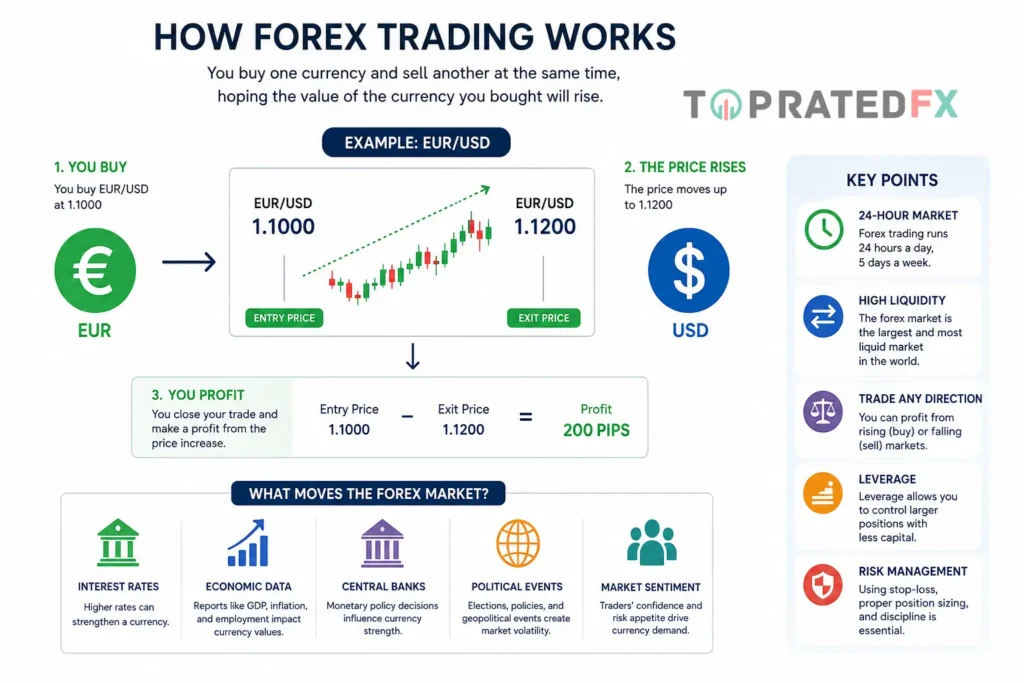
Forex prices fluctuate continuously due to changes in supply and demand.
Factors that affect currency values include:
- Interest rate decisions
- Inflation data
- Employment reports
- Economic growth
- Political events
- Central bank policies
- Global market sentiment
For example:
When the US Federal Reserve raises interest rates, the US Dollar often strengthens because investors seek higher returns from dollar-denominated assets.
Similarly, weak economic data may cause a currency to decline as investors move capital elsewhere.
Who Participates in the Forex Market?
The forex market includes a wide range of participants.
Central Banks
Central banks influence currency values through monetary policy decisions and market interventions.
Examples include:
- Federal Reserve
- European Central Bank
- Bank of England
Commercial Banks
Large banks facilitate currency transactions for clients and institutional investors.
Multinational Corporations
Businesses exchange currencies when conducting international trade and operations.
Hedge Funds and Institutions
Professional investors trade currencies to speculate, hedge risks, or diversify portfolios.
Retail Traders
Individual traders access the market through online brokers and trading platforms.
Over the past two decades, retail participation has increased significantly due to improved internet access and advanced trading technology.
Why Is Forex Trading Important?
Forex trading is far more than speculation. The foreign exchange market plays a critical role in the global economy by enabling international trade, investment, and cross-border transactions.
Without an efficient forex market, modern global commerce would struggle to function.
Facilitates International Trade
Companies regularly buy and sell goods across borders.
For example:
A manufacturer in Germany exporting products to the United States may receive payment in US Dollars but needs Euros to pay employees and suppliers.
The forex market allows that conversion to happen efficiently.
Supports Global Investment
Investors often allocate capital internationally.
A fund manager purchasing Japanese stocks from Europe may need to convert Euros into Japanese Yen before completing the investment.
Forex markets make these transactions possible.
Helps Manage Currency Risk
Businesses exposed to multiple currencies face exchange-rate risk.
Forex instruments allow companies to hedge against adverse currency fluctuations.
For example:
An airline expecting future fuel payments in US Dollars may hedge currency exposure to reduce uncertainty.
Creates Trading Opportunities
Price fluctuations generate opportunities for traders.
Because currencies respond to economic news, interest rates, inflation, and geopolitical developments, traders can potentially profit from both rising and falling markets.
Operates Around the Clock
One of the most attractive features of forex trading is its near-continuous trading schedule.
The market follows major financial centers around the world:
- Sydney
- Tokyo
- London
- New York
As one trading session closes, another opens.
This creates nearly 24-hour trading opportunities from Monday through Friday.
Key Facts About Forex Trading
Before opening a trading account, every beginner should understand the following facts.
Forex Is the Largest Financial Market in the World
The forex market is significantly larger than global stock markets.
Its enormous liquidity allows traders to enter and exit positions quickly under normal market conditions.
High liquidity also contributes to competitive pricing and tighter spreads on major currency pairs.
Forex Trading Takes Place Over the Counter (OTC)
Unlike stock exchanges with a centralized marketplace, forex trading occurs through a decentralized network of banks, brokers, and financial institutions.
Transactions are conducted electronically across global financial centers.
Major Currency Pairs Dominate Trading Volume
The most actively traded pairs typically include:
| Major Pair | Common Name |
|---|---|
| EUR/USD | Euro-Dollar |
| GBP/USD | Cable |
| USD/JPY | Dollar-Yen |
| USD/CHF | Dollar-Swiss |
| AUD/USD | Aussie |
| USD/CAD | Dollar-CAD |
These pairs generally offer:
- High liquidity
- Lower spreads
- Strong market participation
Leverage Can Amplify Both Profits and Losses
Many forex brokers provide leverage, allowing traders to control larger positions with smaller amounts of capital.
For example:
A trader with $1,000 may control a position worth $10,000 or more, depending on available leverage.
While leverage can increase potential profits, it can also magnify losses.
This is one of the primary reasons risk management is essential in forex trading.
Risk Management Is More Important Than Predictions
Many new traders focus exclusively on finding winning trades.
Experienced traders understand that long-term success depends more on:
- Position sizing
- Stop-loss placement
- Risk-to-reward ratios
- Capital preservation
- Trading discipline
A trader can be wrong multiple times and still remain profitable if risk is managed properly.
Economic News Drives Market Volatility
Certain events can create significant price movements, including:
- Interest rate decisions
- Inflation reports
- Non-Farm Payrolls (NFP)
- GDP releases
- Central bank speeches
Professional traders monitor economic calendars closely because these events often influence currency prices.
Forex Trading Requires Continuous Learning
The forex market constantly evolves.
Successful traders invest time in:
- Market analysis
- Economic research
- Trading psychology
- Risk management
- Strategy development
Those who treat trading as a skill to develop over time generally have a stronger foundation than those seeking quick profits.
How the Forex Market Works
Understanding what forex trading is becomes much easier once you learn how the market operates behind the scenes. Unlike traditional stock exchanges, the forex market is decentralized and functions through a global network of banks, brokers, institutions, and traders.
This structure allows participants from nearly every country to trade currencies electronically.
The Structure of the Forex Market
The forex market is often described as a hierarchy.
At the top are major financial institutions that facilitate enormous currency transactions every day. Below them are corporations, investment funds, brokers, and retail traders.
The market structure generally includes:
| Market Participant | Role |
|---|---|
| Central Banks | Influence monetary policy and currency values |
| Commercial Banks | Execute large currency transactions |
| Investment Funds | Speculate and hedge currency exposure |
| Corporations | Exchange currencies for international business |
| Forex Brokers | Provide market access to retail traders |
| Retail Traders | Trade currencies for personal profit |
Because forex trading occurs electronically, there is no single central exchange controlling all transactions.
Instead, prices are determined by supply and demand across the global financial system.
Forex Market Sessions
One reason forex trading is popular worldwide is that the market remains open nearly 24 hours a day during the trading week.
The market follows major financial centers around the world.
Sydney Session
The trading week typically begins in Sydney.
Characteristics:
- Lower volatility
- Strong activity in AUD pairs
- Often sets the tone for Asian trading
Tokyo Session
As Tokyo opens, activity increases across Asian markets.
Popular currency pairs include:
- USD/JPY
- AUD/JPY
- EUR/JPY
Economic news from Japan, China, and Australia often drives volatility during this session.
London Session
The London session is widely considered the most important forex trading session.
Why?
Because London accounts for a significant portion of global currency trading volume.
Characteristics include:
- High liquidity
- Strong price movements
- Heavy institutional participation
Many professional traders focus primarily on the London session.
New York Session
The New York session overlaps with London for several hours.
This overlap often produces:
- Increased volatility
- Higher trading volume
- Strong market momentum
Major US economic releases frequently occur during this period.
Best Trading Times
Generally, the highest liquidity occurs during the London-New York overlap.
This period often provides:
- Tighter spreads
- Better execution
- More trading opportunities
However, traders should choose trading hours that align with their strategy and lifestyle.
Understanding Currency Pairs
Every forex trade involves a currency pair.
A trader is always:
- Buying one currency
- Selling another currency
This relationship creates opportunities to profit from changes in exchange rates.
Major Currency Pairs
Major pairs contain the US Dollar and another highly traded currency.
Examples include:
| Pair | Currency Combination |
|---|---|
| EUR/USD | Euro / US Dollar |
| GBP/USD | British Pound / US Dollar |
| USD/JPY | US Dollar / Japanese Yen |
| USD/CHF | US Dollar / Swiss Franc |
| AUD/USD | Australian Dollar / US Dollar |
| USD/CAD | US Dollar / Canadian Dollar |
Major pairs generally offer:
- High liquidity
- Lower transaction costs
- Strong market participation
For beginners, major pairs are often the easiest starting point.
Minor Currency Pairs
Minor pairs do not include the US Dollar.
Examples:
- EUR/GBP
- EUR/JPY
- GBP/JPY
- AUD/NZD
Although liquidity remains relatively high, spreads may be slightly wider than major pairs.
Exotic Currency Pairs
Exotic pairs combine a major currency with a currency from an emerging economy.
Examples:
- USD/TRY
- USD/ZAR
- EUR/MXN
These pairs often experience:
- Larger price swings
- Lower liquidity
- Wider spreads
New traders should approach exotic pairs cautiously due to increased risk.
Understanding Exchange Rates
An exchange rate represents the value of one currency relative to another.
For example:
EUR/USD = 1.1200
This means:
1 Euro = 1.12 US Dollars.
If EUR/USD rises from 1.1200 to 1.1300, the Euro has strengthened against the Dollar.
If EUR/USD falls from 1.1200 to 1.1100, the Dollar has strengthened against the Euro.
Exchange rates move constantly due to changes in market expectations and economic conditions.
What Moves Currency Prices?
Many beginners assume that forex prices move randomly.
In reality, currencies respond to a wide range of economic and geopolitical factors.
Understanding these drivers helps traders make more informed decisions.
Interest Rates
Interest rates are among the most powerful drivers of currency values.
When a country’s interest rates rise:
- Foreign investment may increase
- Demand for the currency may grow
- Currency values often strengthen
Real-World Example
Suppose the United States raises interest rates while Europe keeps rates unchanged.
Many investors may move capital into US assets seeking higher returns.
As demand for Dollars increases, the US Dollar may strengthen against the Euro.
This could cause EUR/USD to decline.
Inflation
Inflation measures how quickly prices rise within an economy.
Generally:
- Lower inflation tends to support a currency.
- Higher inflation can weaken purchasing power.
Central banks closely monitor inflation because it influences monetary policy decisions.
Trading Scenario
If inflation in the United Kingdom rises significantly above expectations, traders may speculate that the central bank will raise interest rates.
This expectation alone could increase demand for the British Pound.
Employment Data
Labor market reports provide insight into economic health.
Strong employment data often suggests:
- Economic growth
- Consumer spending strength
- Potential interest-rate increases
In the United States, the Non-Farm Payrolls (NFP) report is one of the most closely watched economic releases.
Large surprises can trigger substantial forex volatility.
Economic Growth
Gross Domestic Product (GDP) measures economic output.
Strong GDP growth often indicates:
- Business expansion
- Increased investment
- Stronger economic fundamentals
Currencies of growing economies may attract investor interest.
Central Bank Decisions
Central banks play a crucial role in forex markets.
Traders carefully monitor:
- Interest-rate decisions
- Monetary policy statements
- Economic projections
- Press conferences
Even subtle changes in central bank language can move markets dramatically.
Political Events
Political developments frequently affect investor confidence.
Examples include:
- Elections
- Trade agreements
- Geopolitical conflicts
- Regulatory changes
Political uncertainty can increase volatility and influence currency flows.
Understanding Bid Price and Ask Price
Every forex quote contains two prices.
Bid Price
The bid price represents the highest price a buyer is willing to pay.
When traders sell, they transact at the bid price.
Ask Price
The ask price represents the lowest price a seller is willing to accept.
When traders buy, they transact at the ask price.
Spread
The difference between the bid and ask price is known as the spread.
Example:
| Bid | Ask |
|---|---|
| 1.1200 | 1.1202 |
Spread = 2 pips
The spread effectively represents a trading cost.
Major currency pairs generally have lower spreads due to higher liquidity.
Understanding Pips in Forex Trading
A pip is the standard unit used to measure price movement in most currency pairs.
For many pairs:
- 1 pip = 0.0001
Example:
EUR/USD moves from:
1.1000 → 1.1001
This equals a movement of 1 pip.
Why Pips Matter
Pips help traders:
- Measure profit and loss
- Calculate risk
- Set stop-loss levels
- Define profit targets
Professional traders often think in pips rather than dollars because pips provide a standardized measurement across markets.
Understanding Lots in Forex Trading
A lot represents the size of a forex transaction.
Common lot sizes include:
| Lot Type | Units |
|---|---|
| Standard Lot | 100,000 |
| Mini Lot | 10,000 |
| Micro Lot | 1,000 |
| Nano Lot | 100 |
Micro lots are often preferred by beginners because they allow smaller risk exposure.
Practical Example
Suppose a trader buys:
1 Micro Lot of EUR/USD
If the trade gains 50 pips, the profit will be significantly smaller than that of a trader using a Standard Lot.
This illustrates why position sizing is a critical part of risk management.
Understanding lot sizes helps traders control exposure and preserve capital while learning the market.
What Is Leverage in Forex Trading?
Leverage is one of the most discussed concepts in forex trading because it allows traders to control larger positions using a relatively small amount of capital.
While leverage can increase potential profits, it can also magnify losses. Therefore, understanding how leverage works is essential before placing any trade.
If you’re unfamiliar with leverage, read our complete guide on What Is Leverage in Trading before choosing your leverage settings.
How Leverage Works
Leverage is expressed as a ratio.
Examples:
| Leverage | Meaning |
|---|---|
| 1:10 | Control $10 for every $1 deposited |
| 1:50 | Control $50 for every $1 deposited |
| 1:100 | Control $100 for every $1 deposited |
| 1:500 | Control $500 for every $1 deposited |
For example:
A trader with $1,000 in account equity using 1:100 leverage may control a position worth up to $100,000.
However, this does not mean they should.
Professional traders often use only a fraction of the leverage available because protecting capital is more important than maximizing position size.
Learn more about the Best High Leverage Forex Brokers
Real-World Leverage Example
Imagine two traders each have a $1,000 account.
Trader A
- Uses moderate position sizing
- Risks 1% per trade
- Focuses on consistency
Trader B
- Uses maximum leverage
- Risks are a large portion of the account
- Seeks rapid gains
If the market moves unexpectedly, Trader B may experience substantial losses or even wipe out the account, while Trader A remains in the game.
This example highlights an important reality:
Successful traders survive long enough to benefit from opportunities. Excessive leverage often prevents that.
What Is Margin in Forex Trading?
Margin is the amount of money required to open and maintain a leveraged position.
Think of margin as a security deposit rather than a trading fee.
When a position is opened, the broker sets aside a portion of the account equity as margin.
Margin Example
Suppose:
- Position size = $10,000
- Required margin = 1%
Required margin:
$10,000 × 1% = $100
In this scenario, the trader only needs $100 of available margin to control a $10,000 position.
The remaining funds continue to act as a buffer against losses.
Margin Call
A margin call occurs when account equity falls below required levels.
When this happens, brokers may:
- Request additional funds
- Restrict new positions
- Automatically close losing trades
This mechanism helps prevent accounts from falling into negative balances.
Understanding margin is critical because many beginners focus solely on potential profits while overlooking capital requirements and risk exposure.
Types of Forex Market Analysis
Professional traders do not rely on guesses.
Instead, they analyze markets using structured methods to identify potential opportunities.
The three primary forms of forex analysis are:
- Fundamental Analysis
- Technical Analysis
- Sentiment Analysis
Many experienced traders combine all three approaches.
Fundamental Analysis
Fundamental analysis focuses on economic, political, and financial factors that influence currency values.
The goal is to determine whether a currency is likely to strengthen or weaken over time.
Key Economic Indicators
Forex traders commonly monitor:
Interest Rates
Interest-rate changes often influence global capital flows.
Higher rates can attract investment and strengthen a currency.
Inflation
Inflation affects purchasing power and central bank policy.
Unexpected inflation data frequently creates market volatility.
Employment Reports
Strong employment growth often signals economic strength.
Examples include:
- Non-Farm Payrolls (United States)
- Unemployment rates
- Wage growth reports
GDP Growth
Gross Domestic Product measures economic activity.
Stronger growth may support a country’s currency.
Retail Sales
Consumer spending is a major economic driver.
Strong retail sales often indicate healthy economic conditions.
Fundamental Analysis Example
Imagine:
- US inflation rises.
- Employment remains strong.
- The market expects future interest-rate increases.
Traders may anticipate a stronger U.S. dollar.
As a result:
- EUR/USD may decline.
- GBP/USD may decline.
- USD/JPY may rise.
This demonstrates how economic expectations influence forex prices before official policy changes occur.
Technical Analysis
It studies historical price data to identify patterns and trading opportunities.
Technical traders believe market behavior often repeats because human psychology remains relatively consistent.
Common Technical Analysis Tools
Support and Resistance
Support is an area where buying pressure may emerge.
Resistance is an area where selling pressure may appear.
Example:
If EUR/USD repeatedly bounces from 1.1000, traders may view that level as support.
Trend Analysis
Markets generally move in one of three directions:
| Trend Type | Description |
|---|---|
| Uptrend | Higher highs and higher lows |
| Downtrend | Lower highs and lower lows |
| Range | Sideways movement |
Many professional traders prefer trading in the direction of the prevailing trend.
Moving Averages
Moving averages help smooth price fluctuations.
Popular examples include:
- 20-period moving average
- 50-period moving average
- 200-period moving average
These indicators are frequently used to identify trend direction.
Candlestick Patterns
Candlestick formations provide insight into market sentiment.
Examples include:
- Bullish Engulfing
- Bearish Engulfing
- Hammer
- Shooting Star
- Doji
While no pattern guarantees success, traders often combine candlestick analysis with broader market context.
Sentiment Analysis
Sentiment analysis evaluates how traders collectively feel about the market.
Markets often move based on expectations rather than current conditions.
Questions traders ask include:
- Are investors optimistic?
- Are investors fearful?
- Is risk appetite increasing?
- Are traders seeking safe-haven assets?
For example:
During periods of financial uncertainty, traders may favor currencies traditionally considered safer, such as the US Dollar or Swiss Franc.
Understanding market sentiment can help traders identify trends before they become obvious.
How Traders Make Money in Forex
Many beginners assume profits come only when markets rise.
Forex trading is different because traders can potentially profit from both upward and downward price movements.
Buying (Going Long)
A trader buys when expecting a currency pair to rise.
Example
Entry:
EUR/USD = 1.1000
Exit:
EUR/USD = 1.1200
Result:
Profit from the increase in value.
Selling (Going Short)
A trader sells when expecting a currency pair to fall.
Example
Entry:
GBP/USD = 1.3000
Exit:
GBP/USD = 1.2800
Result:
Profit from the decline.
This ability to trade both directions is one reason forex markets attract active traders.
Common Forex Trading Styles
Different traders approach the market differently.
The best style depends on:
- Available time
- Risk tolerance
- Personality
- Trading objectives
Scalping
Scalpers seek small profits from numerous trades.
Characteristics:
- Very short holding periods
- High trade frequency
- Focus on liquidity and execution speed
Scalping requires discipline and rapid decision-making.
Learn more about the Best Scalping Forex Brokers
Day Trading
Day traders open and close positions within the same trading day.
Advantages include:
- No overnight risk
- Frequent opportunities
- Structured trading routine
Many retail traders begin with day trading because it balances activity and risk.
Take a look at the Best Brokers for Day Trading
Swing Trading
Swing traders hold positions for several days or weeks.
Characteristics:
- Focus on larger market moves
- Less screen time
- Greater emphasis on broader trends
This approach is popular among traders with full-time jobs.
Position Trading
Position traders maintain trades for weeks, months, or even years.
They often rely heavily on:
- Economic trends
- Monetary policy
- Long-term market outlooks
Position trading resembles investing more than active trading.
The Advantages of Forex Trading
Forex trading remains popular for several reasons.
High Liquidity
Major currency pairs can usually be traded quickly under normal market conditions.
Low Barrier to Entry
Many brokers allow traders to start with relatively small deposits.
Global Accessibility
The forex market is accessible from almost anywhere with an internet connection.
Flexible Trading Hours
The market operates nearly 24 hours per day during the trading week.
Ability to Trade Rising and Falling Markets
Traders can potentially profit from bullish and bearish price movements.
Wide Range of Trading Opportunities
Economic events, interest-rate decisions, and geopolitical developments create ongoing opportunities throughout the year.
The Risks of Forex Trading
While many educational resources focus on the opportunities available in the foreign exchange market, understanding the risks is equally important.
Professional traders spend as much time managing risk as they do searching for trading opportunities.
Forex trading is not a guaranteed path to profits. Like any financial market, losses are part of the process.
Market Risk
Market risk refers to the possibility that a currency pair moves against your position.
Example
A trader buys EUR/USD expecting the Euro to strengthen.
Instead, unexpected economic data boosts demand for the US Dollar.
EUR/USD falls sharply.
The trader experiences a loss because the market moved in the opposite direction.
No trading strategy can eliminate market risk completely.
However, proper risk management can significantly reduce its impact.
Leverage Risk
Leverage can amplify gains, but it also increases potential losses.
This is one of the main reasons many inexperienced traders struggle.
Example
A trader opens a position that is too large relative to the account size.
A relatively small market movement causes a substantial percentage loss.
Even if the trader’s overall market idea was reasonable, excessive leverage may result in significant damage to the account.
Professional traders often prioritize position sizing over maximizing returns.
Volatility Risk
Currency prices can move rapidly after major economic announcements or geopolitical events.
Examples include:
- Central bank decisions
- Inflation reports
- Employment data
- Elections
- Unexpected geopolitical developments
Periods of high volatility may produce:
- Larger price swings
- Increased slippage
- Faster stop-loss execution
Traders should be particularly cautious during major news releases.
Psychological Risk
Many trading failures stem from emotional decision-making rather than poor market analysis.
Common psychological mistakes include:
- Revenge trading
- Fear of missing out (FOMO)
- Overtrading
- Moving stop-loss orders
- Holding losing positions too long
- Closing winning trades too early
Real-World Scenario
A trader loses three consecutive trades.
Instead of following the trading plan, they increase position size to recover losses quickly.
A fourth loss occurs.
The account drawdown becomes much larger than necessary.
This is a classic example of emotional trading overriding risk management.
Broker Risk
Choosing an unreliable broker can expose traders to unnecessary risks.
Potential issues include:
- Poor execution quality
- Withdrawal delays
- Lack of transparency
- Weak regulatory oversight
Before opening an account, traders should carefully evaluate:
- Regulation
- Trading costs
- Platform reliability
- Customer support
- Account protection policies
Selecting a reputable broker is an important part of the trading process.
Find Best Forex Brokers
Forex Trading vs Stock Trading
Many beginners compare forex trading with stock trading before deciding which market suits their goals.
Both markets offer opportunities, but they differ significantly in structure and behavior.
Key Differences
| Feature | Forex Trading | Stock Trading |
|---|---|---|
| Asset Traded | Currencies | Company Shares |
| Market Hours | Nearly 24 Hours | Exchange-Specific Hours |
| Liquidity | Extremely High | Varies by Stock |
| Number of Instruments | Limited Currency Pairs | Thousands of Stocks |
| Leverage Availability | Often Higher | Usually Lower |
| Economic Influence | Very High | Moderate to High |
| Company-Specific Risk | Low | High |
Forex Trading Advantages Compared to Stocks
Forex traders often benefit from:
- Greater liquidity
- Lower capital requirements
- More flexible trading hours
- Easier access to global markets
- Ability to trade both directions efficiently
Stock Trading Advantages Compared to Forex
Stock investors may benefit from:
- Long-term capital appreciation
- Dividend income
- Ownership in companies
- Exposure to business growth
Neither market is inherently better.
The right choice depends on a trader’s objectives, personality, and risk tolerance.
Forex Trading vs Cryptocurrency Trading
Cryptocurrency trading has gained significant popularity in recent years.
However, the forex and crypto markets have important differences.
Comparison Table
| Feature | Forex | Cryptocurrency |
|---|---|---|
| Market Maturity | Highly Established | Relatively New |
| Regulation | More Developed | Varies Widely |
| Volatility | Moderate | Often Extreme |
| Liquidity | Extremely High | Varies by Asset |
| Trading Instruments | National Currencies | Digital Assets |
| Institutional Participation | Extensive | Growing |
Volatility Comparison
Major currency pairs rarely experience the same percentage swings commonly seen in cryptocurrencies.
For example:
A major forex pair might move 1% in a day and attract significant attention.
Certain cryptocurrencies may move 10% or more within hours.
This difference makes risk management especially important in crypto markets.
Essential Forex Trading Terms Every Beginner Should Know
New traders often encounter unfamiliar terminology.
Understanding these concepts creates a stronger foundation for future learning.
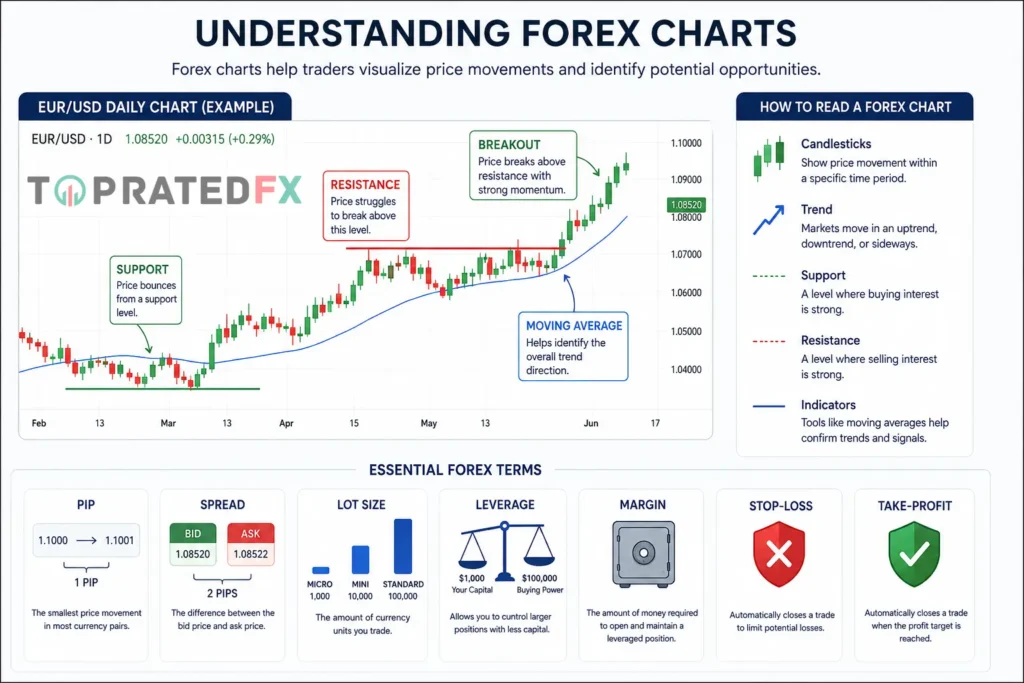
Pip
The standard measurement of price movement.
Example:
EUR/USD moves from 1.1000 to 1.1001.
Movement = 1 pip.
Use our Pip Value Calculator tool
Spread
The difference between the bid and ask price.
The spread represents a trading cost.
Lot
A standardized trading volume.
Common types:
- Standard Lot
- Mini Lot
- Micro Lot
Margin
The capital required to open a leveraged position.
Leverage
A mechanism allowing traders to control larger positions with smaller amounts of capital.
Stop-Loss Order
An instruction that automatically closes a trade when the price reaches a predetermined loss level.
Stop-loss orders help protect capital.
Take-Profit Order
An instruction that automatically closes a trade once a profit target is reached.
Liquidity
The ease with which an asset can be bought or sold without significantly affecting the price.
Major currency pairs typically offer high liquidity.
Volatility
The degree of price fluctuation within a market.
Higher volatility generally means greater potential risk and opportunity.
How Beginners Can Start Forex Trading
Many new traders focus immediately on profits.
A better approach is to focus first on education, risk management, and process development.
Step 1: Learn the Fundamentals
Before risking money, understand:
- Currency pairs
- Market structure
- Risk management
- Economic drivers
- Trading terminology
Building a strong foundation can help prevent costly beginner mistakes.
Step 2: Choose a Reputable Forex Broker
Key factors to evaluate include:
- Regulation
- Trading costs
- Available markets
- Platform quality
- Customer support
- Deposit and withdrawal methods
A broker should be viewed as a long-term business partner, not simply a place to place trades.
Step 3: Open a Demo Account
A demo account allows traders to practice without risking real capital.
Benefits include:
- Learning platform functionality
- Testing strategies
- Developing confidence
- Understanding market behavior
Many experienced traders still use demo accounts when testing new ideas.
Step 4: Develop a Trading Plan
A trading plan should define:
- Entry criteria
- Exit criteria
- Risk per trade
- Trading hours
- Position sizing rules
Without a plan, traders often make inconsistent decisions.
Step 5: Learn Risk Management
Risk management should always come before profit targets.
Important principles include:
- Risking only a small percentage of capital per trade
- Using stop-loss orders
- Avoiding excessive leverage
- Maintaining realistic expectations
Many successful traders focus first on protecting capital.
Step 6: Start Small
Even after moving to a live account, traders should begin with modest position sizes.
Starting small helps:
- Reduce emotional pressure
- Preserve capital
- Build experience gradually
The goal is long-term consistency, not immediate profits.
learn more about the Best Forex Brokers for Beginners
Common Beginner Mistakes in Forex Trading
Understanding common mistakes can accelerate the learning process.
Trading Without a Plan
Random entries often lead to inconsistent results.
Risking Too Much Capital
Overexposure can quickly damage an account.
Overtrading
More trades do not necessarily mean better results.
Quality generally matters more than quantity.
Ignoring Stop-Loss Orders
Failing to define risk can lead to large losses.
Chasing Losses
Attempting to recover losses immediately often creates additional problems.
Expecting Quick Riches
Forex trading is a skill that requires education, practice, and discipline.
Professional traders typically focus on consistency rather than short-term excitement.
Following Unverified Signals
Blindly copying others without understanding the reasoning behind trades can be dangerous.
Independent analysis and education remain essential for long-term success.
Best Practices for Long-Term Forex Trading Success
After understanding what forex trading is, many beginners immediately search for the “best strategy.”
However, long-term success rarely comes from a single indicator, system, or trading setup.
The traders who remain profitable over the years typically focus on consistency, discipline, and continuous improvement.
Treat Trading Like a Business
One of the biggest differences between successful and unsuccessful traders is mindset.
Professional traders approach the market as a business.
They:
- Track performance
- Analyze results
- Follow written rules
- Manage risk carefully
- Focus on long-term growth
By contrast, traders who treat forex as gambling often make emotional decisions that lead to unnecessary losses.
Keep a Trading Journal
A trading journal helps identify strengths and weaknesses.
Important information to record includes:
| Journal Element | Purpose |
|---|---|
| Entry Price | Evaluate timing |
| Exit Price | Measure execution quality |
| Stop-Loss Level | Assess risk management |
| Trade Reason | Verify strategy adherence |
| Market Conditions | Improve future decisions |
| Emotional State | Identify psychological patterns |
Over time, a journal becomes one of the most valuable learning tools available to a trader.
Focus on Risk-to-Reward Ratios
Professional traders understand that winning every trade is impossible.
Instead, they focus on maintaining favorable risk-to-reward ratios.
Example
Trade A:
- Risk = $100
- Potential Reward = $300
Risk-to-Reward Ratio:
1:3
Even if only half of such trades succeed, a trader may remain profitable over time.
This principle is one reason risk management often matters more than prediction accuracy.
Avoid Strategy Hopping
Many beginners constantly switch between indicators and trading systems.
A typical pattern looks like this:
- Use a strategy for one week.
- Experience a few losses.
- Abandon the strategy.
- Search for a new one.
- Repeat the cycle.
The problem is that every legitimate strategy experiences losing trades.
Without sufficient testing and execution, it becomes impossible to determine whether a strategy truly has an edge.
Continue Learning
Financial markets evolve continuously.
Successful traders regularly study:
- Macroeconomic trends
- Central bank policy
- Technical analysis
- Risk management
- Trading psychology
The learning process never fully ends.
Even experienced market participants continue refining their skills.
FAQ
Forex trading is the buying and selling of currencies to profit from changes in exchange rates.
For example, a trader may buy Euros and sell US Dollars if they believe the Euro will increase in value.
Forex trading can be suitable for beginners if they start with education, use a demo account, and apply proper risk management.
Jumping directly into live trading without preparation often leads to avoidable losses.
The amount varies by broker and trading style.
Many brokers allow accounts to be opened with relatively small deposits.
However, having sufficient capital and realistic expectations is important for effective risk management.
Yes, traders can potentially make money in the forex market.
However, profits are never guaranteed.
Yes.
Forex trading involves significant risk, especially when leverage is used improperly.
Losses are possible on every trade.
This is why risk management is a fundamental component of successful trading.
Many beginners start with major currency pairs like EUR/USD, GBP/USD, and USD/JPY because they generally offer High liquidity and Lower spreads.
These pairs are among the most actively traded in the world.
Neither market is universally better.
Forex trading may appeal to traders who prefer:
– High liquidity
– Flexible hours
– Active trading opportunities
Stock trading may appeal to investors seeking:
– Long-term growth
– Dividend income
– Company ownership
The best choice depends on individual goals and preferences.
Some traders eventually transition to full-time trading.
Most successful traders spend years developing their skills before considering trading as a primary source of income
Final Thoughts
So, what is forex trading?
Forex trading is the process of buying one currency and selling another in an attempt to profit from changes in exchange rates. It is the foundation of the global foreign exchange market, which connects governments, banks, multinational corporations, institutional investors, and retail traders around the world.
The forex market offers unique advantages, including exceptional liquidity, nearly 24-hour market access, and opportunities in both rising and falling markets. At the same time, it involves meaningful risks that require careful management.
For beginners, the most important lesson is that successful forex trading is not about predicting every market move correctly. Instead, long-term success comes from understanding how the market works, managing risk effectively, maintaining discipline, and continuously improving your knowledge and skills.
Whether your goal is to become an active trader, diversify your investment knowledge, or better understand global financial markets, learning the fundamentals of forex trading provides a valuable foundation for making informed decisions.
As with any financial endeavor, education should come before execution. The traders who invest time in learning, planning, and risk management are generally better positioned to navigate the opportunities and challenges of the world’s largest financial market.
Key Takeaways
- Forex trading involves exchanging one currency for another to profit from exchange-rate movements.
- The forex market is the largest and most liquid financial market in the world.
- Currencies are traded in pairs such as EUR/USD and GBP/USD.
- Exchange rates are influenced by interest rates, inflation, economic growth, and market sentiment.
- Traders use fundamental, technical, and sentiment analysis to evaluate opportunities.
- Leverage can increase both profits and losses.
- Risk management is essential for long-term success.
- Major currency pairs are often the most suitable starting point for beginners.
- Forex trading offers flexibility and accessibility but requires education and discipline.
- Consistency, patience, and continuous learning are critical for sustainable trading performance.