

Forex trading is often promoted as a simple way to make money online. Social media is filled with screenshots of winning trades, luxury lifestyles, and promises of quick profits. However, the reality is very different.
Professional traders understand that forex trading is a skill that requires education, practice, risk management, and emotional discipline. Like any profession, success comes from developing a structured process rather than chasing shortcuts.
For beginners, the biggest challenge is not opening a trading account. The challenge is learning how to navigate the market without making the costly mistakes that cause most new traders to lose money.
The good news is that forex trading has never been more accessible. Modern trading platforms, educational resources, and demo accounts allow anyone with an internet connection to learn the market before risking real capital.
In this guide, we’ll walk through the exact steps beginners should take to build a solid foundation, choose the right broker, practice effectively, manage risk, and prepare for their first live trade.
By the end of this guide at TopRatedFX, you’ll have a clear roadmap for starting your forex trading journey the right way.
If you’re completely new to the market, start by learning What is Forex Trading before opening your first trading account.
Why Most Beginner Forex Traders Fail
One of the biggest misconceptions about forex trading is that beginners fail because they lack a profitable strategy.
In reality, strategy is rarely the primary reason.
Most beginner traders fail because they skip the fundamentals.
Understanding these common mistakes can help you avoid them from the start.
They Start Trading Without Education
Many new traders open a trading account after watching a few videos or seeing success stories online.
They enter trades without understanding:
- Market structure
- Risk management
- Position sizing
- Trading psychology
- Economic events
As a result, they often treat trading like gambling rather than investing.
Real-World Scenario
A beginner deposits $500 and immediately starts trading using maximum leverage.
After several losing trades, the account balance falls by 50%.
Instead of reviewing mistakes, the trader increases risk to recover losses quickly.
Within days, the account is wiped out.
This scenario is extremely common among inexperienced traders.
They Risk Too Much Per Trade
Professional traders focus on preserving capital.
Beginners often focus only on potential profits.
This leads to excessive position sizes and unnecessary risk.
Example
Two traders each have a $1,000 account.
Trader A risks:
20% per trade
Trader B risks:
1% per trade
After five consecutive losses:
| Trader | Remaining Capital |
|---|---|
| Trader A | Severe Drawdown |
| Trader B | Most Capital Preserved |
The difference is dramatic.
Risk management often determines survival more than strategy quality.
They Ignore Trading Psychology
The market constantly tests emotions.
Common emotional mistakes include:
- Fear
- Greed
- Revenge trading
- Overconfidence
Many beginners know how to enter trades but struggle to manage emotions once real money is involved.
Example
A trader follows their strategy and enters a valid trade.
The position moves slightly against them.
Fear causes them to close the trade early.
Minutes later, the market moves exactly as predicted.
Without emotional control, even good analysis can produce poor results.
They Search for the Perfect Strategy
Many beginners jump from strategy to strategy.
One week, they trade breakouts.
The next week, they trade support and resistance.
Then they switch to indicators.
Soon after, they try automated systems.
This cycle prevents traders from gathering enough data to determine whether a strategy actually works.
Successful traders typically master one approach before experimenting with others.
They Use Excessive Leverage
Leverage can increase profit potential.
However, it also magnifies losses.
Many beginners underestimate this risk.
A small adverse price movement can quickly result in significant losses when leverage is used irresponsibly.
Professional traders often prioritize risk control over maximizing leverage.
If you’re unfamiliar with leverage, read our complete guide on What Is Leverage in Trading before choosing your leverage settings.
What You Need Before You Start Trading Forex
Before placing your first trade, there are several important requirements every beginner should understand.
These requirements go far beyond simply opening a trading account.
Trading Capital
Forex trading should only be funded with money you can afford to lose.
This does not mean expecting losses.
It means avoiding situations where trading losses affect essential expenses, such as:
- Rent
- Mortgage payments
- Food
- Utilities
- Emergency savings
Many successful traders begin with relatively small accounts while focusing on skill development.
A Reliable Internet Connection
Forex markets move quickly.
Execution delays can create unnecessary problems.
A stable internet connection helps ensure:
- Faster order execution
- Reliable chart access
- Smooth platform performance
While this may seem obvious, technical issues can affect trading results.
A Trading Platform
A trading platform is the software used to analyze markets and place trades.
Most brokers offer platforms that include:
- Price charts
- Technical indicators
- Order management tools
- Economic calendars
- Mobile applications
Beginners should spend time learning platform functionality before trading live.
A Risk Management Mindset
The most important tool in trading is not an indicator.
It is the ability to manage risk consistently.
Professional traders ask:
“How much can I lose?”
before asking:
“How much can I make?”
Adopting this mindset early can dramatically improve long-term survival in the market.
A Willingness to Learn
Forex trading is not a one-time learning process.
Markets evolve continuously.
Economic conditions change.
Central bank policies shift.
New opportunities emerge.
The traders who succeed long-term are typically those who remain students of the market throughout their careers.
Building this mindset from the beginning creates a strong foundation for future growth.
Step 1: Choose a Regulated Forex Broker
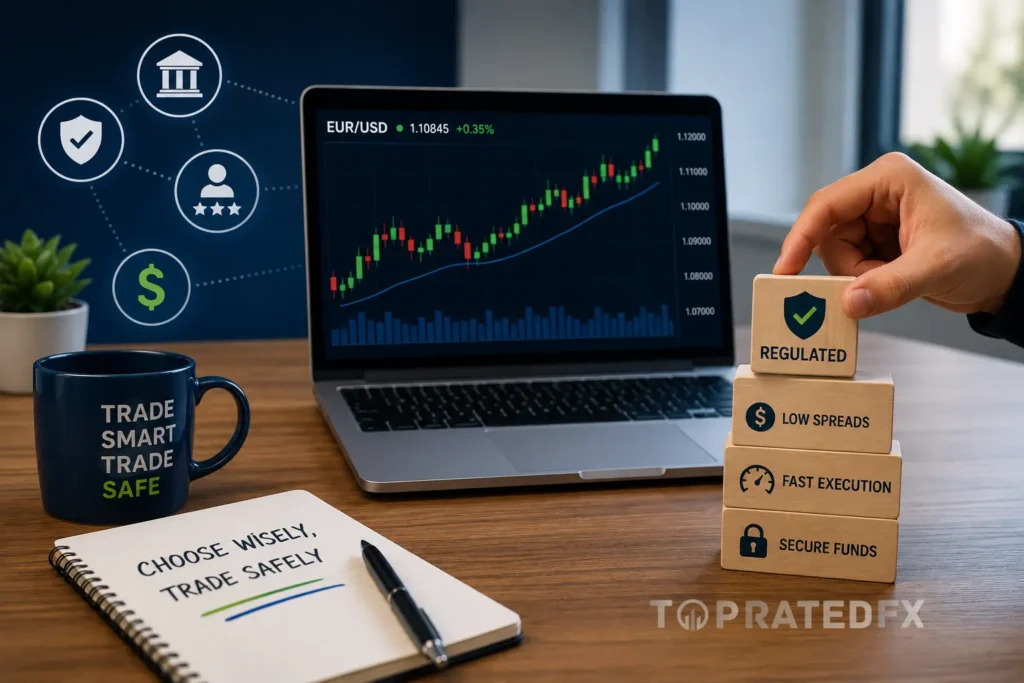
Choosing the right broker is one of the most important decisions you’ll make as a beginner trader.
A broker acts as the bridge between you and the forex market. Every trade you place, every chart you analyze, and every dollar you deposit passes through that broker.
Therefore, selecting a reliable broker can significantly improve your trading experience, while choosing the wrong broker can create unnecessary risks.
Why Broker Selection Matters
Many beginners focus only on bonuses or high leverage offers.
However, experienced traders evaluate brokers differently.
They prioritize:
- Regulation
- Security of funds
- Trading costs
- Execution quality
- Platform reliability
- Customer support
A trustworthy broker helps create a stable environment for learning and trading.
Check Regulation First
The first thing you should verify is whether a broker is regulated by a recognized financial authority.
Regulation helps ensure that brokers follow specific standards regarding:
- Client fund protection
- Financial reporting
- Operational transparency
- Fair business practices
Some of the most respected regulators include:
| Regulator | Region |
|---|---|
| FCA | United Kingdom |
| ASIC | Australia |
| CySEC | Europe |
| FSCA | South Africa |
| CFTC & NFA | United States |
As a beginner, it’s generally safer to choose a broker regulated by at least one reputable authority.
Red Flag
If a broker provides little or no information about regulation, proceed with caution.
Evaluate Trading Costs
Every trade involves costs.
These costs directly affect profitability, especially for beginners with smaller accounts.
Common trading costs include:
Spreads
The spread is the difference between the buy and sell prices.
Example:
EUR/USD
- Buy: 1.1002
- Sell: 1.1000
Spread = 2 pips
Lower spreads generally mean lower trading costs.
Commissions
Some brokers charge a fixed commission per trade.
Others incorporate costs directly into the spread.
Swap Fees
Swap fees may apply when positions remain open overnight.
Long-term traders should pay particular attention to these charges.
Compare Trading Platforms
Your trading platform will become your daily workspace.
A good platform should provide:
- Fast execution
- Reliable charting
- Technical indicators
- Risk management tools
- Mobile access
Features Beginners Should Look For
| Feature | Importance |
|---|---|
| User-Friendly Interface | High |
| Charting Tools | High |
| Mobile Trading | Medium |
| One-Click Trading | Medium |
| Economic Calendar | High |
| Demo Account Availability | High |
A platform should feel intuitive and easy to navigate.
Test Customer Support
Many beginners overlook customer support.
However, support becomes extremely important when:
- Depositing funds
- Withdrawing profits
- Solving technical issues
- Understanding account settings
Before opening an account, test support by asking a few questions.
Pay attention to:
- Response time
- Accuracy
- Professionalism
Reliable support often reflects a broker’s overall quality.
Read Independent Reviews
Broker websites naturally highlight their strengths.
Therefore, it’s useful to read independent reviews and user feedback.
Look for recurring comments about:
- Withdrawal speed
- Platform stability
- Customer service
- Hidden fees
One complaint may be isolated.
Hundreds of similar complaints may indicate a pattern.
Broker Checklist for Beginners
Before opening an account, ask yourself:
- Is the broker regulated?
- Are trading costs competitive?
- Does it offer a demo account?
- Is customer support responsive?
- Does the platform feel easy to use?
- Are deposits and withdrawals straightforward?
If the answer is yes to all of these questions, the broker may be a good candidate for further evaluation.
Compare several Best Brokers and read independent Forex Broker Reviews before opening an account.
Step 2: Open a Demo Trading Account
Once you’ve selected a broker, the next step is opening a demo account.
Many beginners are eager to start trading with real money immediately.
However, experienced traders usually recommend practicing in a demo environment first.
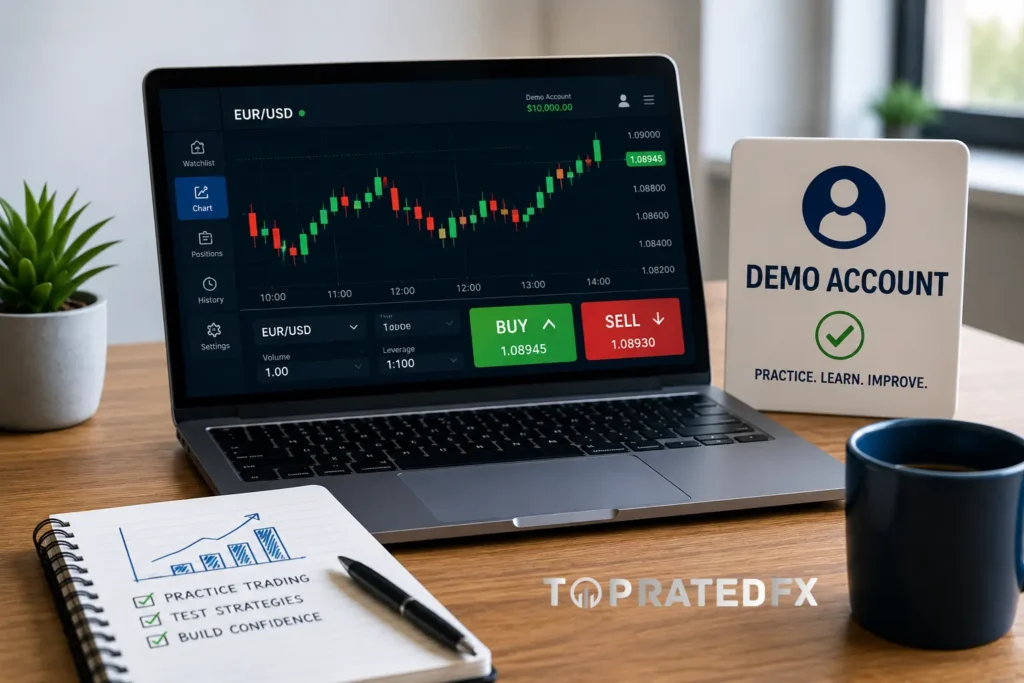
A demo account allows you to trade using virtual funds while experiencing real market conditions.
As a result, you can learn the mechanics of trading without risking actual capital.
What Is a Demo Account?
A demo account simulates a live trading environment.
The prices are real.
The charts are real.
The trading platform is real.
The only difference is that the funds are virtual.
This allows beginners to gain practical experience before committing real money.
Benefits of Demo Trading
A demo account provides several important advantages.
Learn the Trading Platform
Every platform contains numerous tools and features.
For example:
- Opening positions
- Modifying orders
- Setting stop-losses
- Setting take-profits
- Managing risk
A demo account allows you to learn these functions safely.
Practice Without Financial Pressure
One of the biggest challenges in trading is managing emotions.
Although demo trading cannot fully replicate live trading psychology, it still allows beginners to focus on developing technical skills.
You can:
- Test ideas
- Make mistakes
- Learn platform functionality
without losing money.
Build Confidence
Confidence develops through repetition.
The more experience you gain placing trades and analyzing markets, the more comfortable you become with the process.
Demo trading provides valuable screen time that accelerates learning.
How Long Should Beginners Use a Demo Account?
There is no universal answer.
However, many successful traders recommend remaining on a demo account until:
- You understand platform functions.
- You follow a trading plan consistently.
- You understand risk management.
- You achieve stable results over time.
The goal is not perfection.
The goal is consistency.
Common Demo Trading Mistakes
Ironically, many beginners misuse demo accounts.
Trading Unrealistic Position Sizes
Some traders risk massive amounts because the money is not real.
This creates habits that become dangerous in live trading.
Ignoring Risk Management
Because losses are virtual, beginners often skip stop-loss orders.
Unfortunately, this behavior can carry over into live trading.
Switching Strategies Constantly
Some traders test a new strategy every few days.
As a result, they never collect enough data to evaluate performance accurately.
How to Use a Demo Account Correctly
Treat your demo account exactly like a live account.
This means:
- Following a trading plan
- Using realistic position sizes
- Setting stop-loss orders
- Recording trades in a journal
- Reviewing performance regularly
The closer your demo habits resemble live trading habits, the more valuable the experience becomes.
Demo Account vs Live Account
| Feature | Demo Account | Live Account |
|---|---|---|
| Real Market Prices | Yes | Yes |
| Financial Risk | No | Yes |
| Emotional Pressure | Low | High |
| Learning Opportunity | High | High |
| Capital Required | None | Yes |
Both account types play important roles.
However, beginners should view demo trading as preparation rather than a shortcut.
Learning the platform, developing discipline, and testing strategies in a risk-free environment can significantly improve your readiness for live trading.
Step 3: Learn How to Read Forex Charts
Before placing your first trade, you must understand how to read a forex chart.
Charts are the primary tool traders use to analyze market movements, identify trends, and find potential trading opportunities.
Without chart-reading skills, trading becomes little more than guessing.
Fortunately, beginners only need to master a few key concepts to get started.
Understanding Forex Price Charts
A forex chart shows how the price of a currency pair changes over time.
For example, an EUR/USD chart displays the exchange rate between the Euro and the US Dollar.
Traders use charts to answer questions such as:
- Is the market trending higher?
- Is the market trending lower?
- Where are buyers entering?
- Where are sellers entering?
- Is now a good time to trade?
Types of Forex Charts
Most trading platforms offer several chart types.
However, beginners should focus on candlestick charts.
Line Charts
Line charts connect closing prices with a single line.
Advantages:
- Easy to read
- Good for identifying trends
Disadvantages:
- Limited information
- Less useful for active trading
Bar Charts
Bar charts provide more information than line charts.
Each bar shows:
- Open price
- High price
- Low price
- Close price
However, many beginners find them difficult to read.
Candlestick Charts
Candlestick charts are the most popular choice among traders.
Each candlestick shows:
- Opening price
- Closing price
- Highest price
- Lowest price
Bullish Candle
A bullish candle forms when the price closes higher than it opens.
This indicates buying pressure.
Bearish Candle
A bearish candle forms when the price closes lower than it opens.
This indicates selling pressure.
Because candlestick charts clearly display market sentiment, most professional traders rely on them daily.
Understanding Timeframes
A timeframe determines how much market activity each candlestick represents.
Common timeframes include:
| Timeframe | Use Case |
|---|---|
| 1 Minute | Scalping |
| 5 Minutes | Short-Term Trading |
| 15 Minutes | Day Trading |
| 1 Hour | Intraday Analysis |
| 4 Hours | Swing Trading |
| Daily | Long-Term Analysis |
| Weekly | Position Trading |
Beginner Recommendation
Many new traders perform best using:
- 4-Hour Charts
- Daily Charts
These timeframes reduce market noise and encourage patience.
Understanding Trends
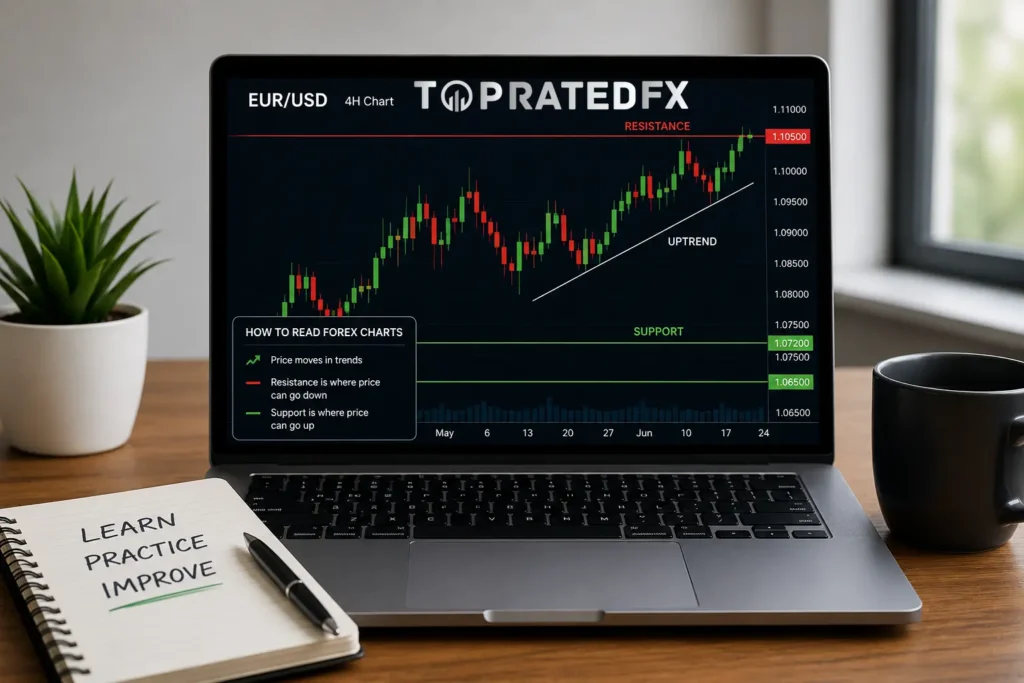
A trend is the overall direction of the market.
Uptrend
An uptrend forms when the price creates:
- Higher highs
- Higher lows
This suggests buyers are in control.
Downtrend
A downtrend forms when the price creates:
- Lower highs
- Lower lows
This suggests sellers are in control.
Sideways Market
Sometimes, prices move within a range.
In this situation:
- Buyers and sellers are balanced.
- Clear trends are absent.
Recognizing market conditions helps traders avoid unnecessary trades.
Support and Resistance
They are two of the most important concepts in technical analysis.
Support
It is a price level where buying pressure tends to appear.
Historically, the price struggles to move below this level.
Resistance
Resistance is a price level where selling pressure tends to appear.
Historically, the price struggles to move above this level.
Practical Example
Suppose EUR/USD repeatedly bounces from 1.1000.
Many traders identify this level as support.
If the price approaches 1.1000 again, traders may look for buying opportunities.
Similarly, if EUR/USD repeatedly fails near 1.1200, traders may view that area as resistance.
Support and resistance help traders identify potential entry and exit points.
Step 4: Place Your First Forex Trade
Once you understand chart basics, you can begin learning how trades are executed.
This section walks through a realistic beginner-friendly trade example.
Remember:
The goal is not to make money immediately.
The goal is to learn the trading process correctly.
Choose a Currency Pair
Most beginners start with EUR/USD because it offers:
- High liquidity
- Low spreads
- Extensive educational coverage
- Stable trading conditions
For this example, we’ll use EUR/USD.
Identify Market Direction
Imagine EUR/USD has been creating:
- Higher highs
- Higher lows
This suggests an uptrend.
Instead of selling against the trend, a beginner trader may look for buying opportunities.
Following the trend often improves probabilities.
Determine Your Entry Price
Suppose EUR/USD pulls back toward a support level.
The trader decides to enter at:
1.1000
This becomes the entry price.
Set a Stop-Loss Order
Before entering the trade, risk should be defined.
Suppose support exists near:
1.0950
The trader places a stop-loss at:
1.0950
Risk:
50 pips
This means losses are limited if the market moves against the trade.
Set a Take-Profit Target
The trader identifies a resistance level near:
1.1100
Take-Profit:
1.1100
Potential Reward:
100 pips
Evaluate Risk-to-Reward Ratio
Risk:
50 pips
Reward:
100 pips
Risk-to-Reward Ratio:
2:1
Many experienced traders seek setups that offer at least a 1:2 ratio.
This allows profitable trading even when some trades lose.
Real EUR/USD Trade Walkthrough
Let’s walk through the complete process.
| Trade Element | Value |
|---|---|
| Currency Pair | EUR/USD |
| Trade Direction | Buy |
| Entry Price | 1.1000 |
| Stop-Loss | 1.0950 |
| Take-Profit | 1.1100 |
| Risk | 50 Pips |
| Reward | 100 Pips |
| Risk-to-Reward | 1:2 |
Scenario 1: Winning Trade
Price rises from:
1.1000 → 1.1100
Result:
+100 pips
The trade automatically closes at the take-profit level.
Scenario 2: Losing Trade
Price falls from:
1.1000 → 1.0950
Result:
-50 pips
The stop-loss closes the trade automatically.
While nobody enjoys losses, protecting capital is a critical part of successful trading.
Why Planning Before Entry Matters
Many beginners enter trades first and think about risk later.
Professional traders do the opposite.
Before entering any position, they know:
- Entry price
- Stop-loss level
- Take-profit level
- Position size
- Maximum risk
This structured approach helps remove emotion from decision-making.
Beginner Trading Checklist
Before entering any trade, ask yourself the following questions.
Market Analysis Checklist
- Is the market trending?
- Have I identified support and resistance?
- Does this trade align with my strategy?
- Have I checked the upcoming economic news?
Risk Management Checklist
- Is my risk limited to 1% or less?
- Have I set a stop-loss?
- Have I calculated position size correctly?
- Is the risk-to-reward ratio acceptable?
Psychology Checklist
- Am I calm and focused?
- Am I following my trading plan?
- Am I trading because of a valid setup?
- Am I avoiding revenge trading?
Final Pre-Trade Question
Ask yourself:
“Would I still take this trade if I knew it might lose?”
If the answer is yes because the setup follows your rules, then you are thinking like a disciplined trader rather than a gambler.
That mindset is one of the most valuable skills a beginner can develop.
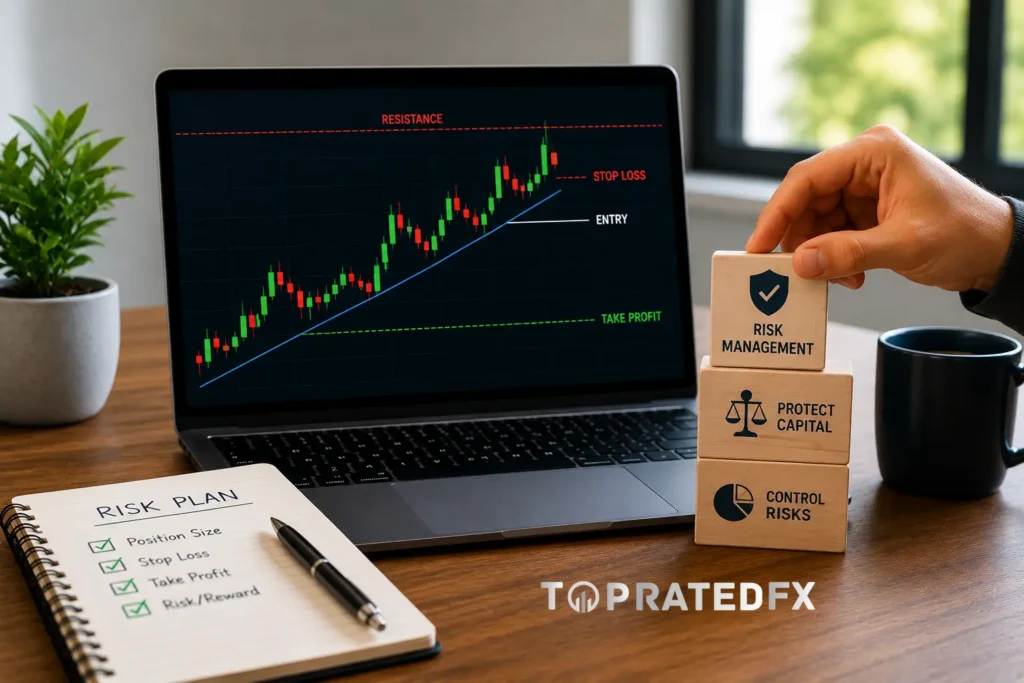
Step 5: Understand Forex Risk Management
If there is one skill that separates successful traders from unsuccessful traders, it is risk management.
Many beginners spend months searching for the perfect trading strategy while ignoring risk management entirely.
However, even a great strategy can fail if risk is not controlled properly.
Professional traders understand a simple truth:
Protecting capital comes before making profits.
Without capital, you cannot continue trading.
Why Risk Management Matters
Every trader experiences losing trades.
Losses are a normal part of trading.
The objective is not to avoid losses completely.
Instead, the goal is to keep losses small enough that your account can recover over time.
Example
Imagine two traders, each starting with a $1,000 account.
Trader A risks:
10% per trade
Trader B risks:
1% per trade
After five losing trades:
| Trader | Approximate Remaining Balance |
|---|---|
| Trader A | Around $590 |
| Trader B | Around $950 |
The difference is enormous.
This is why experienced traders focus on survival first.
The 1% Risk Rule
One of the most common risk management principles is the 1% Rule.
This means risking no more than 1% of your account on a single trade.
Example
Account Balance:
$2,000
Maximum Risk:
1%
Maximum Dollar Risk:
$20
Even if the trade loses, the damage remains limited.
This approach helps traders survive losing streaks while continuing to participate in future opportunities.
Always Use a Stop-Loss
A stop-loss is one of the most important tools in forex trading.
It automatically closes a trade if the market reaches a predefined level.
Benefits of Using a Stop-Loss
- Limits losses
- Removes emotional decision-making
- Protects trading capital
- Improves discipline
Example
Buy EUR/USD:
1.1000
Stop-Loss:
1.0950
Risk:
50 pips
If the market moves against the trade, losses remain controlled.
Without a stop-loss, a small loss can quickly become a large one.
Understand Risk-to-Reward Ratios
The risk-to-reward ratio compares potential profit to potential loss.
Example
Risk:
50 pips
Reward:
150 pips
Risk-to-Reward Ratio:
1:3
This means one winning trade can offset several losing trades.
Many successful traders seek opportunities with a minimum ratio of:
- 1:2
- 1:3
or higher.
Avoid Over-Leverage
Leverage allows traders to control larger positions using a smaller deposit.
While leverage increases opportunity, it also increases risk.
Common Beginner Mistake
A trader deposits:
$500
Uses:
1:500 leverage
Opens a position that is far too large.
A relatively small market movement can wipe out a significant portion of the account.
Professional traders often use leverage conservatively and focus on position sizing rather than maximum exposure.
Position Sizing Matters
Position size determines how much money is at risk.
Many beginners decide position size based on profit potential.
Professional traders calculate position size based on risk.
Before Entering a Trade Ask:
- How much am I willing to lose?
- Where is my stop-loss?
- What position size keeps risk within my rules?
This approach creates consistency and protects capital.
Use our Tool Position Size Calculator
Beginner Forex Trading Strategies
Once risk management is understood, traders can begin exploring simple strategies.
The goal is not to find a perfect system.
The goal is to find an approach that fits your personality and trading style.
Trend Following Strategy
Trend following is one of the most beginner-friendly trading methods.
The idea is simple:
Trade in the direction of the market trend.
Uptrend Characteristics
- Higher highs
- Higher lows
Downtrend Characteristics
- Lower highs
- Lower lows
Example
EUR/USD has been rising for several weeks.
Instead of trying to predict a reversal, a trader waits for a pullback and looks for buying opportunities.
Advantages
- Easy to understand
- Works across multiple markets
- Aligns with market momentum
Support and Resistance Strategy
They help traders identify important price levels.
Support
An area where buying pressure may appear.
Resistance
An area where selling pressure may appear.
Example
EUR/USD repeatedly bounces from:
1.1000
This level becomes support.
If the price returns to that area, traders may look for buying opportunities.
Breakout Strategy
A breakout occurs when the price moves beyond an important support or resistance level.
Example
GBP/USD trades between:
1.2500 and 1.2600
for several days.
Price then breaks above 1.2600 with strong momentum.
Some traders enter long positions expecting continued movement.
Advantages
- Can capture large trends
- Works well during major news events
Risks
- False breakouts occur frequently
- Confirmation is often necessary
Which Strategy Is Best for Beginners?
Most beginners perform best with:
Trend Following
because it offers:
- Clear rules
- Lower complexity
- Fewer emotional decisions
- Easier trade management
Many professional traders still use trend-following principles after years of experience.
Complexity does not necessarily improve results.
Demo Account vs Live Account
Many traders assume they are ready for live trading after a few profitable demo trades.
However, live trading introduces an entirely new challenge:
Emotion.
Demo Account Advantages
- No financial risk
- Easy strategy testing
- Platform familiarity
- Learning opportunity
Drawback
Emotional pressure is limited because no real money is involved.
Live Account Advantages
- Real-world experience
- Genuine emotional development
- Practical risk management
Drawback
Losses become real.
This often changes trader behavior dramatically.
Demo vs Live Comparison
| Feature | Demo Account | Live Account |
|---|---|---|
| Real Money Risk | No | Yes |
| Emotional Pressure | Low | High |
| Learning Opportunity | High | High |
| Strategy Testing | Excellent | Good |
| Psychological Development | Limited | Significant |
When Should You Switch to a Live Account?
Consider transitioning when:
- You understand your platform.
- You follow a trading plan consistently.
- You use stop-loss orders correctly.
- You manage risk appropriately.
- You have achieved stable demo results.
Even then, begin with a small account.
The objective is experience, not immediate profits.
How Much Money Do You Need to Start Forex Trading?
One of the most frequently asked questions by beginners is:
“How much money do I need to start forex trading?”
The answer depends on your goals, risk tolerance, and expectations.
Starting with $100
Possible?
Yes.
Ideal?
Not always.
Challenges
- Limited flexibility
- Small position sizes
- Slower account growth
However, a $100 account can be useful for learning live trading psychology.
Starting with $500
Many beginners start in this range.
Advantages include:
- Better risk management flexibility
- More realistic position sizing
- Greater margin for mistakes
Starting with $1,000
A $1,000 account provides significantly more flexibility.
Traders can:
- Risk conservatively
- Use smaller position sizes
- Focus on consistency rather than rapid growth
Starting with $5,000 or More
Larger accounts allow traders to:
- Manage risk more comfortably
- Diversify positions
- Reduce pressure to overtrade
However, larger capital should never replace proper education.
How Much Should You Personally Start With?
A simple guideline:
Only trade with money you can afford to lose.
Never use:
- Rent money
- Emergency savings
- Debt
- Essential living expenses
The goal is to learn and improve over time rather than seeking quick profits.
A small account combined with strong risk management is often far more effective than a large account combined with poor discipline.
Learn more about Best Forex Brokers for Beginners
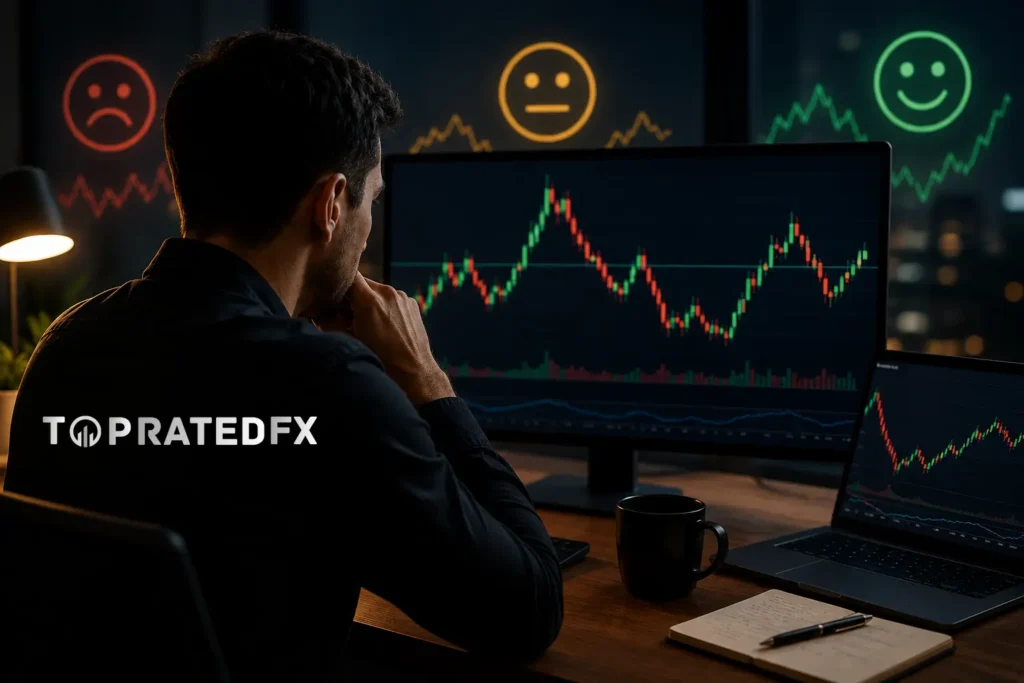
Forex Trading Psychology for Beginners
Many beginner traders believe that success depends entirely on market analysis.
However, after spending time in the market, most traders discover that psychology often plays an even bigger role.
You can have:
- A good strategy
- Proper risk management
- Strong technical analysis
Yet still lose money if emotions control your decisions.
Therefore, understanding trading psychology is essential for long-term success.
Fear
Fear is one of the most common emotions in trading.
It usually appears when money is at risk.
Fear can cause traders to:
- Close trades too early
- Avoid valid setups
- Move stop-loss orders unnecessarily
- Hesitate when opportunities appear
Example
A trader buys EUR/USD based on a valid setup.
The trade moves slightly against them.
Fear takes over.
They close the trade early.
Shortly afterward, the market moves in its original direction.
This situation happens frequently among new traders.
How to Control Fear
- Risk small amounts per trade
- Follow a trading plan
- Accept that losses are part of trading
- Focus on long-term performance
Greed
Greed is the opposite of fear.
It often appears after a series of winning trades.
Greed can cause traders to:
- Increase position sizes excessively
- Ignore risk management rules
- Hold trades too long
- Chase unrealistic profits
Example
A trader wins four trades in a row.
Feeling invincible, they double their position size.
One losing trade then wipes out most of their recent gains.
How to Control Greed
- Use consistent position sizes
- Follow predetermined targets
- Stick to your risk management plan
- Avoid emotional decision-making
Revenge Trading
Revenge trading occurs when traders try to recover losses immediately.
Instead of following their strategy, they become focused on winning back money.
Example
A trader loses 2% on a trade.
Frustrated, they immediately enter several new positions without proper analysis.
The losses continue to grow.
How to Avoid Revenge Trading
- Take a break after losses
- Review your trading journal
- Follow your trading plan strictly
- Accept that losses are part of the business
Overconfidence
Winning streaks can create dangerous levels of confidence.
Traders may begin to believe they cannot lose.
As a result, they often:
- Ignore risk management
- Increase leverage
- Trade lower-quality setups
Example
A trader enjoys several successful weeks.
They stop following their checklist.
Soon afterward, a few poor decisions erase a large portion of their profits.
How to Prevent Overconfidence
- Treat every trade independently
- Continue following your rules
- Review performance objectively
- Stay focused on the process rather than the results
How Professional Traders Think
Professional traders typically approach the market differently from beginners.
Instead of asking:
“How much money can I make?”
They often ask:
“How much can I lose if I’m wrong?”
This mindset helps them focus on risk management rather than emotional decision-making.
Successful trading is not about being right all the time.
It is about managing risk effectively while maintaining consistency.
30-Day Forex Trading Roadmap for Beginners
Many new traders feel overwhelmed by the sheer amount of information available.
The roadmap below provides a structured approach to learning forex trading.
Week 1: Learn the Fundamentals
Focus on understanding:
- How the forex market works
- Currency pairs
- Pips
- Spreads
- Leverage
- Margin
- Trading sessions
Goals:
- Learn basic terminology
- Understand how trades are executed
- Become familiar with a trading platform
Week 2: Practice on a Demo Account
Begin using a demo account daily.
Practice:
- Opening trades
- Closing trades
- Setting stop-losses
- Setting take-profits
Goals:
- Understand platform functionality
- Build confidence
- Develop consistent habits
Week 3: Learn Risk Management
Focus on:
- Position sizing
- The 1% rule
- Risk-to-reward ratios
- Capital preservation
Goals:
- Protect trading capital
- Understand risk exposure
- Create a risk management plan
Week 4: Build and Test a Simple Strategy
Choose one beginner-friendly strategy.
Examples:
- Trend following
- Support and resistance
- Breakout trading
Goals:
- Follow written rules
- Record trades in a journal
- Evaluate performance objectively
By the end of the first month, your objective should be education and consistency—not profitability.
Beginner Forex Trading Checklist
Before placing any trade, review this checklist.
Market Analysis
- Is the market trending?
- Have I identified support and resistance?
- Does the setup match my strategy?
- Have I checked the economic calendar?
Risk Management
- Is the risk limited to 1% or less?
- Is a stop-loss in place?
- Is the position size correct?
- Is the risk-to-reward ratio acceptable?
Trading Psychology
- Am I calm and focused?
- Am I following my trading plan?
- Am I avoiding emotional decisions?
- Am I trading because of a valid setup?
Final Question
Ask yourself:
“If this trade loses, will I still be comfortable with the risk I accepted?”
If the answer is yes, the trade may be worth considering.
Common Forex Trading Mistakes Beginners Make
Understanding common mistakes can save new traders both time and money.
Overtrading
Many beginners believe that more trades equal more profits.
In reality, excessive trading often leads to poor decisions and unnecessary losses.
Trading Without a Plan
Entering trades randomly creates inconsistent results.
Every trade should have:
- An entry reason
- A stop-loss
- A take-profit
- Defined risk
Ignoring Risk Management
Many trading accounts fail because traders risk too much on individual positions.
Risk management should always come before profit targets.
Using Too Much Leverage
High leverage can be attractive.
However, it also increases the speed at which losses accumulate.
Most beginners perform better using conservative leverage.
Switching Strategies Constantly
Many traders abandon a strategy after a few losses.
As a result, they never collect enough data to determine whether the strategy actually works.
Consistency is essential.
Trading Based on Emotions
Fear, greed, frustration, and excitement often lead to poor decisions.
The best traders focus on process rather than emotions.
FAQ
Yes. Forex trading can be suitable for beginners because it offers low barriers to entry, educational resources, and flexible trading hours. However, beginners should focus on education and risk management before trading with real money.
Many brokers allow small deposits. While some traders start with $100, larger balances such as $500 or $1,000 often provide greater flexibility and better risk management opportunities.
Yes. Many successful traders are self-taught through educational resources, demo accounts, books, and practical experience.
The basics can be learned within a few weeks. However, developing consistency often takes months or even years of practice and experience.
Yes. Forex trading involves significant risk. Proper risk management can help reduce losses, but no strategy eliminates risk completely.
Absolutely. A demo account allows traders to gain practical experience and test strategies without risking real money.
Many beginners start with trend-following strategies because they are straightforward, easier to understand, and encourage disciplined trading.
Final Thoughts
Forex trading offers exciting opportunities, but it should never be viewed as a shortcut to wealth.
The traders who achieve long-term success typically focus on:
- Education
- Risk management
- Discipline
- Consistency
- Continuous improvement
If you are learning forex trading for beginners, your primary goal should not be making money immediately.
Instead, focus on building the skills required to survive and grow over time.
Start by choosing a regulated broker, practicing on a demo account, learning proper risk management, and developing a structured trading plan.
Most importantly, remember that successful trading is a marathon, not a sprint.
By following the principles outlined in this guide, you will be far better prepared to navigate the forex market with confidence, realistic expectations, and a professional mindset.