

Leverage is one of the most powerful tools available in modern financial markets. Whether you trade Forex, CFDs, cryptocurrencies, stocks, or commodities, leverage allows you to control a much larger trading position than the amount of money you actually deposit.
If you’re new to the financial markets, we recommend starting with our What Is Forex Trading? Guide to understanding the basics before learning about leverage. You can also read our Forex Trading for Beginners guide for a step-by-step introduction.
For beginners, leverage can seem confusing because it has the potential to significantly increase both profits and losses. Used wisely, it can improve capital efficiency and allow traders to access larger market opportunities. Used carelessly, however, it can quickly lead to substantial losses.
In this comprehensive guide at TopRatedFX, you’ll learn what leverage in trading is, how it works, why brokers offer it, its advantages and disadvantages, and how to use leverage responsibly. We’ll also explain how leverage differs across Forex, CFD, crypto, and binary options trading while providing practical examples to help you understand the concept.
Quick Answer
Leverage is borrowed trading power provided by a broker that allows traders to open positions much larger than their own capital.
For example:
- Deposit: $100
- Leverage: 1:100
- Maximum Position Size: $10,000
This means you control a $10,000 trade while only committing $100 of your own funds as margin.
Since leverage works together with margin, it’s important to understand how margin requirements are calculated. You can use our Forex Margin Calculator to estimate the margin needed for your trades.
Leverage at a Glance
| Feature | Description |
|---|---|
| Definition | Borrowed capital provided by a broker |
| Purpose | Increase buying power |
| Used In | Forex, CFDs, Stocks, Commodities, Crypto |
| Main Benefit | Higher market exposure with less capital |
| Main Risk | Losses are magnified just like profits |
| Requires Margin | Yes |
| Suitable for Beginners | Only when combined with proper risk management |
Why Is Leverage Important?
Without leverage, many retail traders would need tens of thousands of dollars to participate meaningfully in global financial markets.
For example:
Without leverage:
- Want to buy 1 standard lot EUR/USD
- Position value ≈ $100,000
Most traders don’t have $100,000 available.
With 1:100 leverage:
You only need approximately $1,000 in margin to control the same position.
This is why leverage has become one of the defining features of Forex and CFD trading.
To calculate the appropriate trade size based on your account balance and risk tolerance, use our Position Size Calculator.
The amount of leverage available depends on your broker and the regulations in your country. If you’re still looking for a trading platform, compare our list of the Best Forex Brokers. For broker-specific leverage limits, you can also read our Exness Review and HFM Review.
And you should take a look at the best brokers in 2026
How Does Leverage Work in Trading?
Understanding how leverage works is essential before placing your first trade. While leverage can increase your buying power, it does not eliminate risk. Instead, it allows you to control a larger market position by setting aside only a small portion of the trade value, known as margin.
If you’re unfamiliar with margin, read our What Is Margin in Trading? Guide to understanding how these two concepts work together. You can also estimate your required margin using our Forex Margin Calculator.
The Relationship Between Leverage and Margin
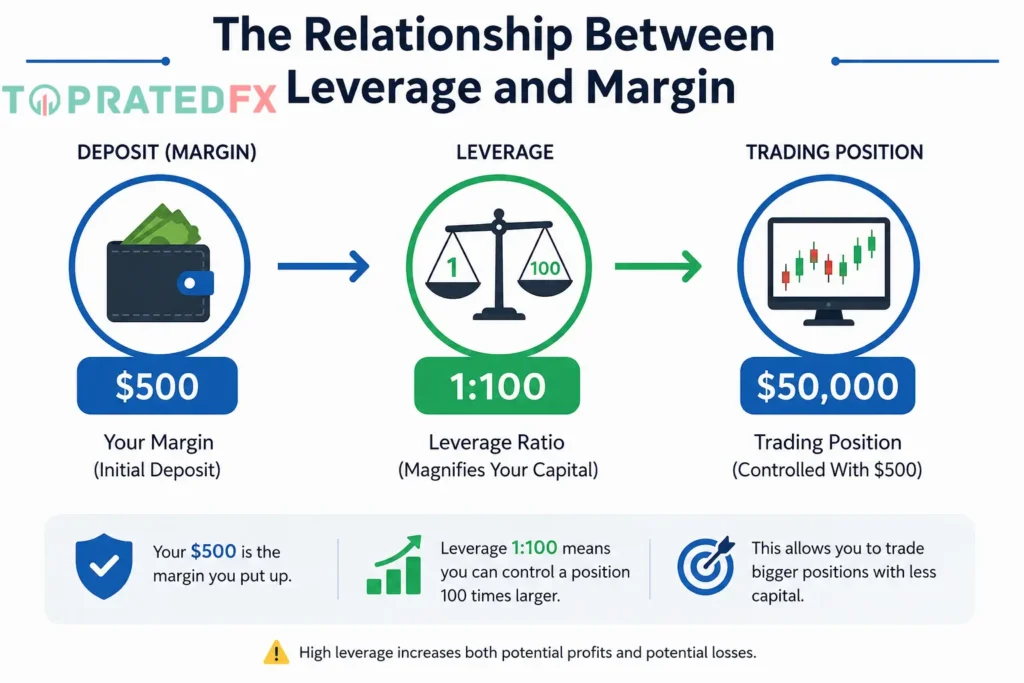
Leverage and margin are closely connected.
- Leverage determines how much larger your trading position can be compared to your deposit.
- Margin is the amount of money your broker requires to open and maintain that leveraged position.
The higher the leverage, the lower the margin required.
| Leverage | Margin Requirement |
|---|---|
| 1:2 | 50% |
| 1:5 | 20% |
| 1:10 | 10% |
| 1:20 | 5% |
| 1:50 | 2% |
| 1:100 | 1% |
| 1:200 | 0.5% |
| 1:500 | 0.2% |
| 1:1000 | 0.1% |
This relationship is why traders with relatively small account balances can still participate in large financial markets.
A Simple Leverage Example
Imagine you deposit $500 into your trading account.
Your broker offers 1:100 leverage.
Instead of being limited to a $500 trade, you can control a position worth:
$500 × 100 = $50,000
Although you’re controlling a $50,000 position, your actual investment is still only $500.
This larger market exposure means even small price movements can have a significant impact on your account balance.
Example: Forex Trade
Let’s say you buy EUR/USD.
- Account Balance: $1,000
- Leverage: 1:100
- Position Size: 100,000 EUR (1 Standard Lot)
If EUR/USD rises by 1%, your profit is much larger than if you had traded without leverage.
However, if the market moves 1% against you, your losses increase by the same proportion.
This is why professional traders focus on risk management, not simply on using the highest leverage available.
Before opening any position, calculate the appropriate trade size using our Position Size Calculator.
Example: Stock Trading Without vs With Leverage
| Without Leverage | With 1:10 Leverage |
|---|---|
| Investment: $1,000 | Investment: $1,000 |
| Position Value: $1,000 | Position Value: $10,000 |
| Stock rises 5% | Stock rises 5% |
| Profit: $50 | Profit: $500 |
Now imagine the stock falls by 5%.
Without leverage, your loss is $50.
With leverage, your loss becomes $500.
Leverage magnifies losses exactly as it magnifies profits.
Why Do Brokers Offer Leverage?
Many beginners wonder why brokers are willing to provide leverage.
The answer is simple:
- Higher trading volume.
- Greater market participation.
- More liquidity.
- Increased trading opportunities for retail traders.
However, regulated brokers must follow strict rules regarding the maximum leverage they can offer.
If you’re looking for regulated brokers with competitive leverage options, compare our Best High Leverage Forex Brokers.
You can also see the leverage offered by individual brokers in our detailed reviews:
Types of Leverage in Different Financial Markets
Leverage is not the same across all financial markets. The maximum leverage available, the level of risk involved, and the regulations governing leverage vary depending on the asset class you trade.
Understanding these differences can help you choose the right market based on your experience, trading strategy, and risk tolerance.
Forex Trading Leverage
Forex is one of the most leveraged financial markets in the world.
Because major currency pairs often move by relatively small percentages each day, leverage allows traders to amplify those small price movements into meaningful trading opportunities.
Some international brokers offer leverage as high as 1:500, 1:1000, or even unlimited leverage under specific account conditions. However, many regulated jurisdictions impose stricter limits to protect retail traders.
For example:
| Region | Typical Maximum Leverage |
|---|---|
| European Union (ESMA) | 1:30 |
| United Kingdom (FCA) | 1:30 |
| Australia (ASIC) | 1:30 |
| Offshore Brokers | Up to 1:1000 or higher |
CFD Trading Leverage
Contracts for Difference (CFDs) allow traders to speculate on a wide range of assets, including:
- Stocks
- Indices
- Commodities
- Metals
- Energy
- ETFs
Leverage in CFD trading depends on the underlying asset.
For example:
| CFD Asset | Typical Leverage |
|---|---|
| Major Forex Pairs | 1:30 – 1:500 |
| Gold | 1:20 – 1:200 |
| Stock Indices | 1:20 – 1:100 |
| Individual Stocks | 1:5 – 1:20 |
Because some CFDs are more volatile than others, brokers often provide lower leverage on higher-risk assets.
Cryptocurrency Trading Leverage
Crypto markets are significantly more volatile than Forex markets.
For this reason, many regulators limit leverage on cryptocurrencies.
Some crypto exchanges offer:
- 1:2
- 1:5
- 1:10
- 1:20
- 1:50
- Up to 1:125 on selected futures contracts
While higher leverage can generate substantial profits, it also increases the risk of liquidation during sudden market swings.
Before trading digital assets, read our What Is Cryptocurrency Trading? guide.
You can also compare platforms in our Best Crypto Brokers guide.
Stock Trading Leverage
Stock trading generally offers lower leverage than Forex.
Many brokers provide:
| Stock Trading Type | Typical Leverage |
|---|---|
| Cash Account | No Leverage |
| Margin Account | 1:2 |
| Professional Account | Up to 1:5 |
Lower leverage helps reduce risk because individual stocks can experience significant price fluctuations.
Commodity Trading Leverage
Commodity traders often use leverage when trading:
- Gold
- Silver
- Crude Oil
- Natural Gas
- Agricultural Products
Typical leverage ranges include:
| Commodity | Typical Leverage |
|---|---|
| Gold | 1:20 – 1:200 |
| Silver | 1:20 – 1:100 |
| Oil | 1:10 – 1:100 |
Leverage levels vary depending on market volatility and broker policies.
Binary Options and Leverage
Unlike Forex or CFDs, binary options trading does not use traditional leverage.
Instead of borrowing capital from a broker, traders simply choose whether the price of an asset will move above or below a specific level before the option expires.
Your maximum risk is limited to the amount invested in the trade, and your potential return is fixed before the trade begins.
If you’re new to binary options, start with our What Is Binary Options Trading? guide.
You can also compare platforms in our Best Binary Options Brokers guide.
Comparison of Leverage Across Markets
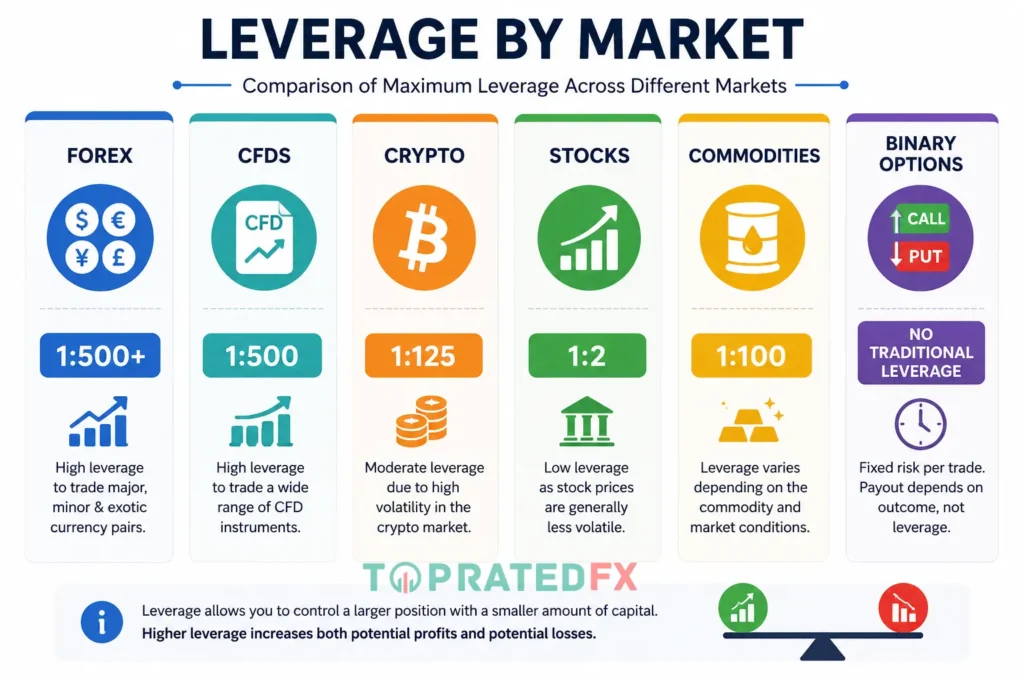
| Market | Typical Maximum Leverage | Risk Level |
|---|---|---|
| Forex | Up to 1:1000+ | High |
| CFDs | Up to 1:500 | High |
| Commodities | Up to 1:200 | Medium–High |
| Stocks | Up to 1:5 | Medium |
| Cryptocurrencies | Up to 1:125 | Very High |
| Binary Options | No Traditional Leverage | High (Fixed Risk) |
Which Market Is Best for Beginners?
For beginners, choosing the highest leverage is rarely the best strategy.
A safer approach is to:
- Learn how leverage and margin work.
- Start with lower leverage.
- Practice on a demo account.
- Follow a strict risk management plan.
- Never risk more than 1–2% of your trading capital on a single trade.
Combining moderate leverage with proper money management can help traders stay in the market longer while reducing the impact of inevitable losing trades.
Advantages and Disadvantages of Leverage in Trading
Leverage is often described as a double-edged sword. It has the potential to increase trading opportunities and improve capital efficiency, but it can also magnify losses if not used responsibly.
Understanding both the benefits and the risks of leverage is essential before trading with real money.
Advantages of Leverage
1. Increased Buying Power
The biggest advantage of leverage is that it allows traders to control larger positions without needing a large trading account.
For example:
- Your Capital: $500
- Leverage: 1:100
- Position Value: $50,000
Without leverage, you would need the full $50,000 to open the same trade.
This makes financial markets more accessible to retail traders.
2. Better Capital Efficiency
Instead of committing all your money to a single position, leverage allows you to keep a large portion of your capital available for other trading opportunities.
For example, if only 1% margin is required, the remaining funds can be used for:
- Diversification
- Risk management
- Additional trades
- Emergency liquidity
Professional traders often focus on using leverage efficiently rather than simply using the highest leverage available.
3. Access to More Markets
Leverage makes it possible for traders with relatively small accounts to participate in markets that would otherwise require significant capital.
Examples include:
- Forex
- Gold
- Oil
- Stock Indices
- Cryptocurrencies
- CFDs
Without leverage, many retail traders would not be able to trade these markets effectively.
4. Potential for Higher Returns
Because profits are calculated based on the full position size rather than your deposited capital, successful trades can generate significantly higher returns.
For example:
| Without Leverage | With 1:100 Leverage |
|---|---|
| Investment: $1,000 | Investment: $1,000 |
| Position: $1,000 | Position: $100,000 |
| Market Move: +1% | Market Move: +1% |
| Profit: $10 | Profit: $1,000* |
Note: This simplified example does not account for spreads, commissions, financing costs, or other trading fees.
5. Greater Trading Flexibility
Leverage enables traders to:
- Open multiple positions simultaneously.
- Diversify across different markets.
- Implement advanced trading strategies.
- Hedge existing positions more efficiently.
This flexibility is one reason why leverage is widely used by experienced traders.
Disadvantages of Leverage
While leverage offers many advantages, it also introduces significant risks.
1. Losses Are Magnified
Just as leverage amplifies profits, it also amplifies losses.
A relatively small adverse market movement can result in substantial losses.
For example:
| Without Leverage | With 1:100 Leverage |
|---|---|
| Market Falls 1% | Market Falls 1% |
| Loss: $10 | Loss: $1,000* |
This is why proper position sizing is essential.
2. Margin Calls
If your account equity falls below the broker’s required maintenance margin, you may receive a margin call.
A margin call means you need to:
- Deposit additional funds.
- Close losing positions.
- Reduce overall market exposure.
Ignoring a margin call can result in automatic position closures.
3. Stop-Out Risk
Many brokers implement a stop-out level.
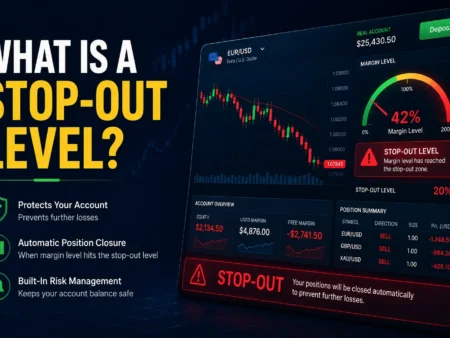
When your account equity falls below this threshold, the broker automatically closes some or all open trades to prevent your balance from becoming negative.
This process happens automatically and can occur very quickly during periods of high market volatility.
4. Emotional Pressure
High leverage often causes traders to experience:
- Fear
- Greed
- Panic
- Overtrading
- Revenge trading
These emotional reactions frequently lead to poor trading decisions.
To improve your decision-making, read our Forex Trading for Beginners guide:
5. Faster Account Drawdowns
Even a few consecutive losing trades can significantly reduce your account balance when excessive leverage is used.
For example:
Using 1:500 leverage while risking a large portion of your account on every trade may lead to rapid losses during normal market fluctuations.
This is one of the primary reasons professional traders prioritize risk management over maximizing leverage.
Pros and Cons of Leverage
| Advantages | Disadvantages |
|---|---|
| Increases buying power | Magnifies losses |
| Improves capital efficiency | Margin calls |
| Enables access to larger markets | Stop-out risk |
| Potential for higher returns | Emotional trading |
| Supports advanced strategies | Faster account drawdowns |
Is High Leverage Always Better?
Not necessarily.
Many beginners assume that higher leverage automatically leads to higher profits.
In reality, leverage simply increases market exposure—it does not improve trading accuracy or guarantee profitable trades.
A trader using 1:20 leverage with a disciplined trading plan may outperform another trader using 1:500 leverage without proper risk management.
Successful trading depends on:
- A well-tested trading strategy.
- Consistent risk management.
- Emotional discipline.
- Proper position sizing.
- Continuous learning.
Leverage should be viewed as a tool, not as a shortcut to quick profits.
How to Use Leverage Safely
Leverage can be a valuable trading tool when used responsibly. The goal is not to maximize leverage but to manage risk while maintaining consistent trading performance.
Whether you trade Forex, CFDs, cryptocurrencies, or commodities, following a disciplined approach can help protect your trading capital.
1. Choose an Appropriate Leverage Ratio
Many beginners are attracted to the highest leverage available, believing it will maximize profits.
In reality, using lower leverage often leads to better long-term results.
A general guideline is:
| Experience Level | Suggested Leverage |
|---|---|
| Beginner | 1:5 – 1:20 |
| Intermediate | 1:20 – 1:50 |
| Experienced | Based on strategy and risk management |
The right leverage depends on your trading style, account size, and risk tolerance—not on what the broker offers.
2. Never Risk More Than 1–2% Per Trade
Professional traders focus on controlling losses rather than chasing profits.
For example:
- Account Balance: $5,000
- Maximum Risk Per Trade: 2%
- Maximum Loss: $100
Even with high leverage, your position size should be calculated so that a stop-loss hit does not exceed your planned risk.
Use our Position Size Calculator to determine the correct trade size:
3. Always Use a Stop-Loss Order
A stop-loss automatically closes your trade if the market moves against you by a predefined amount.
Without a stop-loss, leveraged trades can quickly result in significant losses during periods of high volatility.
Every trade should have:
- A predefined entry point.
- A stop-loss level.
- A take-profit target.
4. Understand Margin Requirements
Before opening any leveraged position, make sure you know how much margin is required.
Unexpected margin shortages can lead to margin calls or automatic stop-outs.
You can estimate margin requirements using our Forex Margin Calculator:
5. Practice on a Demo Account
Before risking real money, test your strategy on a demo account.
This allows you to:
- Learn how leverage affects your trades.
- Practice risk management.
- Build confidence without financial risk.
- Understand broker platform features.
6. Avoid Overleveraging
One of the biggest mistakes beginners make is opening positions that are too large for their accounts.
Just because your broker offers 1:500 or 1:1000 leverage does not mean you should use it.
Professional traders often use only a fraction of the maximum leverage available.
Common Mistakes Beginners Make
Even experienced traders occasionally misuse leverage. However, beginners are especially vulnerable to these common mistakes.
Using Maximum Leverage on Every Trade
High leverage should not become your default setting.
Instead, choose leverage that aligns with your trading strategy and acceptable level of risk.
Trading Without a Stop-Loss
Without a stop-loss, a single trade can erase weeks or even months of profits.
Always define your maximum acceptable loss before entering a trade.
Ignoring Position Size
Many traders focus only on leverage while ignoring position size.
These two concepts work together.
Even with moderate leverage, an oversized position can expose your account to unnecessary risk.
Chasing Losses
After a losing trade, some traders increase leverage in an attempt to recover losses quickly.
This behavior, often referred to as revenge trading, usually results in even greater losses.
Successful traders accept losses as a normal part of trading and stick to their trading plan.
Trading Without a Plan
Leverage should enhance a trading strategy—not replace one.
Before opening any position, you should know:
- Why are you entering the trade?
- Where you will exit if the trade goes against you.
- Where will you take profits?
- How much are you willing to risk?
FAQ
Leverage is a feature provided by brokers that allows traders to control a larger market position using a relatively small amount of their own capital, known as margin.
Leverage can be useful for beginners if it is used conservatively and combined with proper risk management. Starting with lower leverage is generally safer while learning how financial markets work.
There is no single “best” leverage. Many beginners choose lower leverage, while experienced traders select leverage based on their trading strategy, position size, and risk tolerance.
This depends on your broker, the market, and whether negative balance protection applies. Many regulated brokers provide negative balance protection for retail clients, but traders should always review their broker’s policies before trading.
No. Higher leverage increases both potential profits and potential losses. It does not improve trading accuracy or guarantee better results.
Leverage refers to the multiple by which you can increase your market exposure, while margin is the amount of money required to open and maintain a leveraged position.
Final Thoughts
Leverage is one of the defining features of modern trading, allowing retail traders to participate in global financial markets with relatively small amounts of capital.
However, leverage should never be viewed as a shortcut to quick profits. Instead, it should be treated as a financial tool that requires discipline, education, and a solid risk management strategy.
By understanding how leverage works, calculating your position size carefully, using stop-loss orders, and choosing regulated brokers, you can reduce unnecessary risks while making informed trading decisions.
If you’re just starting your trading journey, continue learning with our What Is Forex Trading? and Forex Trading for Beginners guides, then compare trusted platforms in our Best Forex Brokers section before opening a live trading account.
- Best Binary Options Brokers for Beginners In 2026
- Best Binary Options Brokers In 2026
- Best Brokers for Altcoins in 2026
- Best Brokers for Bitcoin in 2026
- Best Brokers for Day Trading In 2026
- Best Brokers in Egypt in 2026: Compare Top Trading Platforms
- Best Brokers in Nigeria 2026
- Best CFD Brokers In 2026
- Best Copy Trading Platforms In 2026
- Best Crypto Brokers 2026
- Best Crypto Brokers for Beginners in 2026
- Best Crypto Copy Trading Brokers in 2026
- Best ECN Brokers in 2026
- Best Forex Brokers for Beginners in 2026
- Best Forex Brokers In 2026
- Best Forex Brokers with Islamic Accounts in 2026
- Best Forex Brokers With No Inactivity Fee in 2026
- Best Free Binary Options Demo Accounts In 2026
- Best High Leverage Forex Brokers In 2026
- Best No Deposit Bonus Forex Brokers in 2026
- Best PayPal Forex Brokers in 2026
- Best Scalping Forex Brokers in 2026
- Lowest Minimum Deposit Binary Options Brokers In 2026
- Lowest Spread Forex Brokers In 2026