

Free margin is one of the most important concepts in leveraged trading, yet it is often misunderstood by beginners.
Simply put, free margin is the portion of your account equity that is not currently being used as margin for open trades. It represents the funds that remain available to open new positions or to absorb temporary market losses without triggering a margin call.
Whenever you open a leveraged trade, your broker sets aside part of your account as used margin. The remaining equity becomes your free margin.
As long as you have sufficient free margin, your account has room to withstand normal market fluctuations. However, if your free margin falls to zero, your account becomes much more vulnerable to margin calls and stop-outs if losses continue to increase.
Understanding free margin is essential because it directly affects your trading flexibility, your ability to manage risk, and the number of positions you can safely maintain.
If you’re new to leveraged trading, it’s recommended to first read our guides on What Is Margin in Trading?, What Is Leverage in Trading?, and What Is a Margin Call?, These concepts are closely connected.
Quick Answer
Free margin is the amount of your account equity that remains available after subtracting the margin currently used for open positions.
It can be used to:
- Open additional trades.
- Absorb floating losses.
- Reduce the likelihood of a margin call.
- Provide flexibility during volatile market conditions.
The higher your free margin, the healthier and more flexible your trading account generally is.
Once you’ve mastered the basics of Free Margin, compare the Free Margin requirements offered by different platforms in our Best Forex Brokers guide, and you should take a look at the best brokers in 2026
Free Margin at a Glance
| Feature | Description |
|---|---|
| Definition | Equity not currently locked as margin |
| Used For | Opening new trades and absorbing losses |
| Changes Constantly | Yes |
| Increases When | Equity rises or positions are closed |
| Decreases When | Losses increase or more positions are opened |
| Related To | Margin, Used Margin, Equity, Margin Level |
| Important For | Risk management and account flexibility |
Why Is Free Margin Important?
Free margin acts as the financial cushion of your trading account.
It provides the flexibility needed to handle normal price movements without immediately putting your account at risk.
A healthy free margin allows you to:
- Open new trading positions when opportunities arise.
- Withstand temporary market fluctuations.
- Reduce the likelihood of receiving a margin call.
- Avoid automatic position closures caused by stop-outs.
On the other hand, if your free margin becomes very low, your account has little capacity to absorb additional losses. Even a relatively small adverse price movement can significantly increase the risk of broker intervention.
For this reason, experienced traders monitor their free margin just as closely as they monitor profits and losses.
How Is Free Margin Calculated?
Free margin is calculated using a simple relationship between your account equity and the margin currently being used for open positions.
Formula:
Free Margin = Equity − Used Margin
This means that:
- If your equity increases because your trades become profitable, your free margin also increases.
- If your equity decreases due to floating losses, your free margin decreases.
- Opening additional positions increases your used margin, which also reduces your available free margin.
Although the calculation is straightforward, understanding how these values interact is essential for effective risk management.
Example of Free Margin
Imagine the following trading account:
| Account Information | Value |
|---|---|
| Balance | $5,000 |
| Equity | $5,000 |
| Used Margin | $1,500 |
Your free margin would be:
$5,000 − $1,500 = $3,500
This means you still have $3,500 available to support existing trades or open additional positions.
Now suppose one of your positions incurs a floating loss of $800.
Your account would look like this:
| Metric | Value |
|---|---|
| Balance | $5,000 |
| Equity | $4,200 |
| Used Margin | $1,500 |
| Free Margin | $2,700 |
Even though your account balance hasn’t changed, your free margin has decreased because your equity has fallen.
This demonstrates why the free margin changes continuously as market prices fluctuate.
What Affects Free Margin?
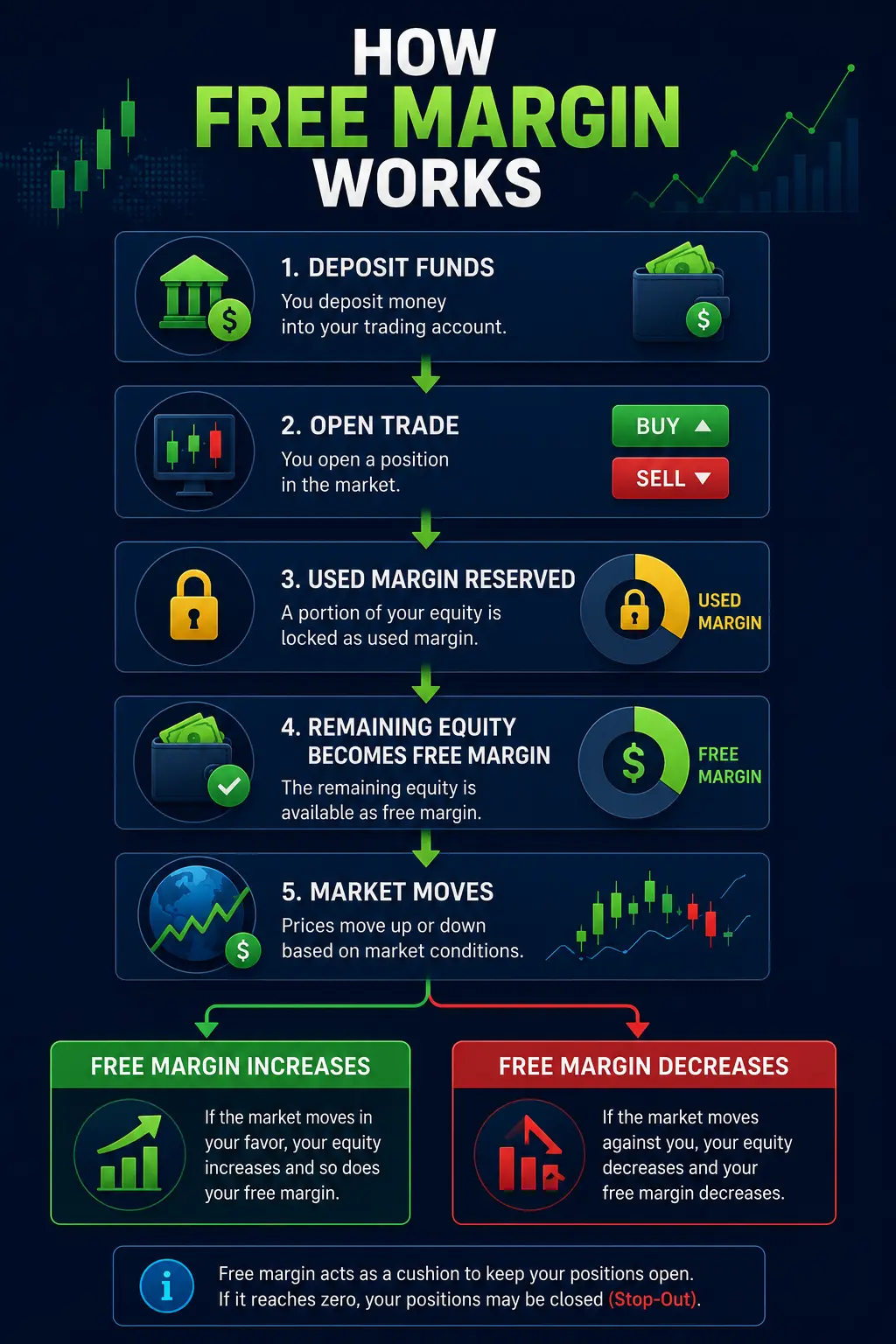
Free margin is not a fixed value.
It changes continuously while the market is open because it depends on both your account equity and the amount of margin currently being used.
Several factors can increase or decrease your free margin throughout the trading day.
1. Floating Profit
When your open trades move in your favor, your account equity increases.
Since the used margin usually remains the same, the increase in equity results in a higher free margin.
For example:
| Account Metric | Before Profit | After Profit |
|---|---|---|
| Equity | $5,000 | $5,600 |
| Used Margin | $1,500 | $1,500 |
| Free Margin | $3,500 | $4,100 |
A profitable trade gives your account more flexibility and increases your ability to open additional positions.
2. Floating Loss
The opposite happens when the market moves against your positions.
As losses increase, your equity decreases, reducing your available free margin.
For example:
| Account Metric | Before Loss | After Loss |
|---|---|---|
| Equity | $5,000 | $4,200 |
| Used Margin | $1,500 | $1,500 |
| Free Margin | $3,500 | $2,700 |
If losses continue, your free margin may eventually reach zero, increasing the risk of a margin call.
3. Opening New Positions
Every new leveraged trade requires additional margin.
As your broker reserves more funds for new positions, your used margin increases.
Since:
Free Margin = Equity − Used Margin
Your free margin decreases whenever you open additional trades.
This is why experienced traders avoid opening too many positions simultaneously.
4. Closing Positions
Closing an open position releases the margin that was reserved for that trade.
As a result, your used margin decreases, and your free margin generally increases.
If the position is profitable, your equity may also increase, giving your account even more available margin.
5. Depositing Additional Funds
Adding money to your trading account increases your account balance and, consequently, your equity.
This immediately increases your free margin and provides a larger safety buffer against future market fluctuations.
How Free Margin Changes During a Trade
Let’s look at a complete trading example.
Step 1: Before Opening a Trade
| Account Information | Value |
|---|---|
| Balance | $10,000 |
| Equity | $10,000 |
| Used Margin | $0 |
| Free Margin | $10,000 |
Since there are no open trades, all available funds are free margin.
Step 2: Open a Leveraged Position
Suppose your broker reserves $2,000 as margin.
| Account Metric | Value |
|---|---|
| Equity | $10,000 |
| Used Margin | $2,000 |
| Free Margin | $8,000 |
Your account is still healthy, but part of your equity is now committed to supporting the open trade.
Step 3: The Trade Moves Into Profit
Your floating profit reaches $700.
| Account Metric | Value |
|---|---|
| Equity | $10,700 |
| Used Margin | $2,000 |
| Free Margin | $8,700 |
Notice that your free margin has increased even though your used margin hasn’t changed.
Step 4: The Market Reverses
Instead of a profit, imagine your trade now has a floating loss of $1,500.
| Account Metric | Value |
|---|---|
| Equity | $8,500 |
| Used Margin | $2,000 |
| Free Margin | $6,500 |
The account still has available free margin, but continued losses could eventually trigger a margin call.
Free Margin vs Used Margin
Although they are closely related, free margin and used margin represent two completely different parts of your trading account.
| Free Margin | Used Margin |
|---|---|
| Available funds | Reserved funds |
| Can absorb losses | Supports open positions |
| Can be used to open new trades | Cannot be used elsewhere until trades are closed |
| Changes with equity and open positions | Changes mainly when positions are opened or closed |
| Higher is generally better | Should remain at a manageable level |
A simple way to remember the difference is:
- Used Margin is money currently committed to keeping your trades open.
- Free Margin is money that remains available for future trading opportunities or unexpected market movements.
We’ll compare these two concepts in greater detail in our dedicated guide, Free Margin vs Used Margin.
Common Mistakes Related to Free Margin
Many traders misunderstand free margin, leading to unnecessary risk and avoidable losses.
Some of the most common mistakes include:
Using All Available Free Margin
Just because your account allows you to open another position doesn’t mean you should.
Using nearly all available free margin leaves little room for normal market fluctuations.
Ignoring Floating Losses
Some traders focus only on their account balance.
However, free margin depends on equity, not balance.
Large floating losses can dramatically reduce your free margin even if your account balance hasn’t changed.
Opening Too Many Trades
Opening several leveraged positions at once rapidly consumes available free margin.
If markets become volatile, the account may approach a margin call much sooner than expected.
Confusing Balance With Free Margin
Many beginners believe their balance represents the money available for trading.
In reality, free margin—not account balance—determines how much additional market exposure your account can safely support.
Trading Without Monitoring Margin Level
Free margin and margin level work together.
Monitoring only one while ignoring the other can lead to poor risk management decisions.
Professional traders regularly check both values before opening new positions.
Best Practices for Managing Free Margin
Maintaining a healthy free margin is one of the foundations of successful leveraged trading.
Rather than trying to maximize the number of trades you can open, professional traders focus on maintaining enough available funds to handle unexpected market movements.
The following best practices can help you protect your trading account.
Keep a Healthy Free Margin Buffer
One of the simplest ways to reduce trading risk is to avoid using all of your available margin.
Leaving a comfortable amount of free margin allows your account to withstand temporary losses without immediately approaching a margin call.
Think of free margin as your account’s emergency reserve rather than unused money waiting to be invested.
Use Appropriate Position Sizes
Every position you open consumes part of your available margin.
Opening positions that are too large can quickly reduce your free margin and increase overall account risk.
Before entering any trade, calculate your position size based on your account balance and acceptable level of risk instead of using the maximum size your broker allows.
Monitor Equity Instead of Balance
Many beginners make the mistake of watching only their account balance.
However, free margin is based on equity, which includes your floating profits and losses.
A large unrealized loss can significantly reduce your free margin even though your account balance has not yet changed.
Always pay attention to your equity while trades are open.
Avoid Overleveraging
High leverage reduces the amount of margin required to open a trade, making it easier to open larger positions.
While this may seem attractive, it can also cause your free margin to disappear much more quickly when the market moves against you.
Using moderate leverage provides greater flexibility and reduces the likelihood of margin calls.
Review Your Margin Before Opening New Trades
Before opening another position, ask yourself:
- How much free margin will remain?
- Can my account survive a temporary adverse market movement?
- Am I risking too much by increasing my exposure?
If the answer to any of these questions is uncertain, it may be better to wait rather than open another trade.
FAQ
Free margin is the amount of money in your trading account that is available for opening new positions or absorbing market losses.
It is the portion of your equity that is not currently being used as margin for open trades.
No.
Your account balance reflects the money in your account after all closed trades.
Free margin depends on your current equity and changes continuously while your trades remain open.
Under normal trading conditions, free margin generally does not remain negative.
If your account approaches zero free margin, your broker may issue a margin call or begin closing positions according to its stop-out policy.
Generally, yes.
A higher free margin provides greater flexibility, allows your account to absorb temporary losses, and reduces the likelihood of margin calls.
However, maintaining a high free margin should be part of an overall risk management strategy rather than the sole objective.
You can increase your free margin by:
Closing open positions.
Depositing additional funds.
Reducing leverage.
Opening smaller positions.
Allowing profitable trades to increase your equity.
Final Thoughts
Free margin is one of the most important indicators of your trading account’s health.
It represents the capital available to support your existing positions, absorb market fluctuations, and take advantage of new trading opportunities.
Successful traders do not focus solely on profits—they also monitor their available free margin to ensure their accounts remain financially stable during both calm and volatile market conditions.
Understanding how free margin interacts with equity, used margin, leverage, and margin level will help you make better trading decisions and reduce the likelihood of margin calls or stop-outs.
Instead of viewing free margin as unused capital, think of it as an essential safety buffer that gives your trading strategy room to operate effectively.
Continue Learning
Build your understanding of leveraged trading with these related guides:
Margin & Leverage
- What Is Leverage in Trading?
- What Is Margin in Trading?
- What Is a Margin Call?
- What Is a Stop-Out Level?
- What Is Used Margin?
- Free Margin vs Used Margin
- What Is Margin Level?
- How to Calculate Margin Level
More Guides
- What Is Cryptocurrency Trading?
- What Is Binary Options Trading?
- What Is Forex Trading
- How to Start Forex Trading
Trading Tools
Best Brokers
- Best Binary Options Brokers for Beginners In 2026
- Best Binary Options Brokers In 2026
- Best Brokers for Altcoins in 2026
- Best Brokers for Bitcoin in 2026
- Best Brokers for Day Trading In 2026
- Best Brokers in Nigeria 2026
- Best CFD Brokers In 2026
- Best Copy Trading Platforms In 2026
- Best Crypto Brokers 2026
- Best Crypto Brokers for Beginners in 2026
- Best Crypto Copy Trading Brokers in 2026
- Best ECN Brokers in 2026
- Best Forex Brokers for Beginners in 2026
- Best Forex Brokers In 2026
- Best Forex Brokers with Islamic Accounts in 2026
- Best Forex Brokers With No Inactivity Fee in 2026
- Best Free Binary Options Demo Accounts In 2026
- Best High Leverage Forex Brokers In 2026
- Best No Deposit Bonus Forex Brokers in 2026
- Best PayPal Forex Brokers in 2026
- Best Scalping Forex Brokers in 2026
- Lowest Minimum Deposit Binary Options Brokers In 2026
- Lowest Spread Forex Brokers In 2026