

A margin call is one of the most important risk management mechanisms in leveraged trading. It occurs when your trading account no longer has enough equity to support your open positions, prompting your broker to warn you that additional funds or corrective action may be required.
Many beginners mistakenly believe that a margin call means they have already lost their entire account. In reality, a margin call is an early warning, giving you an opportunity to reduce risk before your broker begins closing your trades automatically.
Margin calls are common in Forex, CFD, commodity, index, and cryptocurrency trading, where leverage allows traders to control positions much larger than their account balance. While leverage increases buying power, it also increases the speed at which losses can reduce your available margin.
If you’re unfamiliar with the concepts of margin or leverage, we recommend reading our What Is Margin in Trading? And what is leverage in Trading? Guides first, as they provide the foundation needed to fully understand how margin calls occur.
In this comprehensive guide, you’ll learn what a margin call is, why it happens, how brokers calculate it, how it differs from a stop-out, and most importantly, how to avoid receiving one.
Quick Answer
A margin call is a notification from your broker informing you that your account equity has fallen below the required margin level needed to keep your positions open.
To restore your account, you typically need to:
- Deposit additional funds.
- Close one or more open positions.
- Reduce your overall market exposure.
If no action is taken and losses continue to increase, your broker may automatically close your positions once the stop-out level is reached.
Before opening any leveraged position, use our Forex Margin Calculator to estimate your required margin and our Position Size Calculator to calculate a trade size that matches your risk tolerance.
Once you’ve mastered the basics of margin, compare the margin requirements offered by different platforms in our Best Forex Brokers guide, and you should take a look at the best brokers in 2026
Margin Call at a Glance
| Feature | Description |
|---|---|
| Definition | A broker’s warning that your account equity is too low |
| Trigger | Equity falls below the broker’s required margin level |
| Happens In | Forex, CFDs, Commodities, Crypto |
| Purpose | Protect both the trader and the broker |
| Requires Action | Usually yes |
| Same as Stop-Out? | ❌ No |
| Can It Be Avoided? | ✅ Yes, with proper risk management |
Why Do Brokers Issue Margin Calls?
Brokers use margin calls as a protective measure.
When traders use leverage, brokers effectively allow them to control positions much larger than their deposited capital. If the market moves against those positions, losses can quickly reduce the trader’s account equity.
A margin call alerts the trader before the account reaches a critical level where open positions can no longer be safely maintained.
Without margin calls, traders could unknowingly continue holding losing positions until their accounts were completely depleted or even fall into a negative balance in some situations.
For this reason, margin calls are a standard feature of virtually all leveraged trading platforms.
How Does a Margin Call Work?
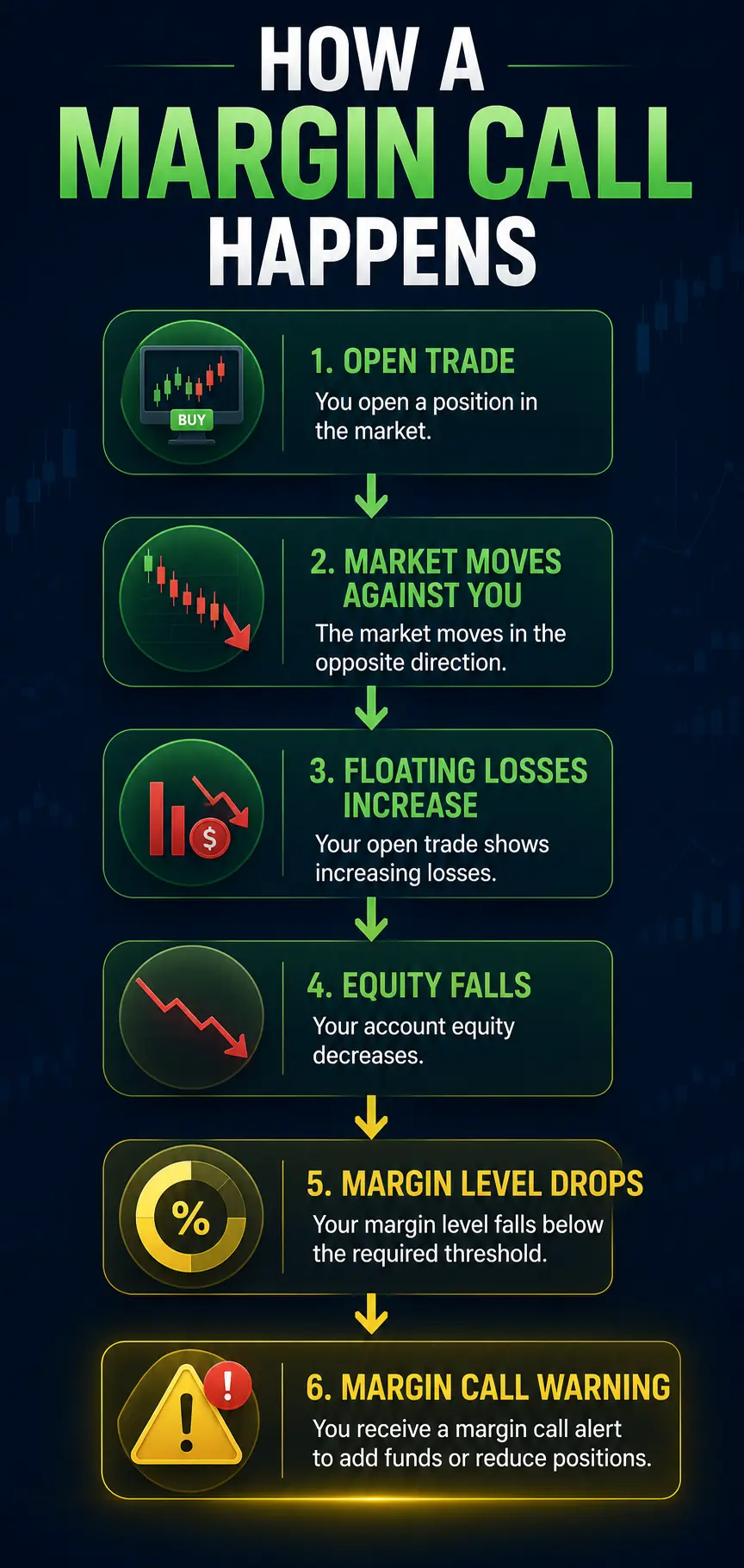
A margin call doesn’t happen immediately after you open a losing trade. Instead, it occurs gradually as market losses reduce your account equity.
To understand the process, it’s important to know how the key components of your trading account interact:
- Balance
- Equity
- Used Margin
- Free Margin
- Margin Level
As your open losses increase, your equity decreases. This causes your margin level to fall.
Once your margin level reaches your broker’s predefined margin call threshold, you’ll receive a warning asking you to take action.
If no action is taken and losses continue, your account may eventually reach the stop-out level, where the broker automatically begins closing your positions.
Step-by-Step Margin Call Example
Imagine you have the following trading account.
| Account Information | Value |
|---|---|
| Account Balance | $2,000 |
| Leverage | 1:100 |
| Trade Size | $100,000 |
| Required Margin | $1,000 |
When you first open the trade:
| Account Metric | Value |
|---|---|
| Balance | $2,000 |
| Equity | $2,000 |
| Used Margin | $1,000 |
| Free Margin | $1,000 |
| Margin Level | 200% |
Your account is healthy.
The Market Moves Against You
Suppose your position begins losing money.
Your floating loss reaches $600.
Your account now looks like this:
| Account Metric | Value |
|---|---|
| Balance | $2,000 |
| Floating Loss | -$600 |
| Equity | $1,400 |
| Used Margin | $1,000 |
| Free Margin | $400 |
| Margin Level | 140% |
You still have available margin, and no margin call has occurred.
Losses Continue
The market continues moving against your trade.
Floating loss:
$1,000
Now your account becomes:
| Account Metric | Value |
|---|---|
| Balance | $2,000 |
| Floating Loss | -$1,000 |
| Equity | $1,000 |
| Used Margin | $1,000 |
| Free Margin | $0 |
| Margin Level | 100% |
At many brokers, this is where a margin call may be triggered.
The platform notifies you that your account no longer has sufficient available margin to support additional losses.
If You Do Nothing
Suppose the market continues falling.
Floating loss:
$1,300
Now:
| Account Metric | Value |
|---|---|
| Equity | $700 |
| Used Margin | $1,000 |
| Margin Level | 70% |
If your broker’s stop-out level is 50%, you still have some room.
However, if losses continue, the broker will automatically begin closing positions to protect your account.
Does Every Broker Use the Same Margin Call Level?
No.
Every broker has its own margin policies.
For example:
| Broker | Example Margin Call Level* |
|---|---|
| Broker A | 100% |
| Broker B | 80% |
| Broker C | 50% |
These values are examples only. Always check your broker’s official trading conditions before opening a leveraged position.
This is one reason why it’s important to compare brokers before opening an account.
You can compare trading conditions in our Best Forex Brokers guide and detailed broker reviews.
What Should You Do After Receiving a Margin Call?
Receiving a margin call doesn’t necessarily mean you’ve lost your account.
In many cases, you still have several options to stabilize your account.
Option 1: Deposit Additional Funds
Adding more capital increases your account equity and improves your margin level.
Option 2: Close Losing Positions
Closing one or more losing trades reduces your used margin and can improve your available free margin.
Option 3: Reduce Position Size
Smaller positions require less margin and expose your account to lower risk.
Option 4: Wait Carefully
Sometimes the market recovers.
However, relying solely on hope is not considered a sound trading strategy.
Professional traders make decisions based on analysis and predefined risk management rules—not emotions.
Why Do Margin Calls Happen?
A margin call doesn’t happen randomly. It is usually the result of poor risk management, excessive leverage, or holding losing positions for too long.
Understanding the most common causes of margin calls can help you avoid them and protect your trading account.
1. Using Too Much Leverage
One of the biggest causes of margin calls is using excessive leverage.
Higher leverage allows you to control larger positions with less capital, but it also magnifies losses. Even a small adverse market movement can significantly reduce your account equity.
For example, a trader using 1:500 leverage is generally much more exposed to rapid account fluctuations than someone using 1:30 leverage.
Before selecting your leverage, read our What Is Leverage in Trading? Guide to understanding how leverage affects both profits and losses.
2. Opening Positions That Are Too Large
Many beginner traders focus on the amount of money they have in their account instead of the size of the position they are opening.
A trade that is too large relative to your account balance increases the amount of margin used and leaves very little free margin to absorb market fluctuations.
Using our Position Size Calculator before every trade can help ensure that your position size matches your risk tolerance.
3. Trading Without a Stop-Loss
A stop-loss is one of the simplest tools for protecting your account.
Without a stop-loss, a losing trade can continue accumulating losses until your equity drops below the required margin level.
Professional traders define their exit before entering a trade, rather than hoping the market will eventually reverse.
4. Holding Losing Trades for Too Long
Many traders refuse to accept a small loss.
Instead, they continue holding a losing position in the hope that the market will recover.
Unfortunately, if the market continues moving against the trade, losses increase, equity falls, and the likelihood of receiving a margin call grows.
Accepting a controlled loss is often far less damaging than allowing a losing position to threaten your entire account.
5. Opening Too Many Trades at the Same Time
Even if each trade seems reasonable on its own, opening multiple positions simultaneously can consume a large portion of your available margin.
This is particularly risky when the trades are highly correlated.
For example:
- Buying EUR/USD
- Buying GBP/USD
- Selling USD/CHF
Although these appear to be different trades, they all involve significant exposure to the U.S. dollar. A strong movement in the dollar could negatively impact all three positions at the same time.
6. Trading During High Volatility
Major economic announcements and unexpected geopolitical events can cause markets to move rapidly.
Examples include:
- Central bank interest rate decisions.
- Inflation reports.
- Non-Farm Payroll (NFP) releases.
- GDP announcements.
- Unexpected geopolitical events.
During these periods, price swings can quickly reduce account equity and trigger margin calls.
Many experienced traders reduce position sizes or avoid opening new leveraged positions immediately before high-impact news releases.
Margin Call vs Stop-Out
Although these terms are closely related, they are not the same.
Understanding the difference helps traders react appropriately when their account comes under pressure.
| Margin Call | Stop-Out |
|---|---|
| Warning from the broker | Automatic closure of positions |
| Gives the trader an opportunity to respond | Requires no action from the trader |
| Usually occurs first | Happens if losses continue |
| May allow additional deposits or position reductions | Broker begins closing trades automatically |
| Designed to warn the trader | Designed to protect the account from further losses |
A simple way to remember the difference is:
Margin Call = Warning
Stop-Out = Automatic Protection
We’ll explain stop-outs in greater detail in our dedicated guide What Is a Stop-Out Level?
How to Avoid a Margin Call
Avoiding a margin call starts long before you place a trade.
Successful traders focus on protecting their capital rather than maximizing leverage.
Here are some practical ways to reduce the risk.
Use Lower Leverage
Just because your broker offers leverage of 1:500 or 1:1000 doesn’t mean you should use it.
Choosing lower leverage generally provides more room for normal market fluctuations and reduces the likelihood of a margin call.
Risk Only a Small Percentage Per Trade
Many professional traders risk no more than 1–2% of their account on a single trade.
This approach allows them to survive losing streaks without significantly damaging their trading capital.
Monitor Your Margin Level
Your trading platform constantly displays your margin level.
Checking this value regularly allows you to identify potential problems before they become serious.
If your margin level begins falling rapidly, consider reducing your exposure before your broker issues a margin call.
Always Use Stop-Loss Orders
A stop-loss limits potential losses on every trade.
Using one consistently is one of the most effective ways to prevent large drawdowns and protect your account equity.
Calculate Margin Before Opening a Trade
Never guess how much margin a trade requires.
Use our Forex Margin Calculator to estimate the required margin and our Position Size Calculator to determine an appropriate position size before entering the market.
Diversify Your Risk
Avoid concentrating your entire account in a single market or highly correlated positions.
Diversification can reduce the impact of adverse price movements on your overall portfolio and help preserve your available margin.
Common Mistakes That Lead to Margin Calls
Even experienced traders occasionally receive margin calls. However, beginners are far more likely to encounter them because they often underestimate the risks of leveraged trading.
Avoiding the following mistakes can significantly improve your long-term trading performance.
Using the Maximum Leverage Available
One of the most common mistakes is assuming that higher leverage automatically leads to higher profits.
In reality, higher leverage simply increases your market exposure. While potential gains become larger, potential losses increase at the same rate.
Professional traders often use only a fraction of the maximum leverage offered by their broker.
Ignoring Margin Level
Many traders focus only on profits and losses while completely ignoring their margin level.
A falling margin level is one of the earliest warning signs that your account is becoming overexposed.
Checking your margin level regularly should become part of your trading routine.
Trading Without a Risk Management Plan
Opening trades without determining:
- Maximum acceptable loss
- Stop-loss level
- Position size
- Risk-to-reward ratio
is one of the fastest ways to receive a margin call.
Every trade should be planned before it is executed.
Averaging Down Losing Positions
Some traders continue adding to losing trades, believing the market will eventually reverse.
Although averaging down can work in certain professional strategies, beginners often misuse it.
Instead of improving the situation, it usually increases:
- Used Margin
- Overall Risk
- Probability of a Margin Call
Emotional Decision-Making
Fear and greed frequently lead traders to ignore their original trading plan.
Common emotional mistakes include:
- Revenge trading
- Removing stop-loss orders
- Increasing leverage after losses
- Refusing to close losing trades
Successful traders rely on discipline rather than emotions.
Best Practices to Protect Your Trading Account
Protecting your account is far more important than maximizing profits.
The following habits can dramatically reduce your chances of receiving a margin call.
Maintain a Healthy Margin Level
Rather than waiting until your margin level becomes dangerously low, aim to maintain a comfortable safety buffer.
Many experienced traders prefer to keep their margin level well above the broker’s minimum requirements.
Keep Sufficient Free Margin
Avoid using your entire account balance to support open positions.
Having additional free margin provides flexibility during periods of increased market volatility.
Review Your Open Positions Regularly
Markets change quickly.
Review your open positions throughout the trading day to ensure they still align with your trading plan and current market conditions.
Trade With Regulated Brokers
Regulated brokers typically provide transparent margin policies, clear risk disclosures, and additional client protections such as negative balance protection in many jurisdictions.
Before opening an account, compare trading conditions in our Best Forex Brokers guide.
FAQ
A margin call is a warning from your broker indicating that your trading account no longer has enough equity to support your open positions.
No, A margin call is simply a warning that your account is approaching a critical level. In many cases, traders can still deposit additional funds or reduce their positions before a stop-out occurs.
Yes.
You can reduce the likelihood of receiving a margin call by:
Using lower leverage.
Managing position size carefully.
Using stop-loss orders.
Monitoring your margin level.
Maintaining sufficient free margin.
If your losses continue and your account reaches the broker’s stop-out level, the broker may automatically close one or more of your open positions.
Final Thoughts
A margin call should not be viewed as a punishment; it is an important risk management mechanism designed to protect both traders and brokers.
Understanding why margin calls occur, how they are triggered, and how to respond can help you avoid unnecessary losses and improve your overall trading discipline.
Rather than trying to maximize leverage, successful traders focus on preserving capital through careful position sizing, disciplined risk management, and continuous monitoring of their account metrics.
If you’re new to leveraged trading, mastering the concepts of margin, leverage, free margin, and margin level will provide a strong foundation for making smarter trading decisions in the future.
Continue Learning
To build a complete understanding of leveraged trading, continue with these guides:
- What Is Margin in Trading?
- What Is Leverage in Trading?
- What Is Cryptocurrency Trading?
- What Is Binary Options Trading?
- What Is Forex Trading
- How to Start Forex Trading
You can also improve your trading decisions using our:
- Best Binary Options Brokers for Beginners In 2026
- Best Binary Options Brokers In 2026
- Best Brokers for Altcoins in 2026
- Best Brokers for Bitcoin in 2026
- Best Brokers for Day Trading In 2026
- Best Brokers in Nigeria 2026
- Best CFD Brokers In 2026
- Best Copy Trading Platforms In 2026
- Best Crypto Brokers 2026
- Best Crypto Brokers for Beginners in 2026
- Best Crypto Copy Trading Brokers in 2026
- Best ECN Brokers in 2026
- Best Forex Brokers for Beginners in 2026
- Best Forex Brokers In 2026
- Best Forex Brokers with Islamic Accounts in 2026
- Best Forex Brokers With No Inactivity Fee in 2026
- Best Free Binary Options Demo Accounts In 2026
- Best High Leverage Forex Brokers In 2026
- Best No Deposit Bonus Forex Brokers in 2026
- Best PayPal Forex Brokers in 2026
- Best Scalping Forex Brokers in 2026
- Lowest Minimum Deposit Binary Options Brokers In 2026
- Lowest Spread Forex Brokers In 2026