

Margin is one of the most important concepts every trader should understand before opening a leveraged position. Whether you’re trading Forex, CFDs, commodities, indices, or cryptocurrencies, margin determines how much of your own money is required to open and maintain a trade.
Many beginners mistakenly believe that margin is a fee charged by the broker. In reality, margin is simply a security deposit, also known as collateral, that allows you to access larger trading positions through leverage.
For example, with 1:100 leverage, you don’t need the full value of a $100,000 Forex position. Instead, your broker may require only $1,000 as margin to open the trade, while the remaining value is effectively covered through leverage.
If you’re new to leveraged trading, it’s helpful to first understand What Is Leverage in Trading?, as margin and leverage always work together. Leverage increases your market exposure, while margin determines how much capital is required to support that exposure.
In this comprehensive guide at TopRatedFX, you’ll learn what margin is, how it works, how to calculate it, the different types of margin, and how to manage your account to avoid margin calls and stop-outs. By the end, you’ll have a solid understanding of one of the most essential concepts in modern trading
Quick Answer
Margin is the amount of money a broker sets aside from your trading account as collateral to open and maintain a leveraged position. It is not a fee or a transaction cost.
For example:
- Account Balance: $2,000
- Leverage: 1:100
- Trade Size: $50,000
- Required Margin: $500
Once the trade is closed, the reserved margin becomes available again, provided your losses have not reduced your account equity.
Before opening any position, it’s also worth using our Position Size Calculator to determine the appropriate trade size based on your account balance and acceptable level of risk.
Margin at a Glance
| Feature | Description |
|---|---|
| Definition | Money reserved as collateral to support a leveraged trade |
| Required By | Your broker |
| Purpose | Allows traders to control larger positions using leverage |
| Markets | Forex, CFDs, Commodities, Indices, Crypto |
| Is It a Fee? | ❌ No |
| Returned After Closing the Trade? | ✅ Yes (if not lost through trading losses) |
| Closely Related To | Leverage, Margin Level, Margin Call, Free Margin |
Why Is Margin Important?
Without margin, leveraged trading would not exist.
Margin protects both traders and brokers by ensuring there is enough capital in a trading account to support open positions.
Understanding margin helps you:
- Open positions responsibly.
- Manage leverage effectively.
- Calculate the capital required before entering a trade.
- Reduce the likelihood of receiving a margin call.
- Improve overall risk management.
Professional traders pay close attention to margin because it directly affects how many positions they can open and how much market exposure they can safely manage.
Once you’ve mastered the basics of margin, compare the leverage and margin requirements offered by different platforms in our Best Forex Brokers guide, and you should take a look at the best brokers in 2026
To improve your decision-making, read our Forex Trading guide.
How Does Margin Work in Trading?
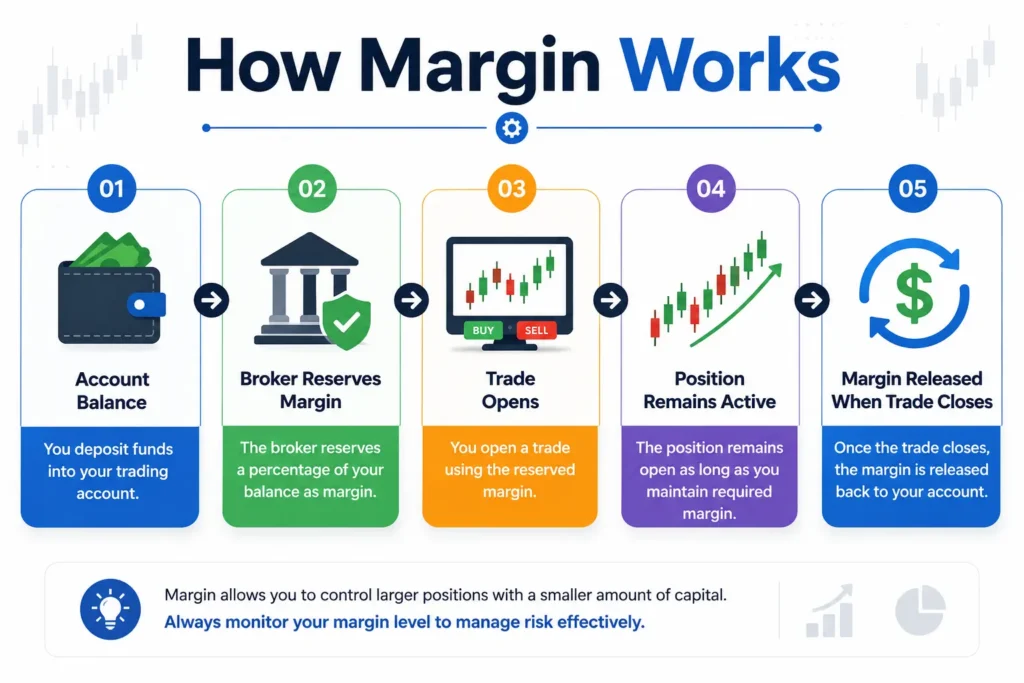
Margin is the amount of money your broker reserves from your account when you open a leveraged position. It acts as collateral rather than a payment, allowing you to control a position that is much larger than your account balance.
Think of margin as a security deposit. While your trade is open, the broker temporarily locks a portion of your funds. Once the position is closed, that margin becomes available again, provided your losses haven’t reduced your account equity.
Understanding how margin works is essential because it directly affects:
- The number of trades you can open.
- Your available buying power.
- Your account’s ability to withstand market fluctuations.
- Your risk of receiving a margin call.
Step-by-Step Example
Let’s walk through a practical example.
Suppose your trading account has:
| Account Information | Value |
|---|---|
| Account Balance | $2,000 |
| Broker Leverage | 1:100 |
| Trade Size | 100,000 EUR/USD |
| Position Value | $100,000 |
With 1:100 leverage, the broker requires only 1% of the total trade value as margin.
Required Margin
$100,000 × 1%
=
$1,000
Although you’re controlling a $100,000 position, only $1,000 is reserved from your account.
The remaining balance continues to act as available funds to absorb market fluctuations.
If you’d like to calculate margin for your own trades, use our Forex Margin Calculator.
Margin Calculation Formula
The basic formula is straightforward.
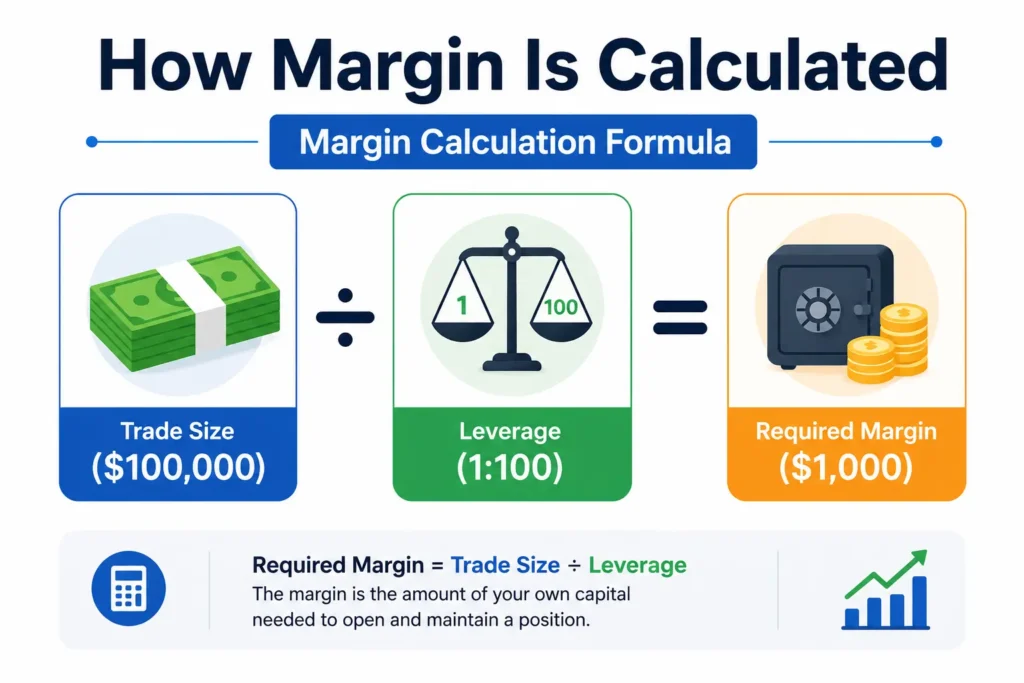
Margin Formula
Required Margin =
Trade Size ÷ Leverage
Example 1
Trade Size
$50,000
Leverage
1:100
Calculation
50,000 ÷ 100 = $500Required Margin
$500
Example 2
Trade Size
$20,000
Leverage
1:50
Calculation
20,000 ÷ 50 = $400Required Margin
$400
Example 3
Trade Size
$250,000
Leverage
1:500
Calculation
250,000 ÷ 500 = $500Notice something interesting.
Although the trade size increased dramatically, the required margin remained relatively small because the leverage was much higher.
This demonstrates why high leverage allows traders to control larger market positions with less capital—but it also increases risk.
The Relationship Between Margin and Leverage
Margin and leverage always move in opposite directions.
As leverage increases:
✅ Required margin decreases.
As leverage decreases:
✅ Required margin increases.
| Leverage | Margin Requirement |
|---|---|
| 1:2 | 50% |
| 1:5 | 20% |
| 1:10 | 10% |
| 1:20 | 5% |
| 1:30 | 3.33% |
| 1:50 | 2% |
| 1:100 | 1% |
| 1:200 | 0.50% |
| 1:500 | 0.20% |
| 1:1000 | 0.10% |
This is why traders often discuss leverage and margin together—they are two sides of the same concept.
If you haven’t already, read our What Is Leverage in Trading? Guide to understanding how leverage affects buying power and overall trading risk.
Margin vs Leverage
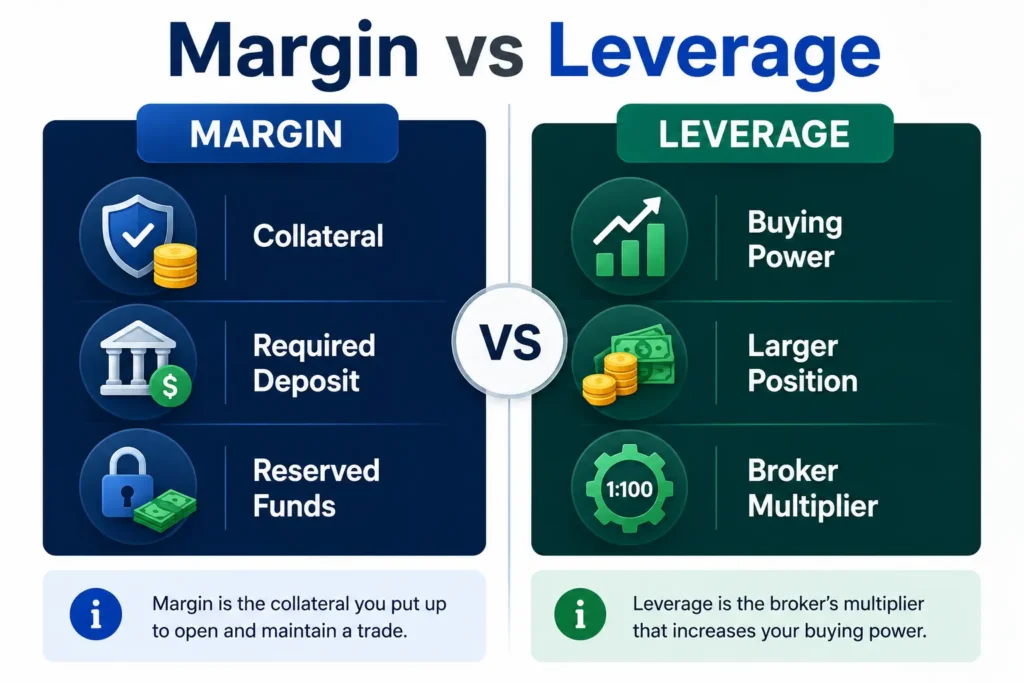
Many new traders mistakenly use these terms interchangeably.
However, they have completely different meanings.
| Margin | Leverage |
|---|---|
| Money required to open a trade | Borrowed buying power provided by the broker |
| Measured in currency or percentage | Expressed as a ratio (1:30, 1:100, etc.) |
| Acts as collateral | Increases market exposure |
| Reserved from your account | Multiplies your purchasing power |
A simple way to remember the difference is:
Leverage determines how much you can control. Margin determines how much you must provide.
Why Do Brokers Require Margin?
Without margin, brokers would be exposed to unlimited financial risk.
Margin helps ensure that traders have enough funds to support their positions and absorb potential losses.
It also allows brokers to:
- Reduce credit risk.
- Protect client accounts.
- Maintain orderly trading conditions.
- Automatically close positions before account balances become negative (subject to broker policies).
This system protects both the trader and the broker while making leveraged trading possible.
Types of Margin in Trading
When you open a leveraged trade, your trading platform displays several margin-related values. Understanding these terms will help you manage your account more effectively and avoid unnecessary risks.
The most common types of margin include:
- Initial Margin
- Maintenance Margin
- Used Margin
- Free Margin
- Margin Level
Let’s examine each one.
Initial Margin
Initial Margin is the minimum amount of money required to open a new leveraged position.
Think of it as the entry requirement for a trade.
For example:
| Trade Details | Value |
|---|---|
| Trade Size | $100,000 |
| Leverage | 1:100 |
| Initial Margin Required | $1,000 |
Once the position is opened, the broker reserves this amount from your available balance.
The remaining funds stay available to support market fluctuations or additional trades.
Maintenance Margin
Maintenance Margin is the minimum amount of equity that must remain in your trading account to keep your positions open.
If your account equity falls below this level, your broker may issue a margin call or begin closing positions automatically.
Unlike Initial Margin, Maintenance Margin is monitored continuously while your trade remains active.
Its purpose is to reduce the broker’s credit risk and prevent your account balance from becoming negative.
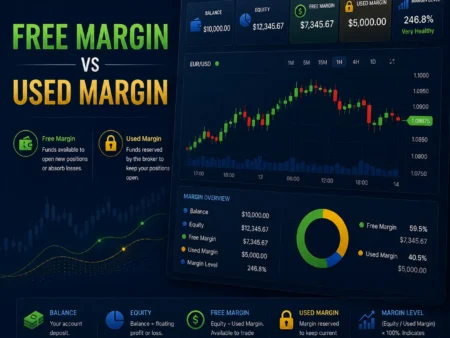
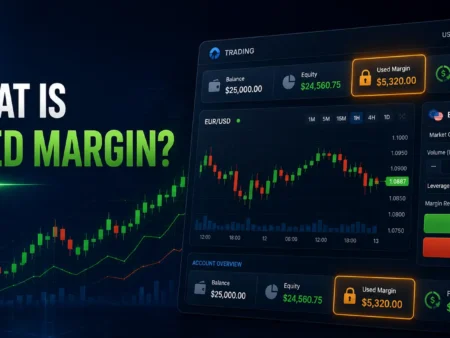
Used Margin
Used Margin is the total amount of money currently reserved by your broker to maintain all open positions.
This money cannot be used to open additional trades until existing positions are closed.
Example
Account Balance
$5,000
Open Position 1
Margin Required
$500
Open Position 2
Margin Required
$700
Total Used Margin
$1,200
As long as both trades remain open, the $1,200 stays reserved by the broker.
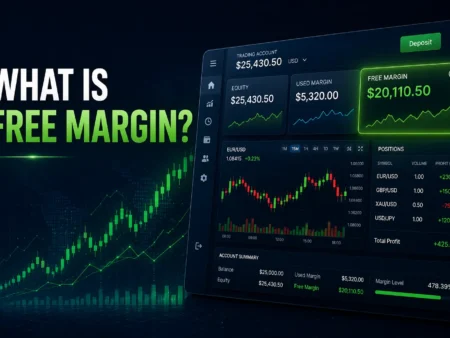
Free Margin
Free Margin is the amount of money still available to open new trades or absorb temporary losses.
It is calculated using the following formula:
Free Margin = Equity − Used MarginExample
| Account Information | Value |
|---|---|
| Equity | $5,000 |
| Used Margin | $1,200 |
| Free Margin | $3,800 |
The higher your Free Margin, the more flexibility you have when trading.
Professional traders monitor this value closely because it reflects how much additional risk their account can safely handle.
Margin Level
Margin Level is one of the most important risk indicators in trading.
It shows the relationship between your account equity and the margin currently being used.
Margin Level Formula
Margin Level (%) = (Equity ÷ Used Margin) × 100Example
| Value | Amount |
|---|---|
| Equity | $4,000 |
| Used Margin | $1,000 |
Calculation:
(4,000 ÷ 1,000) × 100 = 400%Margin Level
400%
A higher Margin Level generally indicates a healthier trading account.
As your losses increase, your Margin Level decreases.
If it falls below your broker’s required threshold, you may receive a Margin Call or reach the Stop-Out Level.
We’ll explain both concepts in detail in our upcoming guides:
- What Is a Margin Call?
- What Is a Stop-Out Level?
Comparison of Margin Types
| Margin Type | Purpose | When It’s Used |
|---|---|---|
| Initial Margin | Required to open a trade | Before entering a position |
| Maintenance Margin | Keeps positions active | While the trade is open |
| Used Margin | Reserved collateral | During open trades |
| Free Margin | Available trading funds | For new trades or absorbing losses |
| Margin Level | Measures account health | Continuously updated |
Why Understanding Margin Types Matters
Many beginner traders focus only on leverage while ignoring margin metrics.
In reality, successful traders monitor:
- Available Free Margin.
- Margin Level.
- Account Equity.
- Used Margin.
- Overall account exposure.
These metrics help traders avoid unnecessary margin calls and maintain better control over risk.
Before opening additional positions, it’s always a good idea to calculate your required margin using our Forex Margin Calculator and determine the appropriate trade size with our Position Size Calculator.
What Is a Margin Call?
A margin call is a warning from your broker that your trading account no longer has enough equity to support your open positions.
In simple terms, it means your losses have reduced your available funds to a level where your broker requires you to either:
- Deposit more money.
- Close some positions.
- Reduce your overall market exposure.
A margin call is not an automatic account closure. Instead, it serves as a warning that your account is approaching a dangerous level.
Many brokers notify traders through:
- Platform notifications
- Mobile app alerts
- Trading terminal pop-ups
Ignoring a margin call can eventually lead to a stop-out, where the broker automatically closes your trades.
Example of a Margin Call
Imagine the following account:
| Account Information | Value |
|---|---|
| Balance | $2,000 |
| Equity | $700 |
| Used Margin | $600 |
| Free Margin | $100 |
As the market continues moving against your position, your equity falls further.
Eventually, your broker’s margin call level is reached.
At this point, you may receive a notification asking you to:
- Deposit additional funds.
- Close losing trades.
- Reduce your position size.
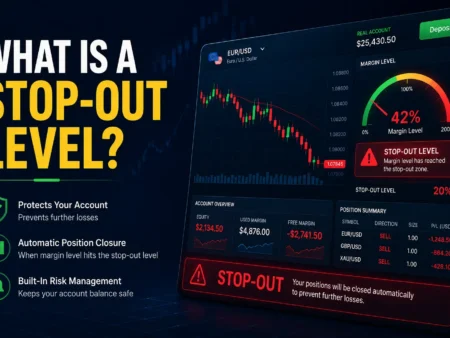
What Is a Stop-Out Level?
A stop-out level is the point at which your broker automatically closes one or more of your open positions because your account no longer has sufficient equity.
Unlike a margin call, a stop-out requires no action from you.
The trading platform closes positions automatically to prevent further losses and, in many cases, to help avoid a negative account balance.
Most brokers start by closing the largest losing position first.
They continue closing positions until your account meets the required margin level again.
Margin Call vs Stop-Out
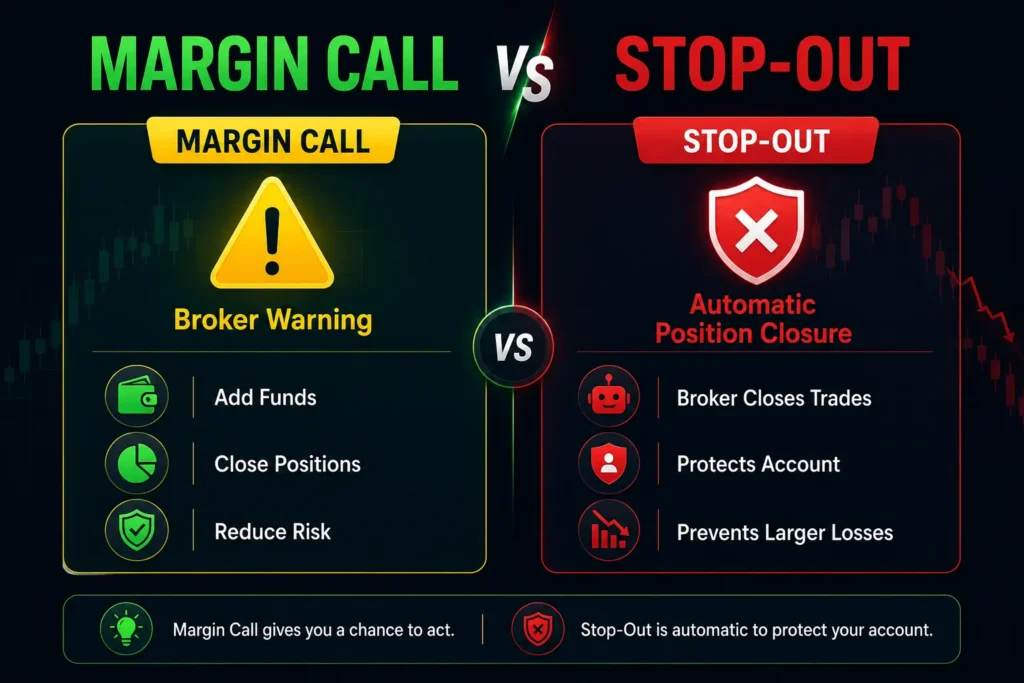
Although these terms are often used together, they represent different stages of risk management.
| Margin Call | Stop-Out |
|---|---|
| Warning from the broker | Automatic position closure |
| Gives the trader time to react | Happens automatically |
| May require depositing additional funds | No action required from the trader |
| Occurs before a stop-out | Final protection mechanism |
A simple way to remember the difference is:
Margin Call = Warning
Stop-Out = Automatic Action
Why Do Margin Calls Happen?
Margin calls usually occur because traders take on more risk than their accounts can support.
The most common causes include:
Using Excessive Leverage
Higher leverage increases market exposure.
While profits may grow faster, losses also accumulate more quickly.
Opening Positions That Are Too Large
Many traders ignore proper position sizing.
Even moderate market movements can significantly reduce account equity when position sizes are too large.
Use our Position Size Calculator before opening any trade.
Trading Without a Stop-Loss
Without a predefined exit point, losing trades can continue to grow until they consume a large portion of your account.
A stop-loss helps limit potential losses before they become unmanageable.
Holding Losing Trades Too Long
Some traders hope the market will reverse instead of accepting a small loss.
Unfortunately, this often leads to larger losses and increases the likelihood of receiving a margin call.
How to Avoid Margin Calls
The best traders don’t simply react to margin calls—they take steps to prevent them.
Here are some practical ways to protect your account:
Use Lower Leverage
Just because your broker offers 1:500 leverage doesn’t mean you need to use it.
Choosing lower leverage can reduce your overall risk.
Monitor Your Free Margin
Keep an eye on your available free margin.
A healthy free margin provides flexibility and helps absorb temporary market fluctuations.
Risk Only 1–2% Per Trade
Many professional traders risk only a small percentage of their account on each trade.
This approach helps preserve trading capital during losing streaks.
Use Stop-Loss Orders
Every trade should include a predefined stop-loss.
This limits downside risk and helps protect your account equity.
Calculate Margin Before Trading
Before opening a position, calculate:
- Required Margin.
- Position Size.
- Potential Loss.
Our Forex Margin Calculator and Position Size Calculator can help you make informed trading decisions.
Common Mistakes Traders Make
Avoid these common mistakes when trading with margin:
- Using the maximum leverage available.
- Ignoring margin level.
- Trading without a stop-loss.
- Overtrading.
- Risking too much on a single position.
- Chasing losses after a losing trade.
- Opening multiple correlated positions without considering total exposure.
Successful traders focus on capital preservation first and profits second.
Advantages and Disadvantages of Margin Trading
Margin is an essential component of leveraged trading. While it provides traders with greater market access and flexibility, it also introduces additional risks that every trader should understand before opening a position.
Understanding both the advantages and disadvantages of margin can help you make more informed trading decisions.
Advantages of Margin
1. Access to Larger Trading Positions
Margin allows traders to control positions that would otherwise require a significantly larger amount of capital.
For example, instead of needing $100,000 to trade one standard lot in the Forex market, a trader using 1:100 leverage may only need $1,000 as margin.
This makes financial markets accessible to a wider range of retail traders.
2. Better Capital Efficiency
Since only a portion of your funds is reserved as margin, the remaining capital stays available for other purposes.
This allows traders to:
- Diversify across multiple markets.
- Maintain additional liquidity.
- Manage multiple trading opportunities.
- Improve portfolio flexibility.
Professional traders often focus on efficient capital allocation rather than on using maximum leverage.
3. Increased Market Opportunities
Margin enables traders to participate in various markets, including:
- Forex
- CFDs
- Commodities
- Stock Indices
- Cryptocurrencies
Without margin, many traders would be unable to access these markets with relatively small trading accounts.
4. More Efficient Portfolio Management
Using margin responsibly allows traders to spread risk across multiple positions instead of committing all available capital to a single trade.
This can improve diversification when combined with a sound risk management strategy.
Disadvantages of Margin
Despite its advantages, margin also introduces significant risks.
1. Increased Trading Risk
While margin itself does not create losses, it enables larger positions, which means market movements have a greater impact on your account.
Small price changes can produce much larger profits—or losses—than trading without leverage.
2. Margin Calls
If your account equity falls below the required maintenance level, your broker may issue a margin call.
This may require you to:
- Deposit additional funds.
- Close positions.
- Reduce overall exposure.
Failure to respond may lead to a stop-out.
3. Automatic Position Closures
If losses continue and your account reaches the broker’s stop-out level, open positions may be closed automatically.
This process helps protect both the broker and the trader from excessive losses.
4. Emotional Trading
Watching your available margin decrease can create psychological pressure.
This often leads to:
- Panic selling.
- Revenge trading.
- Overtrading.
- Ignoring risk management rules.
Maintaining discipline is just as important as understanding margin calculations.
Pros and Cons of Margin
| Advantages | Disadvantages |
|---|---|
| Access to larger positions | Higher trading risk |
| Better capital efficiency | Margin calls |
| Greater market participation | Automatic stop-outs |
| More flexible portfolio management | Emotional decision-making |
| Supports diversification | Larger potential losses |
Best Practices for Managing Margin
Professional traders don’t simply monitor profits—they actively manage their available margin to reduce risk.
Here are some best practices:
Use Appropriate Leverage
Higher leverage reduces the required margin but increases overall exposure.
Choose leverage based on your strategy rather than the maximum offered by your broker.
Monitor Margin Level Frequently
Keep your margin level comfortably above your broker’s minimum requirement.
A healthy margin level provides greater flexibility during periods of market volatility.
Always Use Stop-Loss Orders
Every leveraged position should include a predefined exit point.
This helps protect account equity and reduces the likelihood of margin calls.
Avoid Overleveraging
One of the biggest mistakes beginners make is opening positions that are too large for their account size.
Focus on consistent risk management instead of maximizing position size.
Calculate Before You Trade
Before entering any trade, calculate:
- Required Margin.
- Position Size.
- Potential Risk.
- Risk-to-Reward Ratio.
Using our Forex Margin Calculator and Position Size Calculator can help you make more informed trading decisions.
FAQ
Margin is the amount of money a broker requires as collateral to open and maintain a leveraged trading position.
Leverage determines how much buying power you receive, while margin is the amount of your own money required to support that leveraged position.
Margin is not a trading fee or commission. It is a temporary amount reserved by the broker while your trade remains open.
If your available margin falls too low, your broker may issue a margin call or automatically close positions once the stop-out level is reached.
Yes, in cash accounts or by trading without leverage.
However, leveraged products such as Forex and CFDs always require margin.
You can reduce the likelihood of a margin call by:
Using lower leverage.
Applying proper risk management.
Monitoring free margin.
Using stop-loss orders.
Avoiding oversized positions.
Final Thoughts
Margin is one of the fundamental building blocks of leveraged trading. Rather than viewing it as a cost, traders should understand it as the collateral that makes larger market exposure possible.
Learning how margin interacts with leverage, equity, free margin, and margin level is essential for making informed trading decisions.
Whether you’re trading Forex, CFDs, commodities, or cryptocurrencies, successful margin management comes down to three principles:
- Control your risk.
- Use leverage responsibly.
- Never open a position without understanding its margin requirements.
By combining proper education with disciplined risk management and the right trading tools, you’ll be better prepared to navigate leveraged markets with confidence.
If you’re ready to continue learning, explore our guides on What Is Leverage in Trading?, What Is a Margin Call? And What Is a Stop-Out Level? To deepen your understanding of leveraged trading.
- Best Binary Options Brokers for Beginners In 2026
- Best Binary Options Brokers In 2026
- Best Brokers for Altcoins in 2026
- Best Brokers for Bitcoin in 2026
- Best Brokers for Day Trading In 2026
- Best Brokers in Nigeria 2026
- Best CFD Brokers In 2026
- Best Copy Trading Platforms In 2026
- Best Crypto Brokers 2026
- Best Crypto Brokers for Beginners in 2026
- Best Crypto Copy Trading Brokers in 2026
- Best ECN Brokers in 2026
- Best Forex Brokers for Beginners in 2026
- Best Forex Brokers In 2026
- Best Forex Brokers with Islamic Accounts in 2026
- Best Forex Brokers With No Inactivity Fee in 2026
- Best Free Binary Options Demo Accounts In 2026
- Best High Leverage Forex Brokers In 2026
- Best No Deposit Bonus Forex Brokers in 2026
- Best PayPal Forex Brokers in 2026
- Best Scalping Forex Brokers in 2026
- Lowest Minimum Deposit Binary Options Brokers In 2026
- Lowest Spread Forex Brokers In 2026