

A stop-out level is the point at which your broker automatically closes one or more of your open trading positions because your account equity has fallen too low to support them.
Unlike a margin call, which serves as a warning, a stop-out requires no action from the trader. Once your account reaches the broker’s predefined stop-out threshold, the trading platform starts closing positions automatically until the margin level improves.
Stop-out levels are commonly used in Forex, CFD, commodity, index, and cryptocurrency trading, where leverage enables traders to control larger positions using relatively small amounts of capital.
Every broker defines its own stop-out policy. Some brokers begin closing trades when the margin level reaches 50%, while others may use 30%, 20%, or even 10%, depending on their risk management rules and account type.
Understanding stop-out levels is essential because they represent the final stage of broker protection before losses continue to increase. Knowing how they work can help you manage risk more effectively and avoid having your trades closed unexpectedly.
If you’re new to leveraged trading, we recommend reading What Is Margin in Trading?, What Is Leverage in Trading? and What Is a Margin Call? Before continuing with this guide.
Quick Answer
A stop-out level is the margin level at which a broker automatically closes your open positions because your account equity is no longer sufficient to maintain them.
Unlike a margin call, a stop-out is automatic. The broker’s trading system starts closing losing positions to reduce risk and restore your account to a safer margin level.
Once you’ve mastered the basics of Stop-Out Level, compare the Stop-Out Level requirements offered by different platforms in our Best Forex Brokers guide, and you should take a look at the best brokers in 2026
Stop-Out Level at a Glance
| Feature | Description |
|---|---|
| Definition | Automatic closure of open positions by the broker |
| Trigger | Margin level falls below the broker’s stop-out percentage |
| Trader Action Required | No |
| Happens Automatically | Yes |
| Usually Occurs | After a margin call |
| Purpose | Protect both the trader and the broker from further losses |
| Markets | Forex, CFDs, Commodities, Indices, Crypto |
Why Do Brokers Use Stop-Out Levels?
Leverage allows traders to open positions that are much larger than their account balance.
While this increases potential profits, it also increases potential losses.
If there were no stop-out mechanism, traders could continue holding losing positions until their accounts became completely depleted—or, in some cases, even result in a negative balance.
To reduce this risk, brokers automatically monitor every leveraged account.
When the account’s equity drops below the required margin level, the broker’s risk management system begins closing positions automatically.
This protects:
- The trader from losing more than necessary.
- The broker from financing excessive losses.
- The stability of the trading platform.
For this reason, nearly every regulated broker uses some form of stop-out protection.
How Is a Stop-Out Level Calculated?
A stop-out is based on your margin level, not simply on the amount of money in your account.
The margin level compares your account equity with the margin currently being used to keep your positions open.
As your floating losses increase, your equity decreases while your used margin generally remains unchanged.
As a result, your margin level gradually falls.
Once it reaches your broker’s predefined stop-out percentage, the platform begins closing trades automatically.
This means that the stop-out level depends on several factors, including:
- Your account equity.
- The amount of used margin.
- Your floating profit or loss.
- The broker’s stop-out percentage.
- The leverage used.
- The size of your open positions.
Because of these variables, two traders with the same account balance can reach a stop-out level at completely different times depending on how they manage risk.
Example of a Stop-Out Level
Imagine the following trading account.
| Account Information | Value |
|---|---|
| Balance | $1,000 |
| Equity | $1,000 |
| Used Margin | $500 |
| Broker Stop-Out Level | 50% |
Initially, the account is healthy.
As the market moves against the trade, floating losses increase.
Eventually, the account looks like this:
| Metric | Value |
|---|---|
| Balance | $1,000 |
| Floating Loss | -$750 |
| Equity | $250 |
| Used Margin | $500 |
| Margin Level | 50% |
The account has now reached the broker’s stop-out level.
Instead of waiting for the trader to react, the broker automatically starts closing positions to prevent additional losses.
Most trading platforms close the largest losing position first, although the exact process varies between brokers.
What Happens During a Stop-Out?
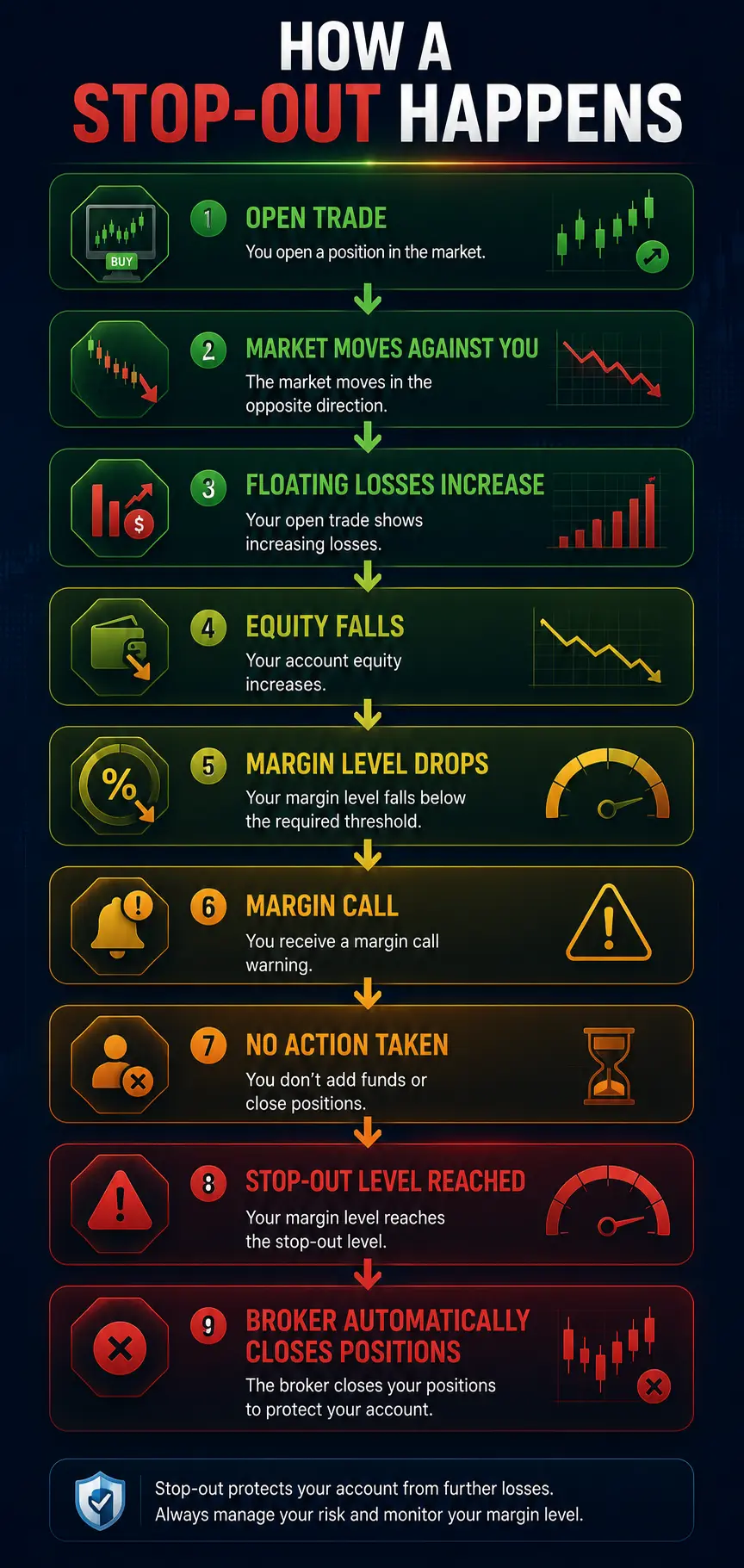
Once your account reaches the stop-out level, the trading platform automatically intervenes.
Depending on the broker’s policy, the platform may:
- Close the largest losing position first.
- Close multiple positions at once.
- Continue closing positions until the margin level rises above the stop-out threshold.
- Prevent additional losses by reducing your account further.
Because the process is automatic, traders cannot stop it once the stop-out level has been reached.
Stop-Out Level vs Margin Call
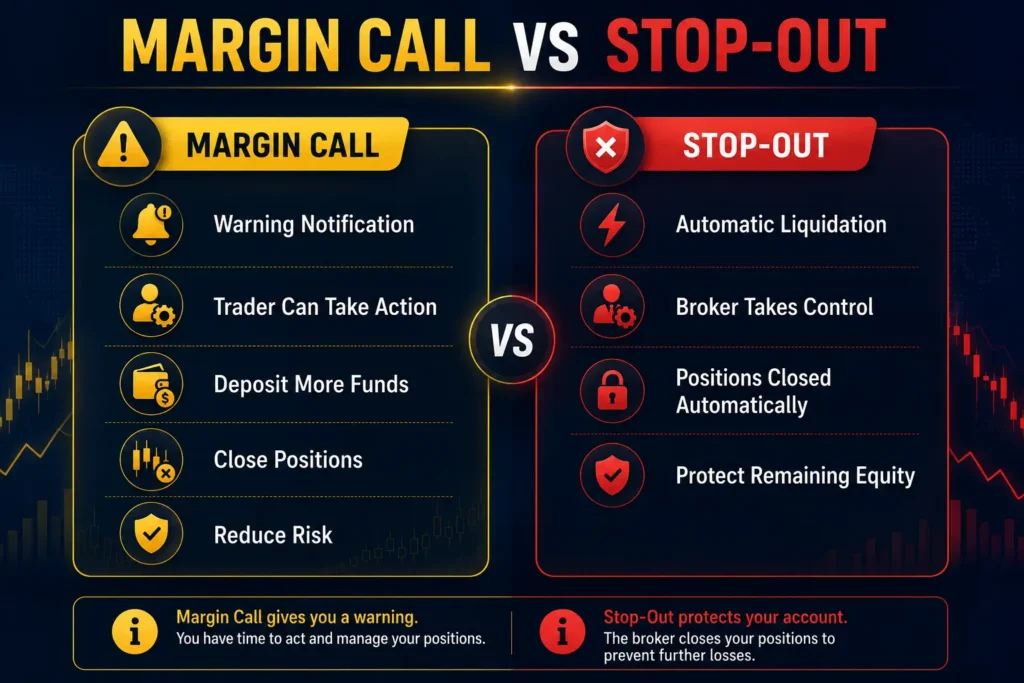
Although traders often use the terms margin call and stop-out level interchangeably, they refer to two different stages of your broker’s risk management process.
A margin call is a warning that your account is approaching a dangerous level, giving you an opportunity to take corrective action.
A stop-out, on the other hand, is the automatic liquidation of your positions when your account no longer meets the broker’s minimum margin requirements.
In simple terms:
- Margin Call = Warning
- Stop-Out = Automatic Action
Understanding this distinction is essential because it helps traders recognize when they still have time to protect their account and when the broker takes control.
| Margin Call | Stop-Out Level |
|---|---|
| Warning from the broker | Automatic closure of positions |
| Trader can still react | No action required from the trader |
| Usually occurs first | Usually occurs after a margin call |
| Additional funds can be deposited | Positions begin closing automatically |
| Helps prevent a stop-out | Protects the account from further losses |
Think of it like a fuel warning in a car.
A margin call is similar to the fuel warning light telling you it’s time to refuel.
A stop-out is like the engine shutting down because the fuel tank has become empty.
Do All Brokers Use the Same Stop-Out Level?
No.
Every broker sets its own stop-out percentage based on its internal risk management policies, account types, and regulatory requirements.
For example, one broker may use a stop-out level of 50%, while another may use 20% or 30%.
Some brokers even offer different stop-out levels depending on the account type.
For this reason, traders should always review a broker’s trading conditions before opening an account.
A lower stop-out level gives positions more room to fluctuate, while a higher stop-out level may result in earlier automatic liquidation.
However, a lower stop-out level should never be viewed as an invitation to take greater risks.
Good risk management remains far more important than the broker’s specific stop-out percentage.
How to Avoid a Stop-Out Level
The best way to deal with a stop-out is to prevent it from happening in the first place.
Professional traders rarely reach stop-out levels because they actively manage risk long before their account approaches dangerous levels.
Here are several practical ways to reduce the likelihood of a stop-out.
Use Conservative Leverage
Higher leverage increases the speed at which losses affect your account.
Choosing lower leverage provides more room for normal market fluctuations and helps maintain a healthier margin level.
Risk Only a Small Percentage of Your Account
Many experienced traders risk only 1% to 2% of their account on a single trade.
This approach makes it much less likely that one losing trade—or even several consecutive losses—will push the account toward a stop-out.
Always Use a Stop-Loss Order
A stop-loss automatically closes a trade when the market reaches a predetermined price.
This limits losses before they become large enough to threaten your margin level.
Trading without a stop-loss exposes your account to unnecessary risk, particularly during volatile market conditions.
Monitor Your Margin Level Regularly
Your trading platform continuously displays your current margin level.
Checking this value frequently allows you to identify problems before they become critical.
If your margin level begins falling rapidly, consider reducing your exposure before the broker intervenes.
Avoid Overtrading
Opening multiple large positions at the same time consumes available margin quickly.
Even if each trade appears reasonable individually, the combined exposure may significantly increase your overall account risk.
Focus on quality trades rather than quantity.
Maintain Sufficient Free Margin
Leaving unused capital in your account creates a buffer against unexpected market movements.
Adequate free margin allows positions to withstand temporary price fluctuations without immediately approaching the broker’s stop-out level.
Common Mistakes That Lead to a Stop-Out
Most stop-outs are not caused by bad luck.
Instead, they result from avoidable trading mistakes.
Some of the most common include:
- Using excessive leverage.
- Opening positions that are too large.
- Ignoring margin level warnings.
- Trading without a stop-loss.
- Holding losing trades in the hope they will recover.
- Averaging down repeatedly on losing positions.
- Risking too much on a single trade.
- Trading during major news events without adjusting position size.
Recognizing these mistakes early can significantly improve your long-term trading performance.
Best Practices for Managing Leveraged Trades
If you use leverage regularly, adopting disciplined trading habits is essential.
Professional traders typically follow these principles:
- Plan every trade before entering the market.
- Determine position size using predefined risk limits.
- Use stop-loss orders consistently.
- Keep leverage at reasonable levels.
- Monitor account equity and margin level daily.
- Avoid emotional decision-making.
- Never rely on hope to recover losing trades.
Successful trading is not about avoiding losses completely—it is about ensuring that individual losses never become large enough to threaten your trading account.
These habits not only reduce the risk of a stop-out but also contribute to more consistent long-term performance.
FAQ
A stop-out level is the point at which your broker automatically closes one or more of your open positions because your account no longer has enough equity to support them.
Unlike a margin call, a stop-out requires no action from the trader. The trading platform automatically begins reducing your exposure to prevent further losses.
No.
Although they are closely related, they occur at different stages.
A margin call is a warning that your account is approaching a dangerous margin level.
A stop-out happens if the account continues losing value and reaches the broker’s predefined stop-out percentage. At that point, positions are closed automatically.
Yes.
The best ways to avoid a stop-out include:
Using lower leverage.
Opening appropriately sized positions.
Setting stop-loss orders.
Monitoring your margin level.
Keeping a sufficient free margin.
Following a disciplined risk management plan.
This depends on the broker’s policy.
Many brokers close the position with the largest floating loss first because doing so often restores the margin level more quickly.
However, some brokers close positions based on the order in which they were opened or use other internal liquidation methods.
Always review your broker’s trading conditions for specific details.
In many cases, a stop-out helps prevent this from happening.
By automatically closing positions before losses become too large, the broker attempts to preserve any remaining equity in your account.
However, during periods of extreme market volatility or significant price gaps, losses may exceed expectations before positions can be closed.
Final Thoughts
A stop-out level is one of the most important safety mechanisms in leveraged trading.
While no trader wants to experience automatic position closures, stop-outs exist to prevent losses from escalating beyond manageable levels. Understanding how they work enables traders to manage leverage more responsibly and maintain better control over their trading accounts.
The most effective way to avoid a stop-out is not by searching for brokers with lower stop-out percentages, but by practicing sound risk management. Using appropriate leverage, maintaining sufficient free margin, sizing positions carefully, and applying stop-loss orders consistently can significantly reduce the likelihood of reaching a stop-out level.
Rather than viewing a stop-out as a punishment, think of it as the final safeguard designed to protect your remaining capital when market conditions move sharply against your positions.
Continue Learning
To deepen your understanding of leveraged trading, continue with these related guides:
Margin & Leverage
- What Is Leverage in Trading?
- What Is Margin in Trading?
- What Is a Margin Call?
- What Is Free Margin? (Coming Soon)
- What Is Used Margin? (Coming Soon)
- Free Margin vs Used Margin (Coming Soon)
- What Is Margin Level? (Coming Soon)
- How to Calculate Margin Level (Coming Soon)
- What Is Cryptocurrency Trading?
- What Is Binary Options Trading?
- What Is Forex Trading
- How to Start Forex Trading
Trading Tools
Best Brokers
- Best Binary Options Brokers for Beginners In 2026
- Best Binary Options Brokers In 2026
- Best Brokers for Altcoins in 2026
- Best Brokers for Bitcoin in 2026
- Best Brokers for Day Trading In 2026
- Best Brokers in Nigeria 2026
- Best CFD Brokers In 2026
- Best Copy Trading Platforms In 2026
- Best Crypto Brokers 2026
- Best Crypto Brokers for Beginners in 2026
- Best Crypto Copy Trading Brokers in 2026
- Best ECN Brokers in 2026
- Best Forex Brokers for Beginners in 2026
- Best Forex Brokers In 2026
- Best Forex Brokers with Islamic Accounts in 2026
- Best Forex Brokers With No Inactivity Fee in 2026
- Best Free Binary Options Demo Accounts In 2026
- Best High Leverage Forex Brokers In 2026
- Best No Deposit Bonus Forex Brokers in 2026
- Best PayPal Forex Brokers in 2026
- Best Scalping Forex Brokers in 2026
- Lowest Minimum Deposit Binary Options Brokers In 2026
- Lowest Spread Forex Brokers In 2026