

Binary options trading remains one of the most debated forms of financial speculation in the online trading industry. Some traders view it as a simple way to participate in market movements, while others criticize it because of its high-risk nature and history of fraudulent operators.
As a trading education website, we believe that understanding the mechanics, risks, and realities of binary options is essential before depositing a single dollar with any platform.
Unlike traditional investing, where profits and losses often depend on how far an asset moves, binary options focus on a single question:
Will the price be above or below a specific level when the trade expires?
The answer is either correct or incorrect. Because of this all-or-nothing outcome, binary options are often described as one of the simplest financial products available to retail traders.
However, simple does not mean easy.
Many beginners are attracted by promises of fast profits, high payout percentages, and short trade durations. In reality, successful binary options trading requires market knowledge, risk management, emotional discipline, and a clear understanding of probability.
Learn more about the Best Binary Options Brokers for Beginners
In this guide at TopRatedFX, we will explain exactly what binary options are, how they work, whether they should be considered gambling or trading, and the key facts every trader should know before getting started.
Risk Warning: Trading financial instruments such as forex, cryptocurrencies, CFDs, and binary options involves a high risk of loss and may not be suitable for all investors. You should only trade with money you can afford to lose. Past performance is not indicative of future results. Binary options are NOT available in EU/EEA and carry high risk.
What Is Binary Options?
Binary options trading is a form of financial trading where a trader predicts whether the price of an asset will be higher or lower than a specified price level at a predetermined expiration time.
The term “binary” comes from the fact that there are only two possible outcomes:
- The prediction is correct, and the trader receives a fixed payout.
- The prediction is incorrect, and the trader loses the amount invested in the trade.
Unlike traditional Forex or stock trading, traders do not own the underlying asset.
Instead, they are speculating on price direction.
Learn more about The Best Binary Options Brokers
How Binary Options Work
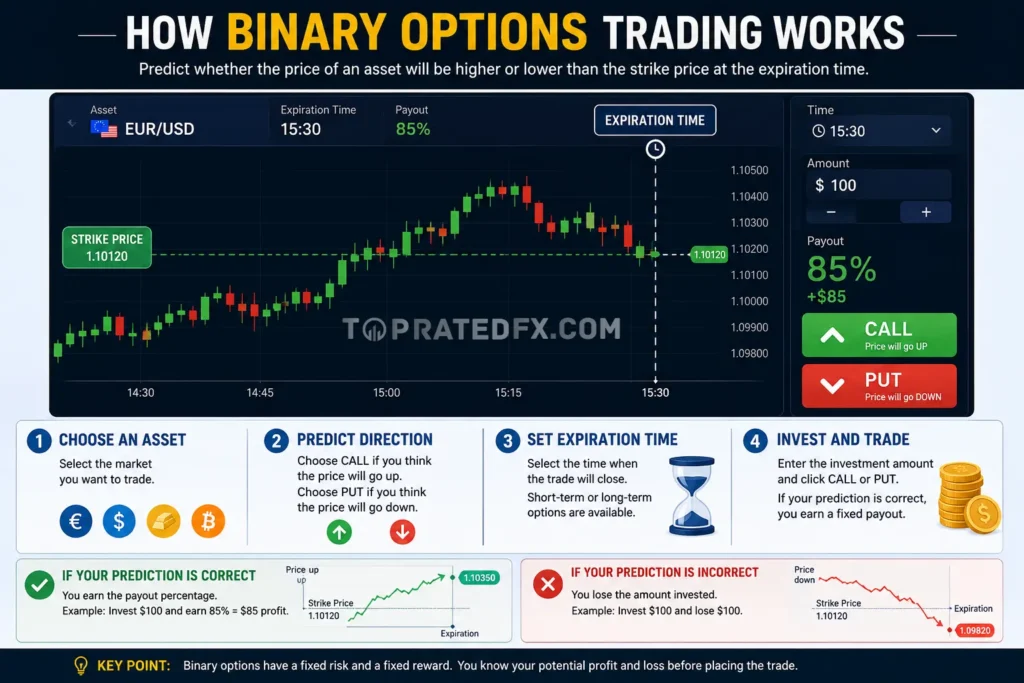
A typical binary options trade follows four simple steps:
Step 1: Choose an Asset
The trader selects a market, such as:
- Forex pairs
- Stocks
- Commodities
- Cryptocurrencies
- Indices
For example, a trader may choose EUR/USD.
Step 2: Select a Direction
The trader predicts whether the price will rise or fall.
- Call Option (Buy) = Price will rise
- Put Option (Sell) = Price will fall
Step 3: Choose an Expiry Time
The trader selects when the trade will end.
Examples include:
- 30 seconds
- 1 minute
- 5 minutes
- 15 minutes
- 1 hour
- End of day
Step 4: Invest and Wait
The trader enters an investment amount and waits for the trade to expire.
If the prediction is correct, the platform pays a predetermined return.
If the prediction is wrong, the invested amount is typically lost.
Practical Example
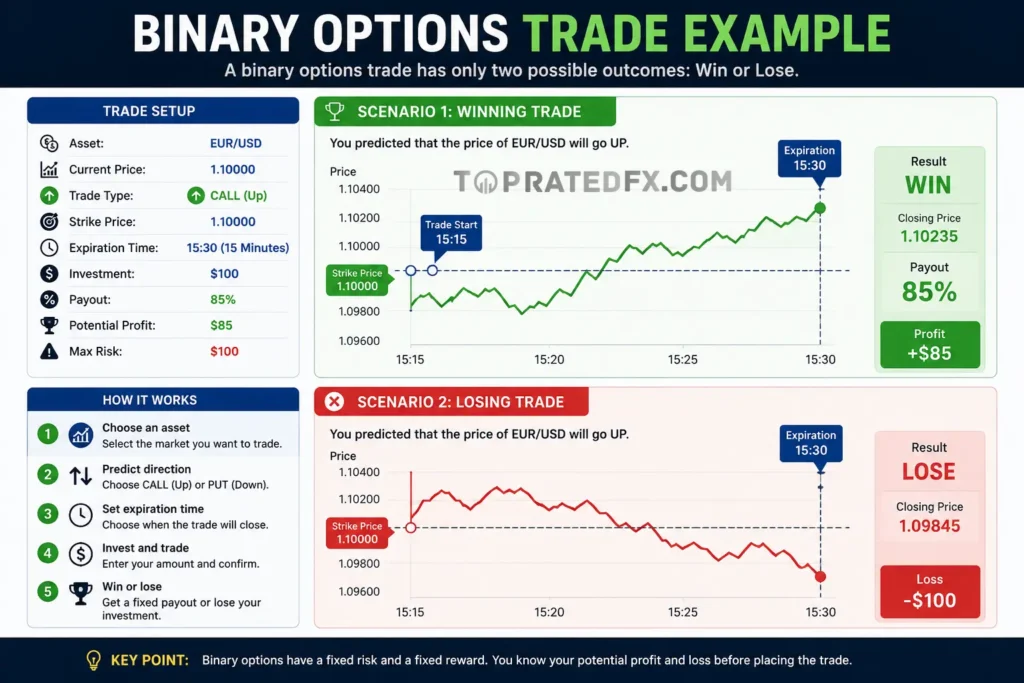
Let’s assume:
| Trade Detail | Value |
|---|---|
| Asset | EUR/USD |
| Current Price | 1.1000 |
| Trade Type | Call |
| Investment | $100 |
| Expiry Time | 5 Minutes |
| Payout | 85% |
The trader believes EUR/USD will rise over the next five minutes.
Scenario 1: Prediction Is Correct
At expiry, EUR/USD closes at 1.10235.
The trader receives:
| Item | Amount |
| Original Investment | $100 |
| Profit | $85 |
| Total Return | $185 |
Scenario 2: Prediction Is Wrong
At expiry, EUR/USD closes at 1.09845.
The trader loses the $100 investment.
This fixed-risk and fixed-reward structure is what makes binary options unique compared to other trading instruments.
Popular Assets Traded Through Binary Options
Most platforms offer access to several asset classes.
| Asset Class | Examples |
| Forex | EUR/USD, GBP/USD, USD/JPY |
| Stocks | Apple, Tesla, Amazon |
| Commodities | Gold, Silver, Oil |
| Indices | S&P 500, NASDAQ 100 |
| Cryptocurrencies | Bitcoin, Ethereum |
Although the mechanics remain the same, volatility and risk levels can differ significantly between assets.
Is Binary Options Gambling or Trading?
One of the most common questions asked by beginners is whether binary options should be considered gambling or legitimate trading.
The answer depends largely on how the activity is approached.
Why Some People Call It Gambling
Critics argue that binary options resemble gambling because:
- Outcomes are often win or lose.
- Many trades have very short expiration times.
- Emotional decision-making is common.
- Some traders rely purely on luck.
- Historical scams damaged the industry’s reputation.
For example, a trader who randomly predicts market direction every 60 seconds without analysis is effectively behaving like a gambler.
The result depends more on chance than skill.
Why Others Consider It Trading
Professional traders argue that binary options can be considered trading when decisions are based on:
- Technical analysis
- Fundamental analysis
- Market structure
- Statistical probability
- Risk management principles
For example, a trader may:
- Analyze support and resistance levels.
- Monitor economic news releases.
- Follow the trend direction.
- Wait for a confirmed entry signal.
- Risk only a small percentage of capital per trade.
In this case, the trader is making informed decisions based on market data rather than pure chance.
The Real Difference
The distinction is not necessarily the product itself.
The distinction is the trader’s process.
| Gambling Behavior | Trading Behavior |
| Random entries | Planned entries |
| Emotional decisions | Rule-based decisions |
| No strategy | Tested strategy |
| Chasing losses | Risk management |
| Short-term excitement | Long-term consistency |
A person can gamble using binary options.
A person can also apply professional trading principles to binary options.
However, even skilled traders face substantial risks because binary options generally offer an unfavorable payout-to-risk ratio compared to many traditional financial instruments.
Industry Reality
One fact often overlooked by beginners is that many financial regulators have imposed restrictions or outright bans on retail binary options trading.
The reason is not that market speculation itself is illegal.
Rather, regulators became concerned about:
- Consumer losses
- Aggressive marketing practices
- Misleading profit claims
- Unregulated offshore brokers
- Fraudulent platforms
Therefore, anyone considering binary options should carefully research the regulatory status of the platform they intend to use.
Key Facts About Binary Options
Before opening an account, every trader should understand the following facts.
1. Risk Is Known Before Entering a Trade
One advantage of binary options is that the maximum risk is usually predetermined.
You know exactly how much can be lost before placing the trade.
2. Profits Are Usually Fixed
Payouts are generally expressed as a percentage.
Typical payouts range from:
- 60%
- 70%
- 80%
- 90%
- Sometimes higher
The payout is known in advance.
3. Short Expiry Times Increase Risk
Many beginners are attracted to one-minute or five-minute trades.
In reality, shorter durations often produce more random price movements and can increase trading risk significantly.
4. Market Analysis Still Matters
Successful traders do not simply guess market direction.
They study:
- Trends
- Support and resistance
- Volume
- Volatility
- Economic events
Analysis remains important regardless of trade duration.
5. Capital Management Is Critical
Even a profitable strategy can fail if position sizing is poor.
Many experienced traders risk only a small percentage of their account equity on each trade.
6. Not All Platforms Are Equal
The binary options industry has historically attracted both legitimate operators and fraudulent businesses.
Before opening an account, traders should evaluate:
- Regulation
- Transparency
- Withdrawal reputation
- Trading conditions
- Customer support quality
7. Binary Options Are High-Risk Financial Products
Perhaps the most important fact is that binary options are inherently high-risk.
The possibility of earning quick returns exists.
However, the possibility of rapid losses exists as well.
Traders should never risk money they cannot afford to lose and should approach binary options with realistic expectations rather than promises of easy profits.
How Does Binary Options Trading Work?
Understanding the mechanics behind a binary options trade is essential before risking real money. While the concept appears simple, several components determine whether a trade ends in profit or loss.
The Main Components of a Binary Options Trade
Every binary options position contains the following elements:
| Component | Description |
|---|---|
| Asset | The market being traded |
| Strike Price | The price at which the trade is opened |
| Direction | Call (up) or Put (down) |
| Expiration Time | When the trade closes |
| Investment Amount | The amount risked on the trade |
| Payout Percentage | The potential return if successful |
A trader must understand each component because even a correct market analysis can fail if the expiration time is poorly chosen.
Understanding the Strike Price
The strike price is the market price at the moment a trade is opened.
For example:
- EUR/USD is trading at 1.1200.
- A trader opens a Call option.
- The strike price becomes 1.1200.
When the expiration time arrives, the platform compares the final market price with the strike price.
Winning Call Trade
| Detail | Value |
|---|---|
| Strike Price | 1.1200 |
| Expiry Price | 1.1215 |
| Result | Win |
Since the market closed above the strike price, the prediction was correct.
Losing Call Trade
| Detail | Value |
|---|---|
| Strike Price | 1.1200 |
| Expiry Price | 1.1190 |
| Result | Loss |
Since the market closed below the strike price, the prediction was incorrect.
Understanding Call and Put Options
Binary options traders generally use two basic trade types.
Call Option
A Call option predicts that the price will rise.
A trader might choose a Call option when:
- An uptrend is forming.
- A support level is holding.
- Positive economic news is released.
- Technical indicators signal bullish momentum.
Put Option
A Put option predicts that the price will fall.
A trader might choose a Put option when:
- A downtrend is forming.
- Resistance levels are rejecting the price.
- Negative economic news affects the market.
- Technical indicators show bearish momentum.
Real-World Trading Scenario
Imagine that the United States releases stronger-than-expected employment data.
Historically, positive employment data can strengthen the U.S. dollar.
A trader notices:
- EUR/USD is approaching resistance.
- Market momentum is weakening.
- The economic report exceeds expectations.
Based on this analysis, the trader opens a Put option on EUR/USD with a 15-minute expiry.
If the market falls before expiration, the trade wins.
This example demonstrates how market analysis can be incorporated into binary options trading rather than relying on random predictions.
Types of Binary Options
Not all binary options function exactly the same way.
Depending on the platform, traders may encounter several different contract types.
High/Low Options
High/Low options are the most common form of binary options.
The trader predicts whether the price will finish:
- Higher than the strike price
- Lower than the strike price
Because of their simplicity, High/Low contracts are usually recommended for beginners.
One-Touch Options
With a One-Touch option, the market must reach a predetermined target price before expiration.
For example:
- Gold is trading at $3,300.
- The platform sets a target of $3,320.
- If Gold touches $3,320 before expiry, the trade wins.
These contracts often offer higher payouts because the target price may be difficult to reach.
No-Touch Options
No-Touch options work in the opposite way.
The market must avoid touching a specific price level before expiration.
If the target level is never reached, the trader receives the payout.
These contracts are commonly used during low-volatility market conditions.
Range Options
Range options require traders to predict whether the price will remain inside or outside a predefined range.
Example:
| Upper Boundary | Lower Boundary |
|---|---|
| 1.1250 | 1.1200 |
The trader forecasts whether the market will stay within these boundaries until expiration.
Range contracts are often used during consolidation periods.
Binary Options Trading Terminology Every Beginner Should Know
New traders often struggle because they do not understand common industry terminology.
The following concepts appear frequently on most trading platforms.
Expiration Time
Expiration time is the moment when the trade closes automatically.
Common expirations include:
- 30 seconds
- 1 minute
- 5 minutes
- 15 minutes
- 1 hour
- 4 hours
- End of day
Choosing an appropriate expiration is often as important as choosing the correct direction.
In-The-Money (ITM)
A trade is considered “In-The-Money” when it expires successfully.
Example:
- Call opened at 1.1200
- Price expires at 1.1210
Result:
- In-The-Money
- Profit earned
Out-Of-The-Money (OTM)
A trade is considered “Out-Of-The-Money” when it expires unsuccessfully.
Example:
- Put opened at 1.1200
- Price expires at 1.1215
Result:
- Out-Of-The-Money
- Investment lost
Payout Percentage
The payout percentage represents the profit potential of a successful trade.
Example:
| Investment | Payout | Profit |
|---|---|---|
| $100 | 80% | $80 |
| $100 | 90% | $90 |
| $100 | 95% | $95 |
Higher payouts can significantly affect long-term profitability.
Return on Investment (ROI)
ROI measures the percentage return generated by a winning trade.
For example:
- Investment: $50
- Profit: $40
ROI = 80%
Understanding ROI helps traders evaluate whether a trading strategy is statistically viable over hundreds of trades.
Why Many Beginners Lose Money in Binary Options
Despite the apparent simplicity of binary options, many new traders lose money quickly.
Common reasons include:
- Trading without a strategy.
- Chasing losses after a losing trade.
- Using excessively short expirations.
- Ignoring economic news events.
- Risking too much capital on one trade.
- Following unverified social media signals.
- Choosing unreliable offshore platforms.
From our experience reviewing trading platforms and trader behavior over the years, the biggest mistake is treating binary options as a shortcut to quick wealth rather than a high-risk speculative activity requiring discipline and risk management.
Advantages and Disadvantages of Binary Options Trading
Before deciding whether binary options are suitable for your trading goals, it is important to understand both the benefits and the drawbacks.
Many marketing campaigns focus exclusively on potential profits. However, experienced traders evaluate both opportunity and risk before participating in any market.
Advantages of Binary Options Trading
Binary options have several characteristics that make them attractive to retail traders.
1. Simple Trading Concept
One of the biggest advantages is simplicity.
The trader only needs to answer one question:
Will the price be higher or lower at expiration?
Unlike traditional Forex trading, there is no need to calculate position sizes, stop-loss distances, or take-profit levels for every trade.
This simplicity makes binary options easy for beginners to understand.
2. Fixed Risk
With most binary options contracts, the maximum possible loss is known before the trade is placed.
For example:
| Investment | Maximum Loss |
|---|---|
| $10 | $10 |
| $50 | $50 |
| $100 | $100 |
There are no surprise margin calls or losses that exceed the amount invested.
3. Fixed Potential Reward
The expected payout is displayed before entering the trade.
Example:
| Investment | Payout | Potential Profit |
|---|---|---|
| $100 | 80% | $80 |
| $100 | 90% | $90 |
| $100 | 95% | $95 |
This transparency allows traders to understand the exact risk-to-reward profile before committing capital.
4. Access to Multiple Markets
Many binary options platforms provide access to:
- Forex pairs
- Cryptocurrencies
- Commodities
- Global stock indices
- Individual stocks
This allows traders to diversify their market exposure.
5. Low Capital Requirements
Many platforms allow traders to start with relatively small deposits.
Some brokers permit trades as small as $1.
While this lowers the financial barrier to entry, it should not encourage reckless trading.
Learn more about the Lowest Minimum Deposit Binary Options Brokers
6. Short-Term Opportunities
Binary options allow traders to take advantage of short-term market movements.
This can be useful during:
- Economic news releases
- Earnings announcements
- High-volatility market sessions
- Trend continuation setups
However, short-term opportunities also create additional risks, which many beginners underestimate.
Disadvantages of Binary Options Trading
Although binary options offer certain advantages, they also contain significant drawbacks that every trader should understand.
1. Limited Profit Potential
A major disadvantage is that profits are capped.
Even if the market moves significantly in the predicted direction, the trader receives only the predetermined payout.
Consider this example:
| Scenario | Binary Options | Traditional Trading |
|---|---|---|
| Large Market Move | Fixed payout | Potentially larger profit |
| Small Market Move | Fixed payout | Smaller profit |
The trader cannot benefit from extended market trends.
2. Unfavorable Risk-to-Reward Ratios
Many platforms offer payouts between 70% and 90%.
This means traders often risk 100% of their investment to earn less than 100%.
Example:
| Trade Outcome | Result |
|---|---|
| Win | +$80 |
| Loss | -$100 |
This mathematical disadvantage means traders typically need a relatively high win rate to remain profitable over time.
3. Short Expirations Can Encourage Emotional Trading
Many brokers heavily promote:
- 30-second trades
- 60-second trades
- 5-minute trades
These short durations can encourage impulsive decisions rather than disciplined analysis.
As a result, many traders end up overtrading.
4. High Industry Risk
The binary options industry has a history of problematic operators.
Common issues have included:
- Withdrawal delays
- Misleading advertising
- Fake profit claims
- Unregulated platforms
- Poor customer support
This is one reason why trader due diligence is extremely important.
5. Limited Long-Term Investment Potential
Binary options are designed for short-term speculation.
They are not intended for:
- Wealth building through ownership
- Dividend investing
- Long-term portfolio growth
- Compound investment strategies
Investors seeking long-term capital appreciation often prefer stocks, ETFs, or other investment vehicles.
Risks of Binary Options Trading
Understanding the risks is arguably more important than understanding the rewards.
Many new traders focus on how much they can make while ignoring how quickly losses can accumulate.
Market Risk
Financial markets are unpredictable.
Even the most experienced traders encounter losing trades.
Unexpected events such as:
- Central bank announcements
- Geopolitical developments
- Economic data releases
- Market sentiment shifts
can quickly invalidate a trade setup.
Volatility Risk
High volatility can produce sudden price movements.
A trade that appears profitable moments before expiration can reverse rapidly.
This is particularly common in:
- Cryptocurrency markets
- News-driven Forex pairs
- Commodity markets during major events
Psychological Risk
Psychology is one of the biggest challenges facing binary options traders.
Common emotional mistakes include:
- Fear of missing out (FOMO)
- Revenge trading
- Overconfidence after winning streaks
- Panic after losses
- Excessive risk-taking
Many losing traders have adequate strategies but poor emotional discipline.
Capital Risk
Poor money management can destroy an account quickly.
Consider two traders:
| Trader | Risk Per Trade |
|---|---|
| Trader A | 2% |
| Trader B | 20% |
After several losses, Trader A still has sufficient capital to continue trading.
Trader B may have already depleted a significant portion of the account.
This is why professional traders prioritize capital preservation above short-term gains.
How Much Money Can You Make with Binary Options?
One of the most searched questions online is whether binary options can generate significant income.
The honest answer is:
It depends on skill, risk management, strategy quality, market conditions, and consistency.
There is no guaranteed income.
For example:
| Account Size | Risk Per Trade | Potential Profit at 80% Payout |
|---|---|---|
| $500 | $10 | $8 |
| $1,000 | $20 | $16 |
| $5,000 | $100 | $80 |
While profits can accumulate over time, losses can accumulate just as quickly.
Any platform or promoter promising guaranteed profits should be viewed with skepticism.
Successful traders focus on consistency and risk control rather than unrealistic profit targets.
How to Start Binary Options Trading
If you decide to explore binary options trading, following a structured process can help reduce common beginner mistakes.
While no process can eliminate risk, a disciplined approach can improve decision-making and capital preservation.
Step 1: Learn the Basics
Before opening a live account, understand:
- How binary options contracts work
- How payouts are calculated
- The role of expiration times
- Basic market analysis
- Risk management principles
Many beginners skip the education phase and immediately begin trading with real money. This often leads to preventable losses.
Step 2: Choose a Reputable Trading Platform
The quality of your trading platform matters.
When evaluating a broker, consider:
| Factor | Why It Matters |
|---|---|
| Regulation | Provides oversight and accountability |
| Reputation | Reflects trader experiences |
| Withdrawals | Indicates reliability |
| Asset Selection | Provides trading opportunities |
| Customer Support | Important when issues arise |
| Transparency | Reduces hidden surprises |
Research independently rather than relying solely on promotional content.
Read Reviews about the best Binary Options brokers
Step 3: Use a Demo Account
Many platforms provide demo accounts funded with virtual money.
Benefits include:
- Learning platform features
- Testing strategies
- Understanding market behavior
- Building confidence
A demo account cannot replicate the emotions of real-money trading, but it remains a valuable educational tool.
Step 4: Develop a Trading Strategy
Successful traders rarely enter trades randomly.
Instead, they use predefined rules.
A basic strategy may be defined:
- Entry conditions
- Market selection
- Expiration time
- Risk per trade
- Daily loss limits
Having rules helps remove emotion from decision-making.
Step 5: Start Small
When transitioning to live trading:
- Begin with small trade sizes.
- Focus on execution rather than profits.
- Avoid increasing position sizes after a few wins.
The goal is to gain experience while protecting capital.
Step 6: Keep a Trading Journal
Professional traders often maintain detailed records.
A trading journal can include:
- Asset traded
- Trade direction
- Entry reason
- Expiration time
- Outcome
- Lessons learned
Over time, this information can reveal strengths and weaknesses in your approach.
Binary Options Strategies for Beginners
There is no perfect strategy that guarantees profits.
However, several approaches are commonly used by traders.
Trend Following Strategy
Trend trading involves trading in the direction of the prevailing market movement.
Bullish Trend Example
A trader notices:
- Higher highs
- Higher lows
- Strong buying momentum
The trader focuses on Call opportunities.
Bearish Trend Example
A trader notices:
- Lower highs
- Lower lows
- Strong selling pressure
The trader focuses on Put opportunities.
Trading with the trend often provides better probabilities than constantly attempting to predict reversals.
Support and Resistance Strategy
They remain among the most widely used concepts in technical analysis.
Support Level
Support is an area where buyers have historically entered the market.
When price approaches support:
- Traders may look for Call opportunities.
- Rejection candles can confirm buyer activity.
Resistance Level
Resistance is an area where sellers have historically entered the market.
When price approaches resistance:
- Traders may look for Put opportunities.
- Bearish rejection patterns may provide confirmation.
Moving Average Strategy
Moving averages help identify trend direction.
A simple example:
- Price above the moving average = bullish bias.
- Price below the moving average = bearish bias.
Many traders combine moving averages with support and resistance analysis for additional confirmation.
News-Based Strategy
Economic news can create significant market movement.
Common market-moving events include:
- Non-Farm Payrolls (NFP)
- Inflation reports
- Interest rate decisions
- GDP releases
- Employment reports
However, beginners should be cautious.
News events can create extreme volatility that increases trading risk.
Price Action Strategy
Price action trading focuses on chart behavior rather than indicators.
Common price action signals include:
- Pin bars
- Engulfing candles
- Breakouts
- Rejections
- Trend continuation patterns
Many experienced traders prefer price action because it reflects raw market behavior.
Risk Management in Binary Options Trading
Risk management often determines whether a trader survives long enough to develop profitable skills.
Without risk management, even a strong strategy can fail.
The 1% to 2% Rule
Many experienced traders risk only a small portion of their account on each trade.
Example:
| Account Balance | 1% Risk | 2% Risk |
|---|---|---|
| $500 | $5 | $10 |
| $1,000 | $10 | $20 |
| $5,000 | $50 | $100 |
This approach helps limit damage during losing streaks.
Set Daily Loss Limits
A daily loss limit can prevent emotional decision-making.
Example:
- Maximum daily loss: 5% of account balance.
- Once reached, trading stops for the day.
This rule protects traders from revenge trading.
Avoid Martingale Systems
The Martingale strategy involves increasing trade size after losses.
Example:
| Trade | Investment |
|---|---|
| 1 | $10 |
| 2 | $20 |
| 3 | $40 |
| 4 | $80 |
While the system appears attractive on paper, a losing streak can rapidly deplete trading capital.
For most retail traders, Martingale introduces excessive risk.
Focus on Long-Term Consistency
Many beginners obsess over individual trades.
Professional traders focus on large sample sizes.
Questions that matter include:
- Is the strategy profitable over 100 trades?
- Is risk controlled?
- Is discipline maintained?
Long-term consistency is more important than any single winning trade.
Common Binary Options Trading Mistakes
Learning from common mistakes can save traders significant time and money.
Trading Without a Plan
Entering trades based on intuition alone often leads to inconsistent results.
Every trade should have a clear rationale.
Overtrading
Many traders believe more trades equal more profits.
In reality, excessive trading often reduces performance.
Quality setups generally outperform quantity.
Ignoring Risk Management
Even profitable traders can fail without proper risk controls.
Protecting capital should always remain the top priority.
Following Social Media Gurus Blindly
The internet is filled with screenshots of profits.
Many lack context, verification, or transparency.
Always test strategies independently before risking capital.
Expecting Instant Wealth
Perhaps the most dangerous mistake is believing binary options provide an easy path to financial freedom.
Professional trading is a skill developed over time through:
- Education
- Practice
- Discipline
- Experience
- Continuous improvement
Traders who approach binary options with realistic expectations are often better positioned than those seeking quick riches.
Are Binary Options Legal?
The legality of binary options depends on the country where a trader resides and the regulatory status of the broker being used.
This is one of the most important aspects that traders often overlook.
Many beginners assume that if a trading platform is available online, it is automatically legal and regulated. That is not always the case.
Why Regulations Matter
Financial regulators exist to protect consumers and maintain fair market practices.
A regulated broker is typically required to:
- Follow strict operational standards
- Maintain transparent business practices
- Separate client funds from company funds
- Implement anti-fraud measures
- Provide dispute resolution procedures
Without regulatory oversight, traders may face increased risks.
Countries With Restrictions on Binary Options
Over the years, several major regulators have imposed restrictions on retail binary options trading due to concerns regarding:
- Consumer protection
- High loss rates
- Misleading advertising
- Fraudulent operators
As regulations continue to evolve, traders should always verify the current legal status of binary options in their jurisdiction before opening an account.
How to Check a Broker’s Status
Before funding an account, consider the following checklist:
| Verification Item | Importance |
|---|---|
| Regulatory Status | High |
| Company Information | High |
| Withdrawal History | High |
| Customer Reviews | Medium |
| Terms and Conditions | High |
| Risk Disclosure | High |
Conducting proper due diligence can help reduce the likelihood of choosing an unreliable platform.
Binary Options vs Forex Trading
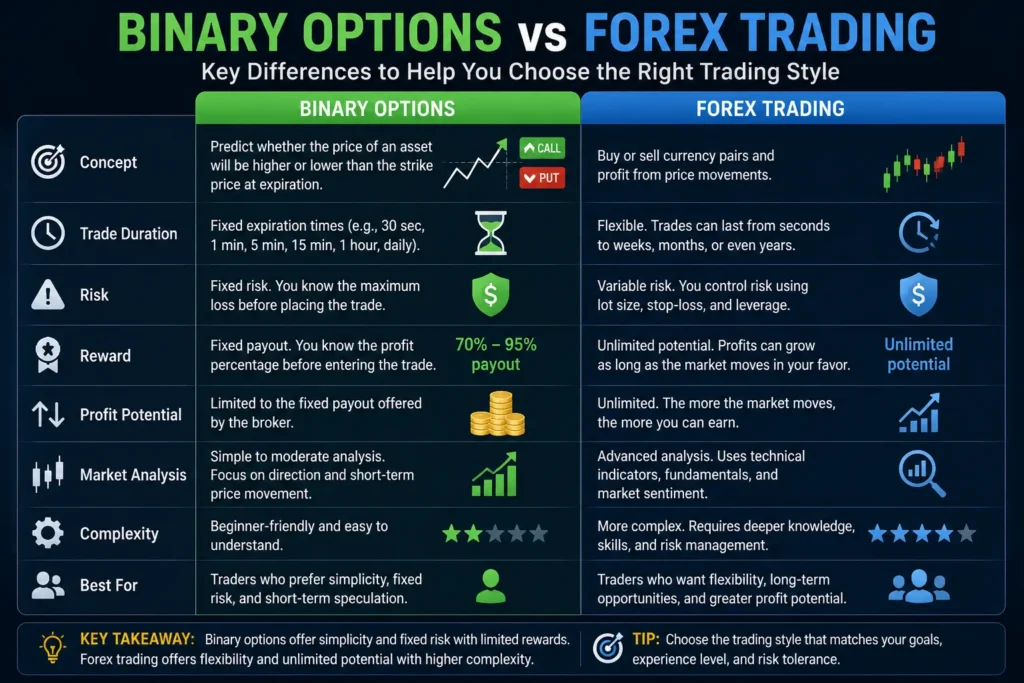
Many beginners compare binary options with Forex trading because both involve speculating on price movements.
However, the two products operate very differently.
Key Differences
| Feature | Binary Options | Forex Trading |
|---|---|---|
| Ownership of Asset | No | No |
| Fixed Risk | Yes | Not Always |
| Fixed Reward | Yes | No |
| Expiration Time | Required | Not Required |
| Profit Potential | Limited | Potentially Unlimited |
| Stop Losses | Usually Not Needed | Commonly Used |
| Complexity | Lower | Higher |
Binary Options Advantages Compared to Forex
Binary options may appeal to traders who prefer:
- Simplicity
- Defined risk
- Short-term opportunities
- Straightforward trade execution
Forex Advantages Compared to Binary Options
Forex trading offers:
- Greater flexibility
- More sophisticated risk management
- Larger profit potential
- Longer-term opportunities
- Extensive analytical tools
For many traders, Forex provides more strategic flexibility than binary options.
Learn more about what Forex Trading is
Binary Options vs Stock Trading
Another common comparison is between binary options and traditional stock investing.
Binary Options
Characteristics include:
- Short-term speculation
- Fixed payouts
- No ownership rights
- High-risk environment
Stock Investing
Characteristics include:
- Ownership of shares
- Potential dividend income
- Long-term growth opportunities
- Greater emphasis on investment fundamentals
Investors seeking long-term wealth accumulation often prefer stock investing, while short-term speculators may be attracted to binary options.
FAQ
Binary options trading is a form of financial speculation where traders predict whether an asset’s price will be above or below a specific level at a predetermined expiration time.
Yes, traders can make money with binary options, depending on Market knowledge, strategy quality, risk management, emotional discipline, and consistency. However, there are no guaranteed profits.
Binary options trading involves significant risk. Traders should never risk money they cannot afford to lose.
There is no universally best strategy.
Common approaches include: Trend following, Support and resistance trading, Price action analysis, News-based trading, and Moving average strategies.
The effectiveness of any strategy depends on market conditions and execution.
Minimum deposits vary by platform.
Some brokers allow traders to start with relatively small amounts. The common minimum deposit used by most brokers is $10.
Binary options offer simplicity and fixed risk, while Forex provides greater flexibility and potentially larger profit opportunities.
Final Thoughts
Understanding what binary options trading is—and what it is not—is essential before entering this highly speculative market.
Binary options offer a simple way to participate in financial market movements. Traders know their potential risk and reward before placing a trade, and the mechanics are generally easy to understand.
However, simplicity should not be mistaken for profitability.
Successful binary options trading still requires:
- Market analysis
- Risk management
- Emotional discipline
- Consistent execution
- Realistic expectations
Throughout our experience reviewing trading platforms and educating traders, one pattern remains consistent: those who approach binary options as a professional skill tend to perform better than those seeking quick profits.
Before opening a live account, take the time to learn how markets work, test strategies in a demo environment, and develop a risk management plan.
Most importantly, remember that preserving capital is just as important as generating returns.
Binary options can be a useful speculative instrument for some traders, but they should always be approached with caution, education, and a clear understanding of the risks involved.
Risk Warning: Trading financial instruments such as forex, cryptocurrencies, CFDs, and binary options involves a high risk of loss and may not be suitable for all investors. You should only trade with money you can afford to lose. Past performance is not indicative of future results. Binary options are NOT available in EU/EEA and carry high risk.
Continue Learning
Expand your knowledge with these related guides:
More Guides
- What Is Cryptocurrency Trading?
- What Is Forex Trading
- How to Start Forex Trading
- What Is Leverage in Trading?
- What Is Margin in Trading?
Trading Tools
Best Brokers
- Best Binary Options Brokers for Beginners In 2026
- Best Binary Options Brokers In 2026
- Best Brokers for Altcoins in 2026
- Best Brokers for Bitcoin in 2026
- Best Brokers for Day Trading In 2026
- Best Brokers in Nigeria 2026
- Best CFD Brokers In 2026
- Best Copy Trading Platforms In 2026
- Best Crypto Brokers 2026
- Best Crypto Brokers for Beginners in 2026
- Best Crypto Copy Trading Brokers in 2026
- Best ECN Brokers in 2026
- Best Forex Brokers for Beginners in 2026
- Best Forex Brokers In 2026
- Best Forex Brokers with Islamic Accounts in 2026
- Best Forex Brokers With No Inactivity Fee in 2026
- Best Free Binary Options Demo Accounts In 2026
- Best High Leverage Forex Brokers In 2026
- Best No Deposit Bonus Forex Brokers in 2026
- Best PayPal Forex Brokers in 2026
- Best Scalping Forex Brokers in 2026
- Lowest Minimum Deposit Binary Options Brokers In 2026
- Lowest Spread Forex Brokers In 2026