

Many beginner traders confuse free margin with used margin because both appear in the trading platform at the same time. Although they are closely related, they serve completely different purposes.
One represents the capital that is already committed to supporting open positions, while the other represents the capital that is still available for new opportunities or to absorb temporary market losses.
Understanding the difference between these two values is essential for managing leveraged trades, maintaining account stability, and avoiding unnecessary risk.
This guide explains free margin vs used margin, how each one works, and why both are equally important in every leveraged trading account.
Read more about What Is Margin in Trading
Compare the Margin requirements offered by different platforms in our Best Forex Brokers guide, and you should take a look at the best brokers in 2026
Quick Answer
Used margin is the amount of money your broker reserves as collateral for open positions.
Free margin is the remaining capital available to open new trades or absorb floating losses.
Together, these values determine how much flexibility your trading account has.
Free Margin vs Used Margin at a Glance
| Feature | Free Margin | Used Margin |
|---|---|---|
| Purpose | Available trading capital | Reserved collateral |
| Can Open New Trades | ✅ Yes | ❌ No |
| Supports Existing Positions | ❌ No | ✅ Yes |
| Changes With Floating P/L | ✅ Yes | Usually No |
| Released After Closing Trades | — | ✅ Yes |
| Helps Prevent Margin Calls | ✅ Yes | Indirectly |
Why Do Traders Confuse Free Margin and Used Margin?
The confusion usually comes from the fact that both values are displayed together on almost every trading platform.
When a new trade is opened:
- One value increases.
- The other decreases.
As a result, many beginners assume they represent the same thing.
In reality, they simply describe different portions of the same trading account.
Think of your account like a monthly budget.
- Money already allocated to paying bills cannot be spent elsewhere.
- The money left after those commitments is still available for future expenses.
Trading accounts work in a very similar way.
Understanding the Difference
Although both metrics are linked, they answer different questions.
Used Margin answers:
How much of my capital is currently committed to supporting open positions?
Free Margin answers:
How much capital do I still have available for new trades or market fluctuations?
Looking at both values together provides a much clearer picture of your account than monitoring either one individually.
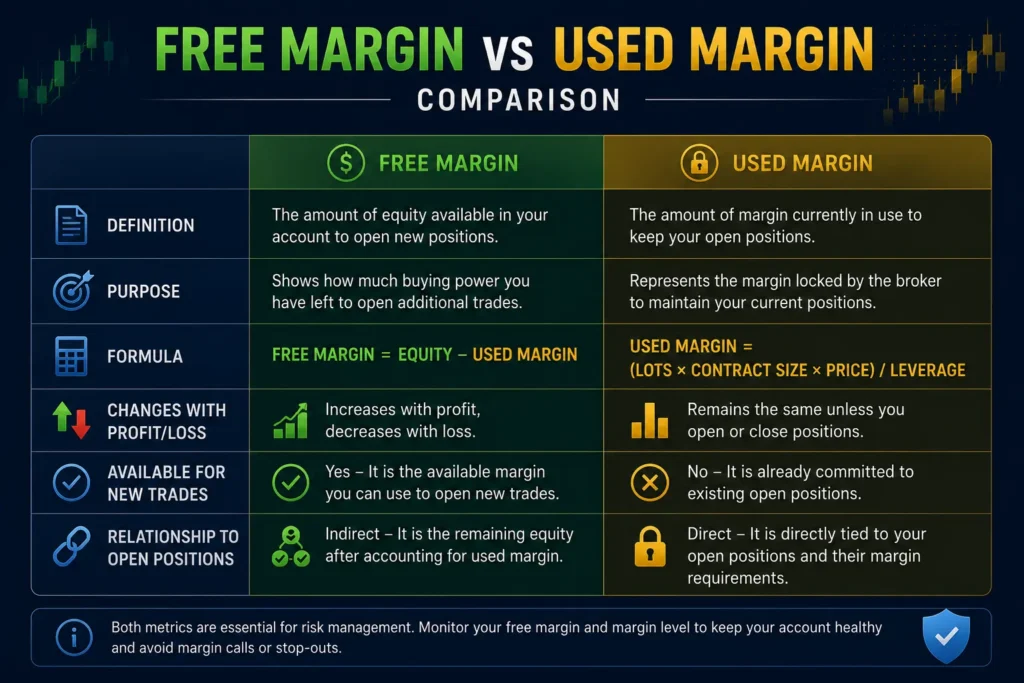
Side-by-Side Comparison
| Category | Free Margin | Used Margin |
|---|---|---|
| Definition | Available trading funds | Funds reserved by the broker |
| Main Purpose | Open new positions | Maintain existing positions |
| Available for Withdrawal | Usually yes (if no restrictions apply) | No |
| Changes When Prices Move | Yes | Normally no |
| Changes When Trades Open | Decreases | Increases |
| Changes When Trades Close | Increases | Decreases |
| Risk Indicator | Higher is generally safer | Lower is generally more flexible |
Why Both Metrics Matter
Neither value is more important than the other.
Instead, they complement each other.
Reserved collateral keeps your existing positions open, while available capital gives your account room to grow and survive temporary market volatility.
Professional traders monitor both metrics before opening additional positions because doing so provides a better understanding of overall account exposure.
Formula Comparison
Although free margin and used margin are closely connected, they are calculated differently and serve different purposes within a trading account.
Free Margin Formula
It represents the capital that remains available after the broker reserves funds for your open positions.
Free Margin = Equity − Used Margin
As your account equity changes, your available trading capital changes as well.
Used Margin Formula
Used margin is the amount of collateral your broker reserves to support leveraged positions.
The basic calculation is:
Used Margin = Position Value ÷ Leverage
Once a position is opened, this amount remains reserved until the trade is closed or the broker changes its margin requirements.
Formula Comparison Table
| Metric | Free Margin | Used Margin |
|---|---|---|
| Basic Formula | Equity − Used Margin | Position Value ÷ Leverage |
| Main Purpose | Available trading capital | Required collateral |
| Calculated From | Equity and reserved funds | Position size and leverage |
| Changes Continuously | Yes | Usually no |
Both formulas work together.
The more collateral reserved for existing positions, the less capital remains available for future trades.
How They Work Together
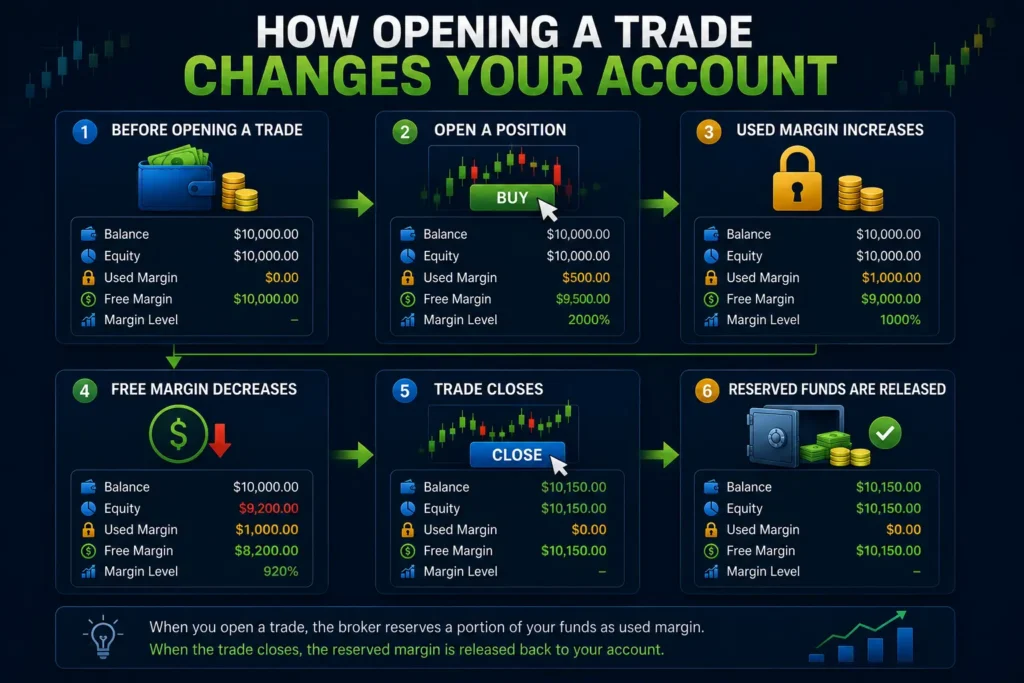
The easiest way to understand these two values is to follow what happens after opening a leveraged trade.
Before Opening a Position
| Account Metric | Value |
|---|---|
| Balance | $5,000 |
| Equity | $5,000 |
| Used Margin | $0 |
| Free Margin | $5,000 |
Since there are no open positions, the entire account is available.
After Opening a Trade
Suppose a new position requires $600 in collateral.
Your account becomes:
| Account Metric | Value |
|---|---|
| Balance | $5,000 |
| Equity | $5,000 |
| Used Margin | $600 |
| Free Margin | $4,400 |
Notice that:
- Your balance does not change.
- Your equity does not change.
- Reserved collateral increases.
- Available trading funds decrease.
After Opening Another Trade
You decide to open a second position requiring $400.
| Account Metric | Value |
|---|---|
| Balance | $5,000 |
| Equity | $5,000 |
| Used Margin | $1,000 |
| Free Margin | $4,000 |
Every additional trade shifts more capital from available funds into reserved collateral.
After Closing One Position
You close the first trade.
| Account Metric | Value |
|---|---|
| Balance | $5,000 |
| Equity | $5,000 |
| Used Margin | $400 |
| Free Margin | $4,600 |
The broker immediately releases the collateral from the closed position.
This increases the capital available for future trades.
What Happens During a Winning Trade?
One common misconception is that both values increase when a trade becomes profitable.
In reality, only one of them usually changes.
Suppose your remaining position generates an unrealized profit of $500.
| Account Metric | Before Profit | After Profit |
|---|---|---|
| Equity | $5,000 | $5,500 |
| Used Margin | $400 | $400 |
| Free Margin | $4,600 | $5,100 |
The broker still reserves the same amount of collateral.
However, your higher equity increases the capital available for trading.
What Happens During a Losing Trade?
Now imagine the market moves against your position.
Your unrealized loss reaches $800.
| Account Metric | Before Loss | After Loss |
|---|---|---|
| Equity | $5,000 | $4,200 |
| Used Margin | $400 | $400 |
| Free Margin | $4,600 | $3,800 |
Again, the reserved collateral remains unchanged.
Instead, your available trading capital decreases because your equity has fallen.
This explains why traders should monitor equity instead of relying only on their account balance.
Which One Changes More Often?
Although both metrics change over time, they don’t change for the same reasons.
| Event | Free Margin | Used Margin |
|---|---|---|
| Open a position | ▼ Decreases | ▲ Increases |
| Close a position | ▲ Increases | ▼ Decreases |
| Floating profit | ▲ Increases | No change |
| Floating loss | ▼ Decreases | No change |
| Deposit funds | ▲ Increases | No change |
| Withdraw funds | ▼ Decreases | No change |
| Broker raises margin requirements | ▼ May decrease | ▲ May increase |
This comparison helps explain why free margin is considered a dynamic value, while used margin is generally more stable during the life of a trade.
Real Trading Scenario
Imagine two traders with identical account balances of $10,000.
Trader A
- Uses moderate leverage.
- Opens one position.
- Broker reserves $800.
Available trading capital remains high.
This trader still has enough flexibility to manage market fluctuations or open another position if necessary.
Trader B
- Uses aggressive leverage.
- Opens several positions.
- Broker reserves $6,500.
Although both traders started with the same account balance, Trader B has committed a much larger portion of the account.
As a result, even a relatively small market movement could significantly increase the risk of a margin call.
The difference isn’t the account balance—it’s how the available capital is allocated.
Key Takeaway
Think of your trading account as having two separate pools of capital.
- Used Margin supports the positions you already have.
- Free Margin supports the positions you may open in the future and protects your account from temporary market fluctuations.
Healthy trading accounts maintain a balance between these two values rather than maximizing either one.
Which One Is More Important?
One of the most common questions among beginner traders is whether free margin or used margin is more important.
The answer is simple:
Neither is more important on its own.
Both metrics serve different purposes and should always be evaluated together.
- Used margin tells you how much of your capital is already committed to open positions.
- Free margin tells you how much flexibility your account still has.
A trader who focuses on only one of these values may overlook important risks.
Think of It Like a Budget
Imagine your monthly salary is $5,000.
- You’ve already committed $1,500 to rent and bills.
- The remaining $3,500 is available for savings, shopping, or emergencies.
In this example:
- Committed expenses = Used Margin
- Available money = Free Margin
Neither figure is useful without the other because they describe different parts of the same budget.
Trading accounts work exactly the same way.
How They Affect Your Trading Decisions
Every trading decision changes the relationship between these two metrics.
Before opening a new position, ask yourself:
- Do I have enough available capital?
- Will this trade leave sufficient room for normal market fluctuations?
- Am I committing too much of my account to existing positions?
Professional traders rarely look at only one account metric before placing a trade.
Instead, they evaluate the entire account to determine whether taking additional risk is justified.
Relationship With Equity
Both metrics are directly connected to equity, but they respond differently.
Think of equity as the foundation of your trading account.
As equity rises or falls, your available capital changes immediately, while the collateral reserved for open positions often stays the same.
The relationship can be summarized as follows:
| Equity Changes | Free Margin | Used Margin |
|---|---|---|
| Equity increases | ▲ Usually increases | No change |
| Equity decreases | ▼ Usually decreases | No change |
| New position opened | ▼ Decreases | ▲ Increases |
| Position closed | ▲ Increases | ▼ Decreases |
This is why experienced traders monitor equity throughout the trading day instead of relying only on their account balance.
Relationship With Margin Level
Another important account metric is margin level.
Margin level measures how healthy your trading account is by comparing your equity with the collateral currently reserved for open positions.
A strong margin level usually means your account has enough available capital to withstand normal market movements.
A declining margin level suggests that your account is becoming more vulnerable to margin calls.
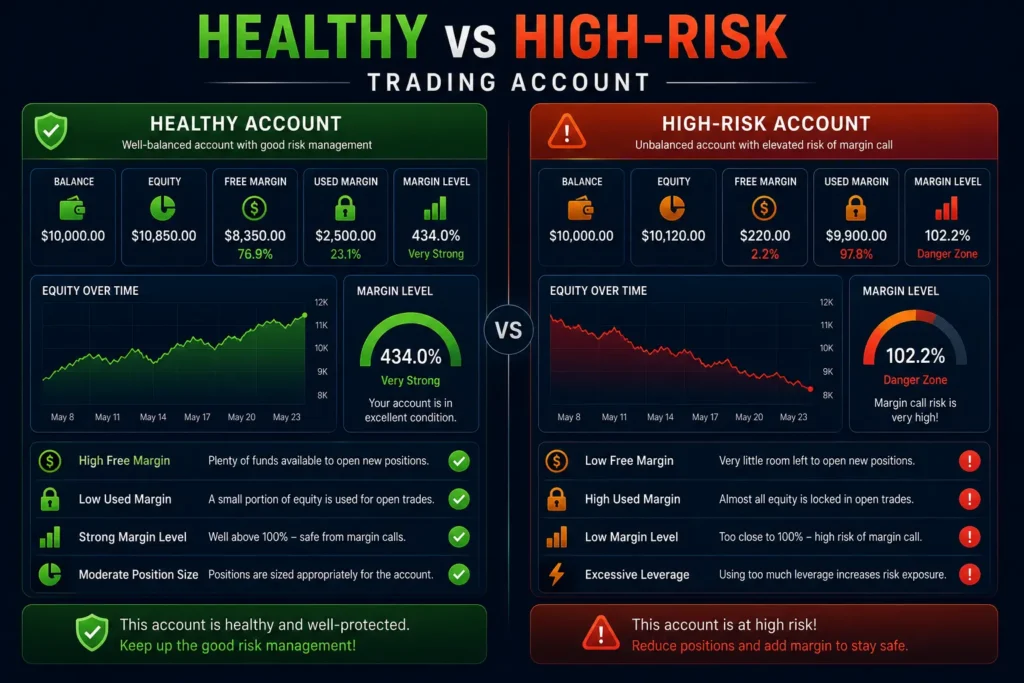
Example 1: Healthy Account
| Account Metric | Value |
|---|---|
| Equity | $8,000 |
| Used Margin | $1,000 |
| Free Margin | $7,000 |
| Margin Level | 800% |
In this example, only a small portion of the account is committed.
The trader still has significant flexibility.
Example 2: High Exposure
| Account Metric | Value |
|---|---|
| Equity | $8,000 |
| Used Margin | $5,500 |
| Free Margin | $2,500 |
| Margin Level | 145% |
Although the account balance hasn’t changed, a much larger share of the capital is supporting existing positions.
A relatively small adverse market movement could quickly reduce the margin level further.
Which Metric Should You Watch First?
Different situations require different priorities.
| Situation | Focus On |
|---|---|
| Before opening a trade | Free Margin |
| Managing existing positions | Margin Level |
| Checking account health | Equity |
| Reviewing market exposure | Used Margin |
| Monitoring overall risk | All four metrics together |
No single metric provides a complete picture of your trading account.
The best decisions come from evaluating all of them together.
How Professional Traders Monitor Their Accounts
Professional traders rarely focus on profits alone.
Before entering a new trade, they typically review a simple checklist:
- Is my position size appropriate?
- Will enough free margin remain after opening this trade?
- Is too much capital already committed?
- Is my margin level still healthy?
- Can my account handle normal market volatility?
Following this routine helps reduce emotional decision-making and encourages more consistent risk management.
Common Trading Scenarios
The table below shows how both metrics typically respond to common trading actions.
| Trading Action | Free Margin | Used Margin |
|---|---|---|
| Open a new trade | ▼ Decreases | ▲ Increases |
| Close a position | ▲ Increases | ▼ Decreases |
| Floating profit grows | ▲ Increases | No change |
| Floating loss grows | ▼ Decreases | No change |
| Deposit additional funds | ▲ Increases | No change |
| Withdraw available funds | ▼ Decreases | No change |
| Broker increases margin requirements | ▼ May decrease | ▲ May increase |
Recognizing these patterns makes it much easier to understand what is happening inside your trading account without being surprised by changing account metrics.
Key Takeaway
Instead of asking whether free margin or used margin is more important, ask whether they are balanced.
A healthy trading account typically has:
- Enough collateral to support existing positions.
- Sufficient available capital for new opportunities.
- Strong equity relative to open exposure.
- A comfortable margin level that reduces the risk of forced liquidations.
Successful traders don’t try to maximize one metric at the expense of the other. They maintain a balance between both, allowing them to manage risk while preserving the flexibility to respond to changing market conditions.
Brokers that support leveraged trading where relevant:
Common Mistakes
Many trading mistakes happen not because traders misunderstand individual account metrics, but because they fail to understand how those metrics work together.
Avoiding the following mistakes can help you manage leverage more effectively and reduce unnecessary trading risk.
Confusing Available Capital With Total Account Balance
One of the most common misconceptions is believing that your account balance represents the amount you can use to open new positions.
In reality, part of your capital may already be reserved to support existing trades.
Before entering a new position, always check your available trading capital rather than relying solely on your account balance.
Ignoring Used Margin Before Opening New Trades
Some traders focus only on free margin without considering how much capital is already committed.
Opening several leveraged positions can gradually increase reserved collateral until very little flexibility remains.
Even if you still have available funds, committing too much of your account can significantly increase overall exposure.
Watching Balance Instead of Equity
Account balance changes only after a trade is closed.
Equity, however, reflects your account’s real-time value by including floating profits and losses.
Since free margin is directly affected by equity, experienced traders monitor equity continuously instead of relying only on balance.
Using Excessive Leverage
Higher leverage reduces the collateral required to open a position, but it also allows traders to control much larger positions with the same amount of capital.
This often encourages overexposure.
Although your available trading capital may initially appear healthy, relatively small market movements can quickly reduce it if your position size is too large.
Opening Too Many Positions at Once
Each additional position requires collateral.
Individually, the amount may seem small, but multiple trades can gradually consume a significant portion of your account.
This leaves less flexibility to manage unexpected market volatility.
Ignoring Margin Level
Many traders watch only free margin and overlook margin level.
However, margin level provides a broader view of overall account health.
A declining margin level is often an early warning that your account is becoming increasingly vulnerable to a margin call or stop-out.
Assuming Reserved Funds Are Lost
Used margin is not a trading cost.
The reserved amount remains part of your account and is released automatically when the related position is closed.
Understanding this distinction helps traders interpret their account information more accurately.
Best Practices for Managing Both Metrics
Monitoring free margin and used margin together allows traders to make more informed decisions and maintain healthier trading accounts.
The following practices can improve overall risk management.
Keep Sufficient Free Margin
Avoid using nearly all of your available trading capital.
Maintaining a healthy buffer provides room for normal price fluctuations and reduces the likelihood of forced liquidations during periods of increased volatility.
Control Position Size
Rather than focusing only on leverage, determine an appropriate position size before entering a trade.
Smaller positions generally require less collateral and leave more capital available for future opportunities.
Use our free tool Position Size Calculator
Monitor Equity Regularly
Since floating profits and losses directly affect available trading capital, reviewing equity throughout the trading day provides a more accurate picture of account health than checking balance alone.
Avoid Overtrading
Opening multiple trades simultaneously may appear to increase profit opportunities, but it also increases overall exposure.
Quality trade setups are generally more effective than simply increasing the number of open positions.
Review Margin Requirements Before Trading
Different asset classes often require different amounts of collateral.
For example, major Forex pairs may require less collateral than cryptocurrencies, stock CFDs, or highly volatile commodities.
Understanding these requirements before placing a trade helps prevent unexpected reductions in available trading capital.
Use Conservative Leverage
Just because high leverage is available doesn’t mean it should always be used.
Many professional traders choose moderate leverage because it provides greater flexibility during periods of market volatility.
Read more about Best High Leverage Forex Brokers
Monitor the Entire Account, Not Just One Number
Healthy trading decisions are based on several account metrics working together.
Before opening or managing a position, review:
- Equity
- Free Margin
- Used Margin
- Margin Level
- Position Size
Looking at the complete picture provides a much better understanding of your account’s overall risk.
Practical Checklist Before Opening a Trade
Use this simple checklist before placing any leveraged trade:
- Is there enough free margin remaining after this trade?
- Will this position leave my account comfortably above my broker’s margin requirements?
- Is my position size appropriate for my risk tolerance?
- Am I relying on reasonable leverage rather than the maximum available?
- Will I still have sufficient flexibility if the market moves against me?
If the answer to any of these questions is No, consider reducing your position size or waiting for a better trading opportunity.
Read more about Best Forex Brokers for Beginners
Key Takeaway
Successful traders don’t try to maximize either free margin or used margin.
Instead, they maintain a healthy balance between the two.
Keeping enough capital available while avoiding excessive exposure allows traders to respond more effectively to changing market conditions, withstand temporary drawdowns, and manage leveraged positions with greater confidence.
This balanced approach is one of the foundations of long-term risk management and disciplined trading.
FAQ
Used margin is the capital reserved by your broker to maintain open positions. Free margin is the remaining capital available to open new trades or absorb floating losses.
Free margin usually changes more often because it fluctuates with unrealized profits and losses. Used margin generally remains the same unless you open or close positions or your broker changes margin requirements.
Yes. If floating losses exceed your available trading capital, free margin can fall below zero. This often indicates a high risk of receiving a margin call or reaching a stop-out level.
No. Used margin is not a fee. It is simply collateral reserved while your positions remain open. Once those positions are closed, the reserved funds are released.
Initially, yes. Higher leverage reduces the amount of collateral required to open a position, leaving more capital available. However, it also increases overall trading risk because even small price movements can have a larger impact on your account.
No. Funds reserved as used margin cannot be withdrawn while they are supporting open positions. Only available funds can typically be withdrawn.
Beginners should monitor equity, free margin, used margin, and margin level together. Looking at only one metric provides an incomplete picture of account health.
Use appropriate position sizes, avoid excessive leverage, maintain sufficient free margin, and regularly monitor your account metrics before opening additional positions.
Final Thoughts
Understanding the difference between free margin and used margin is one of the foundations of successful leveraged trading.
Although these two metrics are closely connected, they serve very different purposes. One represents the capital already committed to supporting your existing positions, while the other represents the flexibility your account still has for new opportunities and unexpected market movements.
Rather than focusing on either value in isolation, experienced traders evaluate them together with equity and margin level to gain a complete picture of account health. This broader perspective helps them manage risk more effectively, avoid unnecessary margin calls, and make better-informed trading decisions.
Whether you’re trading Forex, CFDs, commodities, or cryptocurrencies, understanding how these account metrics interact will help you trade with greater confidence and discipline.
Continue Learning
Expand your knowledge with these related guides:
Margin & Leverage
- What Is Margin in Trading?
- What Is Free Margin?
- What Is Used Margin?
- What Is Margin Level?
- How to Calculate Margin Level
- What Is Leverage in Trading?
Risk Management
- What Is a Margin Call?
- What Is a Stop-Out Level?
- Position Size Explained
- Risk-to-Reward Ratio
- How to Manage Trading Risk
Trading Tools
More Guides
- What Is Cryptocurrency Trading?
- What Is Binary Options Trading?
- What Is Forex Trading
- How to Start Forex Trading
Best Brokers
- Best Binary Options Brokers for Beginners In 2026
- Best Binary Options Brokers In 2026
- Best Brokers for Altcoins in 2026
- Best Brokers for Bitcoin in 2026
- Best Brokers for Day Trading In 2026
- Best Brokers in Nigeria 2026
- Best CFD Brokers In 2026
- Best Copy Trading Platforms In 2026
- Best Crypto Brokers 2026
- Best Crypto Brokers for Beginners in 2026
- Best Crypto Copy Trading Brokers in 2026
- Best ECN Brokers in 2026
- Best Forex Brokers for Beginners in 2026
- Best Forex Brokers In 2026
- Best Forex Brokers with Islamic Accounts in 2026
- Best Forex Brokers With No Inactivity Fee in 2026
- Best Free Binary Options Demo Accounts In 2026
- Best High Leverage Forex Brokers In 2026
- Best No Deposit Bonus Forex Brokers in 2026
- Best PayPal Forex Brokers in 2026
- Best Scalping Forex Brokers in 2026
- Lowest Minimum Deposit Binary Options Brokers In 2026
- Lowest Spread Forex Brokers In 2026